










Zen Technologies Reports Record Q2 Revenue of ₹345 Crore
Key highlights
- Zen Technologies reported record Q2 FY27 revenue of ₹345.13 crore, up 98.8% year on year.
- Operational EBITDA was ₹131.99 crore and the operational EBITDA margin was 38.2% in Q2 FY27.
- Zen Technologies had a consolidated order book of ₹1,375.7 crore as of 30 September 2026.
- Domestic orders accounted for ₹1,283.84 crore of the order book, while export orders were ₹91.86 crore.
powered by IRIS
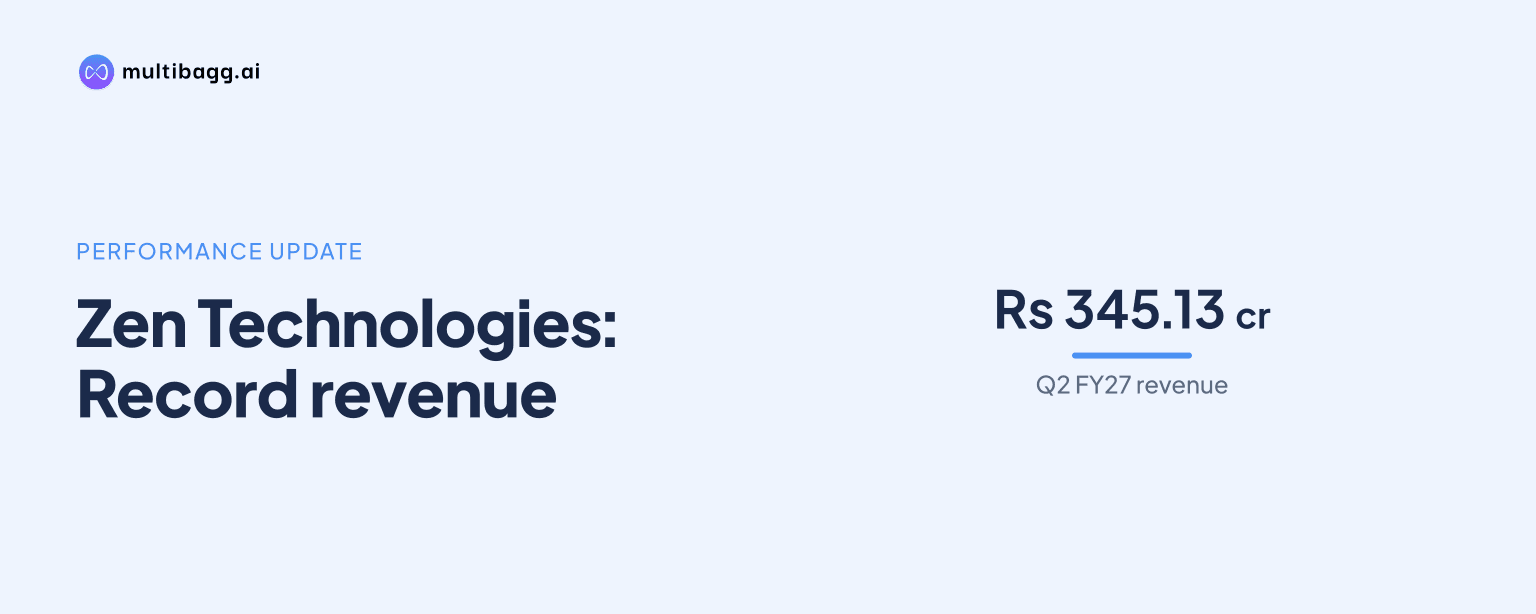
Zen Technologies Limited reported record revenue from operations of ₹345.13 crore in Q2 FY27, up 98.8% year on year and 143.7% sequentially, as it executed a defence-focused order book built over the previous year. The quarter ended 30 September 2026 also delivered a 38.2% operational EBITDA margin.
Know Zen Technologies inside out
Results, valuation, peers and who's buying, in one view.
What did Zen Technologies report for Q2 FY27?
Zen Technologies reported its highest-ever quarterly revenue from operations at ₹345.13 crore for the quarter ended 30 September 2026. Revenue was almost double the ₹173.57 crore reported in Q2 FY26 and more than twice the ₹141.6 crore recorded in Q1 FY27. The company declared the unaudited Q2 results on 31 October 2026.
The company reported total income of ₹361.85 crore and profit before tax of ₹138.85 crore. The consolidated results showed profit after tax of ₹101.88 crore. Separately, management said profit after tax attributable to shareholders was ₹89.54 crore, compared with ₹59.40 crore a year earlier. The difference reflects the distinction used in the reported result and the management presentation for profit attributable to shareholders.
Operational EBITDA stood at ₹131.99 crore, with the operational EBITDA margin at 38.2%. This compared with a 37.3% margin in Q2 FY26 and 27.3% in Q1 FY27. Management linked the margin improvement to operating leverage as revenue scaled during the quarter.
How did the quarter’s growth unfold?
Zen Technologies said the quarterly performance reflected execution of an order book that it had been building since the previous year. Chief Financial Officer Hariharan Charath said revenue was expected to be weighted towards the second and third quarters, and Q2 reflected that planned execution pattern.
The company’s core business is centred on defence technology, including simulation, anti-drone systems and related technologies. It operates manufacturing and research facilities in Hyderabad and has strategic subsidiaries and shareholdings in areas including electronic warfare, naval simulation and propulsion. The disclosed performance was therefore tied to delivery activity across these core product lines rather than a single named contract.
Chairman and Managing Director Ashok Atluri said India’s push for defence indigenisation supported the company’s strategy of owning core technology. Management also referred to its focus on command and control, robotics and other defence capabilities. These comments were made during the earnings discussion held on 2 November 2026 for the quarter and half year ended 30 September.
The board also approved the proposed voluntary strike-off of wholly owned subsidiary Zen Medical Technologies Private Limited, subject to regulatory approvals. The exchange filing said the standalone and consolidated unaudited results received an unmodified limited-review conclusion.
Got a follow-up? Ask IRIS
What does the order book indicate for Zen Technologies?
Zen Technologies had a consolidated order book of ₹1,375.7 crore as of 30 September 2026. Equipment orders accounted for ₹994 crore, while annual maintenance contract orders made up ₹380.7 crore, providing a disclosed view of work pending execution and service-related commitments.
Domestic orders dominated the book at ₹1,283.84 crore, while export orders stood at ₹91.86 crore. The figures show that the company’s near-term disclosed order pipeline remained primarily linked to the domestic market. They do not, by themselves, establish the timing of revenue recognition or future profitability.
For the first half of FY27, revenue from operations was ₹486.8 crore, up 46.7% from ₹331.8 crore in H1 FY26. Operational EBITDA for the half year was ₹170.7 crore, while profit after tax attributable to shareholders was ₹124 crore. The half-year figures include a much lower first-quarter revenue base before the sharp Q2 execution increase.
Management maintained FY27 revenue guidance of ₹1,200 crore to ₹1,300 crore and said it was confident of achieving a little more than that range. This remains management guidance, rather than a reported financial result, and depends on the pace of order execution through the remaining quarters.
Why are margins and defence indigenisation relevant?
Zen Technologies said operating leverage helped restore margins towards the 35% operational EBITDA level previously indicated by management. The 38.2% Q2 margin exceeded that level and was 10.9 percentage points above the 27.3% reported in Q1 FY27. The quarter’s revenue scale was a key factor in that improvement.
The company has positioned its technology ownership around India’s domestic defence sourcing and Make in India policies. Management said the policy focus on indigenisation validates its long-term approach. The reported domestic order book of ₹1,283.84 crore provides a numerical indication of the current importance of local demand to its operations.
For investors, the Q2 result offers evidence of substantial quarterly order execution, but the revenue concentration described by management also makes quarterly comparisons important. The company has explicitly said that revenue is weighted toward Q2 and Q3, meaning performance across the full year will depend on delivery schedules and conversion of the existing order book.
The company made the earnings call recording available through its investor relations webpage after the 2 November 2026 call. That disclosure gave shareholders access to management’s comments alongside the financial results and investor presentation.
How does the result affect investors and industry participants?
Zen Technologies’ Q2 performance raised its H1 FY27 revenue to ₹486.8 crore and highlighted the role of defence-sector execution in its financial results. The nearly 99% year-on-year quarterly revenue growth and 38.2% operational EBITDA margin are the principal reported indicators for investors assessing the period.
Customers and industry participants can also see the scale of the company’s AMC order book, at ₹380.7 crore, alongside equipment orders of ₹994 crore. The available data does not identify individual customers, project schedules or contract-level margins. As a result, the disclosed order book should be read as an aggregate measure of pending business rather than a quarter-by-quarter revenue forecast.
Conclusion
Zen Technologies delivered record Q2 FY27 revenue of ₹345.13 crore, supported by execution of its defence order book, while operational EBITDA margin reached 38.2%. The results also showed a large domestic-led order book and a sharp increase in half-year revenue, reinforcing the importance of project delivery and operating leverage to the company’s reported performance.
Investors will next watch progress toward management’s FY27 revenue guidance of ₹1,200 crore to ₹1,300 crore, the execution of the ₹1,375.7 crore order book, and developments in the proposed strike-off of Zen Medical Technologies Private Limited, which remains subject to regulatory approvals.