










Zetwerk says AI tender tool cuts BOM work to 10 minutes
Key highlights
- Zetwerk says ZetSpec reduces tender BOM generation from three to four days to 10 minutes.
- The ZetSpec demonstration covers 757.5 MWp of solar-module capacity in two 378.75 MWp blocks.
- Business teams shipped 12 self-service AI applications in the last six months, with 24 prototypes in testing.
- Zetwerk says ZHIP tracks 100% of domestic and export shipments.
powered by IRIS
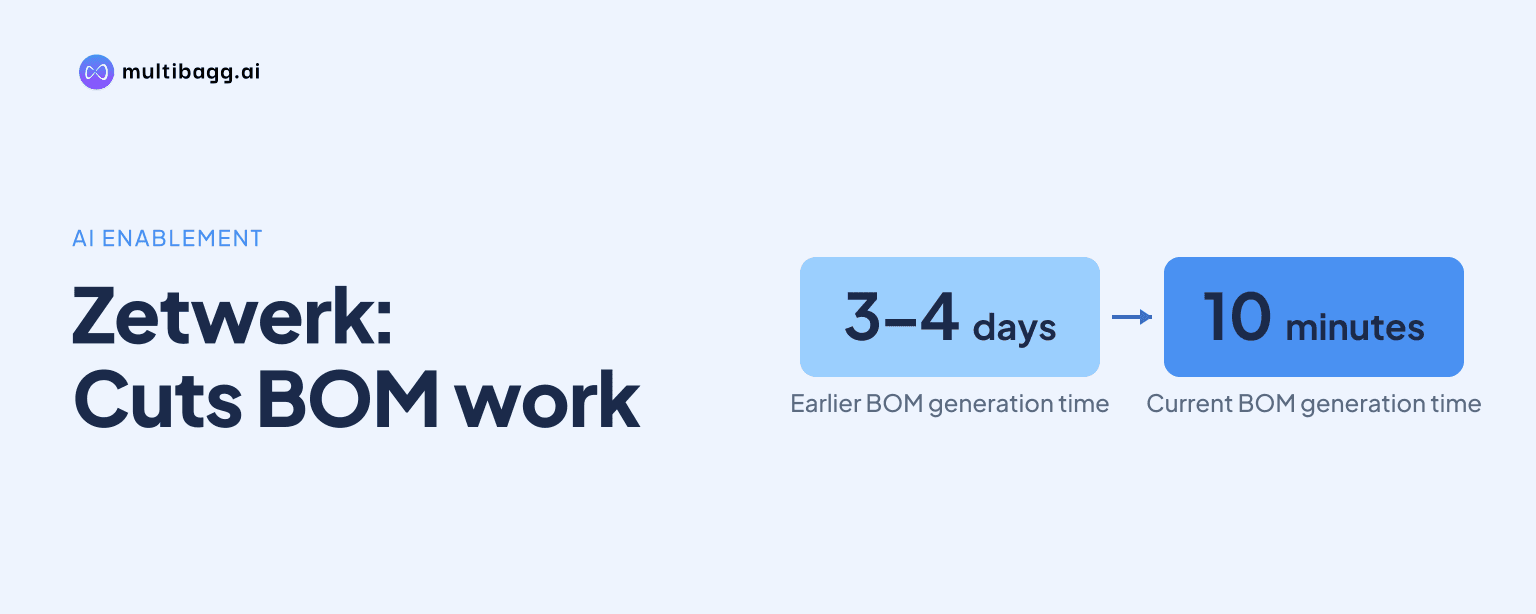
Zetwerk says ZetSpec reduced bill-of-material, or BOM, generation for tender bidding from three to four days to 10 minutes, illustrated by a 757.5 MWp solar-module tender. The company also says business teams shipped 12 self-service applications in the last six months and have 24 prototypes in testing.
Know Zetwerk Manufacturing Businesses inside out
Results, valuation, peers and who's buying, in one view.
How does ZetSpec cut tender BOM generation to 10 minutes?
ZetSpec cuts the stated BOM-generation process from three to four days to 10 minutes by reading tender specifications and producing component requirements. Zetwerk describes the product as AI-powered tender intelligence and BOM generation software that embeds industry-specific expertise to decode complex tender documents and generate expert-grade BOMs for bidding.
The demonstration uses a Bom Extractor identified as Z-SQL, where a user asks for a BOM from a tender document. The resulting output includes material categories, specifications, units of measure, per-module quantities, wastage assumptions and total quantities. Zetwerk says this can accelerate bidding velocity and ultimately help it win more orders, although the presentation gives no tender-win rate, order intake or cost-saving figure linked to ZetSpec.
The comparison is between a process measured in days and a company-stated result of 10 minutes. Zetwerk also displays a warning that “ZEUS is an AI and can make mistakes,” making clear that the generated output requires review. The presentation does not disclose ZetSpec’s accuracy rate, the number of tenders processed, or the proportion of output changes made by reviewers.
What does ZetSpec extract from the 757.5 MWp solar tender?
ZetSpec extracts tender-stated information and derives materials where the tender does not provide a component-level bill of quantities. The example concerns the 600 MW NGEL Solar Project near Nakhatrana, Kutch, Gujarat, for NTPC Green Energy Limited and an Indian Oil Corporation joint venture. Its displayed direct-current capacity is 757.5 MWp, including spares, split into two separately biddable 378.75 MWp blocks.
The tender output records bid reference NRC-CS-5784-004(MOD)-9, a 1,500-volt system, crystalline-silicon TOPCon bifacial glass-to-glass modules and a minimum module rating of 570 Wp. It also captures a module envelope of 2,278 millimetres by 1,133 millimetres and a stated bifaciality of 75%. These fields show the tool is intended to interpret technical requirements, rather than merely summarise a tender’s headline capacity.
The BOM lists 48,205,080 N-type mono-crystalline bifacial cells as architecture-derived, based on 72 cells per module. It identifies 1,715,833.04 square metres each of front and back glass after 1% wastage, with those quantities labelled geometry-derived. Zetwerk’s screen distinguishes architecture-derived, geometry-derived, tender-stated, structural-default and recovered-default inputs, showing the mechanism used to build each part of the BOM.
Other displayed quantities include 669,515 aluminium-frame sets, 669,515 IP68-rated split junction boxes, 1,339,030 solar cables and 1,339,030 MC4-compatible positive connectors. Frames and junction boxes each carry 1% wastage in the example. The presentation does not disclose whether the 10-minute result applies to every tender type, including manufacturing categories outside solar modules.
Got a follow-up? Ask IRIS
How widely is Zetwerk deploying Zeus AI applications?
Zetwerk says its Zeus AI Agent Platform enables business teams to build and deploy AI agents and functional business applications with minimal engineering latency. The platform is presented as a no-code environment for creating agents, applications and user interfaces, while also connecting specialised agents to execute multi-step business processes.
Business teams shipped 12 self-service applications in the last six months, while 24 prototypes were in testing. The testing pipeline is twice the number of shipped applications, but Zetwerk does not identify the full list of applications, their user counts or which of the 24 prototypes will be deployed. The disclosed figures therefore establish activity and a pipeline, rather than measured productivity or financial outcomes.
One illustrated application is a Quality Assurance Plan Parameter Extractor. The proposed agent reads a customer Quality Assurance Plan, manufacturing quality plan or inspection-and-test plan and extracts testing and inspection parameters into a structured format for quality and production teams. Its setup supports conversational multi-turn interactions and one-shot jobs, and the screen shows Claude Sonnet 5.5 with medium thinking effort.
Zeus is also described as providing human oversight, accuracy controls, application monitoring and enterprise-system integration. These capabilities are relevant because ZetSpec’s tender workflow uses specifications, assumptions and derived quantities. Zetwerk does not report time savings, error rates or adoption data for the Quality Assurance Plan application or the other 11 shipped self-service applications.
How does ZHIP extend Zetwerk’s operational software?
ZHIP is Zetwerk’s shipment-tracking application for domestic and export goods. Zetwerk says 100% of domestic and export shipments can be tracked through ZHIP, which is positioned differently from ZetSpec’s pre-bid document analysis and Zeus’s business-application platform. Its purpose is to provide real-time visibility of physical goods after dispatch.
The displayed ZHIP-0000005 shipment runs from Mundra, Gujarat, to Houston, Texas, with a predicted arrival of 29 January 2024 at 8:00 AM. Its event trail shows full-container gate-in at Mundra on 7 December 2023, loading on 10 December 2023 and departure at 5:55 AM on 10 December 2023. Zetwerk says such tracking helps provide customer comfort, support contingency planning and enable more proactive responses.
Across the three products, the presentation shows software supporting tender preparation, execution documentation and shipment visibility. ZetSpec carries the specific three-to-four-day to 10-minute time claim, Zeus has the 12 shipped applications and 24 testing prototypes, and ZHIP has the 100% tracking-coverage claim. Zetwerk does not provide a combined measure of revenue, margin, order conversion or operating-cost impact across these tools.
Conclusion
Zetwerk’s presentation describes an operational software programme spanning a tender workflow, an AI application platform and logistics tracking. The most specific disclosed result is ZetSpec’s claimed reduction in BOM generation from three to four days to 10 minutes for a 757.5 MWp solar-module tender, while Zeus has 12 shipped applications and ZHIP is said to track 100% of domestic and export shipments.
The next disclosed development to watch is whether the 24 Zeus prototypes move into deployment and whether Zetwerk publishes measured outcomes for those applications. For ZetSpec, the unresolved issues are accuracy, the extent of required human review and whether faster BOM preparation results in disclosed improvements in bidding or order outcomes.