










Zetwerk manufacturing margin reaches 25% on mix shift in H1 FY27
Key highlights
- Zetwerk’s manufacturing gross margin reached 25% in H1 FY27, versus 21% in H1 FY26.
- Manufacturing gross profit rose 41% to Rs 1,092 crore in H1 FY27 while revenue increased 20% to Rs 4,448 crore.
- Captive fulfilment reached 60% of H1 FY27 manufacturing revenue, up from 36% in H1 FY26.
- Manufacturing order backlog reached Rs 14,595 crore at H1 FY27, with Precision backlog up 80% from FY26.
powered by IRIS
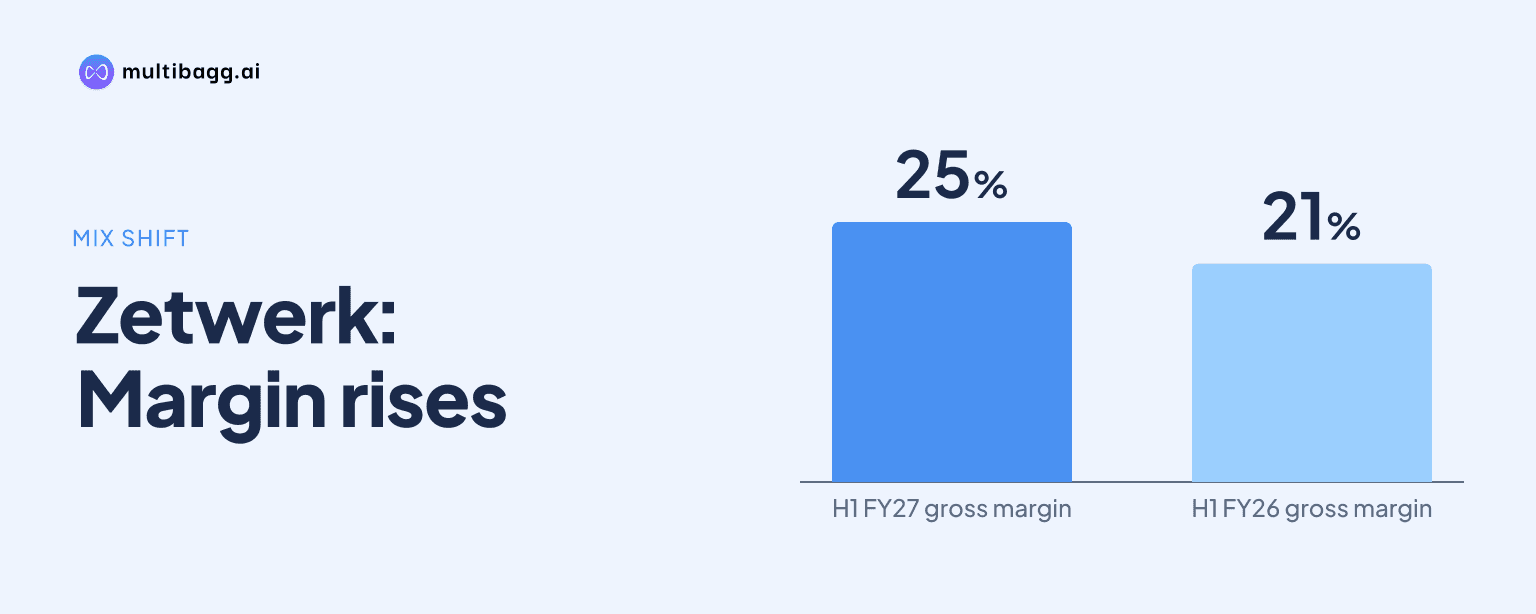
Zetwerk reported a 25% manufacturing gross margin in H1 FY27, up from 21% in H1 FY26, as gross profit increased 41% to Rs 1,092 crore while segment revenue rose 20% to Rs 4,448 crore. The change coincided with higher captive fulfilment, international revenue and recurring-component sales.
Know Zetwerk Manufacturing Businesses inside out
Results, valuation, peers and who's buying, in one view.
Why did Zetwerk manufacturing gross margin reach 25% in H1 FY27?
Zetwerk’s manufacturing gross margin reached 25% in H1 FY27 because gross profit grew faster than revenue under management’s Mix, Market and Model approach. Manufacturing gross profit increased to Rs 1,092 crore from Rs 772 crore in H1 FY26, while revenue rose to Rs 4,448 crore from Rs 3,698 crore.
The segment-analysis page rounds the H1 FY27 margin to 25%, while Zetwerk’s detailed financial table reports 24.5%; the equivalent H1 FY26 figures are 21% and 20.9%, respectively. Quarterly gross margin reached 25.5% in Q2 FY27, compared with 23.2% in Q1 FY27 and 22.0% in Q2 FY26.
The half-year result continued a longer reported progression: manufacturing gross margin was 13% in FY24, 18% in FY25 and 19% in FY26. The company identifies category mix, international markets and captive manufacturing as the three mechanisms behind its gross-profit percentage strategy.
How did captive fulfilment affect Zetwerk’s manufacturing margin?
Captive fulfilment accounted for 60% of Zetwerk’s H1 FY27 manufacturing revenue, up from 36% in H1 FY26. Captive means in-house manufacturing, while marketplace supply means third-party manufacturing; captive activity generated Rs 2,672 crore of the Rs 4,448 crore segment total, compared with Rs 1,776 crore from marketplace activity.
Zetwerk reported a 25% H1 FY27 gross margin for captive manufacturing, compared with 24% in H1 FY26. Marketplace margin rose to 24% from 19% over the same periods, but captive remained the larger revenue model in H1 FY27.
The supply-model mix has changed materially since FY23, when captive fulfilment represented 10% of manufacturing revenue. Its share was 7% in FY24, 29% in FY25, 33% in FY26, 44% on a FY27 trailing 12-month, or TTM, basis, and 60% in H1 FY27; management says captive manufacturing provides a margin lift relative to marketplace activity.
Which mix changes supported Zetwerk’s H1 FY27 margin?
International revenue and recurring components increased as a share of Zetwerk’s manufacturing sales in H1 FY27. International revenue represented 41% of the segment, up from 36% in H1 FY26, while recurring components rose to 76% from 59%.
International manufacturing revenue was Rs 1,815 crore in H1 FY27, versus Rs 2,633 crore in India. Zetwerk reported a 32% gross margin on international business and 19% in India, compared with 28% and 17%, respectively, in H1 FY26.
Recurring components generated Rs 3,375 crore of H1 FY27 manufacturing revenue, while products generated Rs 1,072 crore. Zetwerk defines components as recurring build-to-print parts, such as printed circuit board assemblies, or PCBAs, and describes products as build-to-spec work; 50% of product revenue was original design manufacturer, or ODM, work designed fully by Zetwerk.
Energy supplied Rs 2,836 crore, or 64%, of H1 FY27 manufacturing revenue, followed by Precision at Rs 980 crore, or 22%, and Capital Goods at Rs 633 crore, or 14%. Management cites Aerospace, Defence and Space within Precision as examples of higher-margin categories in its mix approach.
Got a follow-up? Ask IRIS
What changed in Zetwerk’s manufacturing demand and order pipeline?
Zetwerk’s manufacturing order backlog was Rs 14,595 crore at H1 FY27, compared with Rs 12,370 crore at FY26 and Rs 8,740 crore in Q2 FY26. New orders won totalled Rs 7,760 crore in H1 FY27, a 48% year-on-year increase, while Q2 FY27 new orders were Rs 4,613 crore, up 46% quarter on quarter.
Precision backlog increased 80% to Rs 2,698 crore in H1 FY27 from Rs 1,494 crore at FY26, which management attributed to Aerospace, Defence and Space. Energy remained the largest backlog category at Rs 9,708 crore, while Capital Goods backlog reached Rs 2,189 crore.
International orders represented 46% of H1 FY27 backlog, compared with 54% at FY26, while ODM work represented 33%, versus 32%. Zetwerk describes international backlog as an all-time high, primarily from US Energy business, and says backlog converts to revenue over approximately two years.
How does repeat business support Zetwerk’s manufacturing execution?
Repeat customers generated 83% of Zetwerk’s H1 FY27 manufacturing revenue, compared with 88% in H1 FY26 and 80% in FY26. The H1 FY27 proportion declined from the prior-year half, but it remained above four-fifths as manufacturing revenue reached Rs 4,448 crore.
Zetwerk reported revenue coverage of 3.2 years at H1 FY27, compared with 2.6 years at FY26. The company calculates the measure as current-year closing order backlog plus current-year new orders divided by current-year revenue, and says it indicates the time needed to convert all orders to revenue in a no-growth scenario.
Manufacturing revenue on a FY27 TTM basis was Rs 10,125 crore, above the Rs 9,375 crore reported for FY26. Segment earnings before interest, tax, depreciation and amortisation, or EBITDA, were Rs 336 crore in H1 FY27, up 37% from Rs 245 crore, while EBITDA margin increased to 7.5% from 6.6%.
Conclusion
Zetwerk’s H1 FY27 manufacturing margin expansion reflected both faster gross-profit growth and a changed operating mix. Gross profit rose 41% against 20% revenue growth, while captive fulfilment reached 60%, international revenue reached 41% and recurring components reached 76% of segment sales.
The next measure to watch is whether the mix holds as the Rs 14,595 crore backlog converts over approximately two years. Management expects Precision to drive growth moving forward after Energy was the dominant demand-growth driver in FY26, and Precision backlog had reached Rs 2,698 crore in H1 FY27.