








ZF CV India adds 120 branches to expand EV spares channel
MAX Plan at ₹4,999/yr

Find your next multibaggerBe a Pro Investor
Research stocks and track your picks on the go. Download the app.
Key highlights
- ZF CV India added 120 aftermarket branches in Q2 FY 2026-27.
- ZF CV India’s network includes about 550 dealers and distributors and around 270 authorised service partners.
- Management said more than 15,000 electric buses are already operating on Indian roads.
- ZF CV India reported Q2 FY 2026-27 total income of Rs 1,252.30 crore, up 30.7% year on year.
powered by IRIS
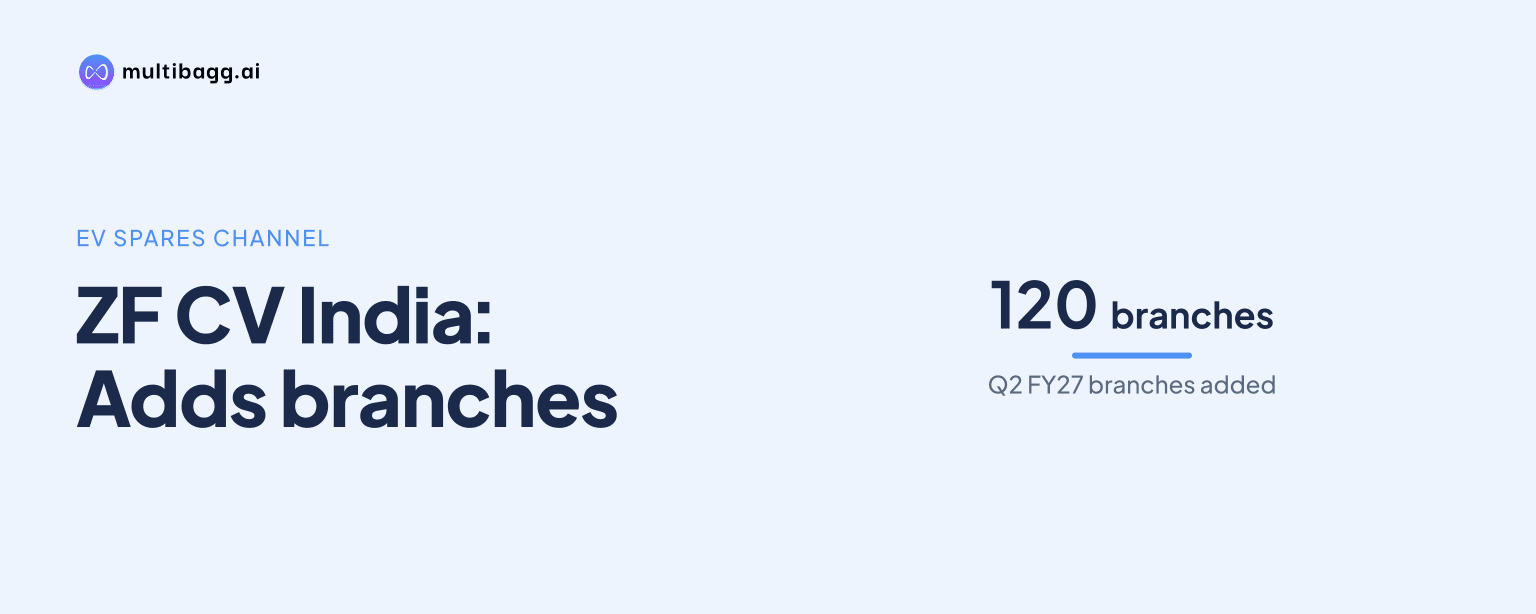
ZF Commercial Vehicle Control Systems India Limited added 120 aftermarket branches in Q2 FY 2026-27, widening its replacement-parts reach through a network that already included about 550 dealers and distributors and around 270 authorised service partners. Management is also using this network to introduce EV-focused spares and retrofit offerings.
Know ZF Commercial Vehicle Control System India inside out
Results, valuation, peers and who's buying, in one view.
How is ZF CV India expanding its aftermarket reach?
ZF CV India expanded its aftermarket reach by adding 120 branches in Q2 FY 2026-27, alongside about 550 dealers and distributors and around 270 authorised service partners across India. Management said the expansion is intended to increase engagement with fleet owners and workshops as healthy fleet utilisation and replacement-spares demand support the segment.
The company complemented the network additions with customer-facing brand campaigns, promotional activity and mechanic-training programmes. These initiatives target the points where repair and service decisions are made. ZF CV India is pursuing the effort through Project SPARK, or Spare Parts Aftermarket Reforms Kickoff, which is designed to broaden its product offering beyond its established commercial-vehicle systems.
Management described the aftermarket as a strategic priority for maintaining a balanced portfolio alongside original-equipment, or OE, sales. The network expansion came as commercial-vehicle production above 6 tonnes increased 47.7% year on year in Q2 FY 2026-27, a market backdrop that management said was supported by infrastructure activity, logistics demand and fleet utilisation.
Which replacement products has ZF CV India introduced?
ZF CV India has introduced four replacement-product categories through Project SPARK: Disc Brake Rotors, Diesel Exhaust Fluid, Wheel Bearing Grease and Clutch Master Cylinders. The launches extend the range available to fleet owners and workshops into adjacent service categories that can use the company’s existing distribution and service channels.
The pipeline under evaluation includes Brake Pads, Air Springs, a Reverse Parking Camera Solution, Lift Axle Dampers, nitrogen-oxide sensors and Diesel Exhaust Fluid sensors. Management also cited more than 10 merchandise products, but did not disclose launch dates, sales volumes or revenue contribution for either the four launched categories or the proposed products.
This route differs from the OE business, in which ZF CV India supplies vehicle manufacturers. OE sales grew 51.6% year on year in Q2 FY 2026-27, about 3.9 percentage points faster than the commercial-vehicle industry, according to management. The aftermarket strategy instead seeks sales after vehicles enter service, using the ZF CV India brand and partner footprint.
Management linked the segment’s Q2 momentum to fleet use, replacement demand and growing adoption of preventive maintenance practices. ZF CV India did not disclose aftermarket revenue, growth or profitability, so the call does not show the segment’s present financial share of total income.
How does the electric-bus fleet support ZF CV India’s plan?
More than 15,000 electric buses on Indian roads create an installed base for EV-specific spares, service and maintenance, according to management. As the bus population grows, management expects requirements for workshop support and replacement components to rise, providing an additional channel for the aftermarket programme.
ZF CV India said its e-compressors, Electronic Braking Systems, or EBS, and Electronically Controlled Air Suspension, or ECAS, are fitted on many of these vehicles. The company’s plan depends on these systems already being installed: components supplied during vehicle production can subsequently require servicing, retrofit work or replacement through aftermarket channels.
Project SPARK is extending the offering to independent EV players, starting with a Door Control Retrofit Solution and other EV-focused products. Management did not quantify the number of electric buses equipped with ZF CV India systems, the revenue from EV aftermarket sales, or the timetable for further product launches.
Electric-bus sales reached 2,228 units in Q2 FY 2026-27. During the same quarter, ZF CV India said it was increasing e-compressor and EBS penetration among independent bus manufacturers, and moved an e-compressor with a localised oil filter into series production. Those actions support the domestic supply base for the technologies management identifies as relevant to future EV servicing.
Got a follow-up? Ask IRIS
What other operations support ZF CV India’s growth plan?
ZF CV India is supporting growth with capacity additions, product programmes and regulatory testing. Between July and September 2026, it commissioned seven production lines, including a crankshaft machining line for internal-combustion-engine compressors and brake-actuator and valve assembly lines at Ambattur, Jamshedpur, Lucknow and Pantnagar.
Management said its short-term capacity focus includes compressors and actuators. It is also expanding OPR compressors, OptiDrive Automated Manual Transmission kits, Air Processing Units and High-Performance Actuators. The company had secured Electronic Stability Control, or ESC, nominations from three leading original-equipment manufacturers and was pursuing further programmes ahead of regulation.
Testing capacity is another disclosed route to business generation. ZF CV India’s dedicated ESC test track was booked until Q2 FY 2027-28, with close to 200 original-equipment manufacturer vehicles queued for testing. Its Hemi Anechoic Chamber received National Accreditation Board for Testing and Calibration Laboratories accreditation for Noise, Vibration and Harshness testing in September 2026, and management said the first invoice for that service had been raised.
Exports of goods returned to growth in Q2 FY 2026-27, supported by recovery in the United States and sustained European demand. Higher volumes of Double Diaphragm Spring Brake Actuators, Uni Stop Disc and Cam Brake Chambers, and air compressors contributed. An additional ASP cartridge line for an export customer was commissioned, with validation expected during the quarter and start of production planned in early Q4 FY 2026-27.
What was ZF CV India’s financial and market backdrop?
ZF CV India reported total income of Rs 1,252.30 crore for the quarter ended September 30, 2026, an increase of 30.7% from Q2 of the preceding financial year. That total-income increase was below the 51.6% OE-sales growth cited by management, although the call did not provide a segment-level reconciliation or disclose aftermarket revenue.
Commercial-vehicle production above 6 tonnes rose 47.7% year on year during Q2 FY 2026-27, while the trailer industry grew 19%. Management attributed the industry growth to infrastructure and construction work, industrial demand, e-commerce logistics, replacement demand, export recovery and a favourable base effect.
Management identified geopolitical developments, inflation, commodity-price volatility and supply-chain disruptions as factors to watch. ZF CV India engaged with more than 70 suppliers during the quarter to prepare for higher volumes and potential constraints. It also implemented more than 15 digital use cases at its Chennai plant, with rollout beginning at Jamshedpur.
Conclusion
The addition of 120 branches gives ZF CV India more points of access to fleet owners and workshops as it launches four aftermarket product categories and evaluates a wider pipeline. The strategy combines its 550-dealer-and-distributor network, 270 authorised service partners, rising vehicle utilisation and management’s stated opportunity to service electric buses already operating in India.
Next, investors can watch whether Project SPARK converts products such as Brake Pads, Air Springs and EV-focused offerings into launches, and whether the company discloses aftermarket financial performance. Management also plans further brake-system capacity investments, while the additional ASP cartridge export line is expected to complete validation in Q2 FY 2026-27 and begin production in early Q4 FY 2026-27.

