








ZF CV India underlying Q2 PBT rises 24.1%, FX masks pace
MAX Plan at ₹4,999/yr

Find your next multibaggerBe a Pro Investor
Research stocks and track your picks on the go. Download the app.
Key highlights
- ZF CV India’s Q2 FY 2026-27 PBT excluding FX rose 24.1% to Rs 170.10 crore.
- Reported Q2 PBT rose 17.2% to Rs 171 crore, while FX gains fell to Rs 0.90 crore from Rs 8.80 crore a year earlier.
- Q2 total income increased 30.7% to Rs 1,252.30 crore, and domestic OE grew 51.6%.
- H1 FY 2026-27 PBT excluding FX margin improved to 13.3% from 13.1% a year earlier.
powered by IRIS
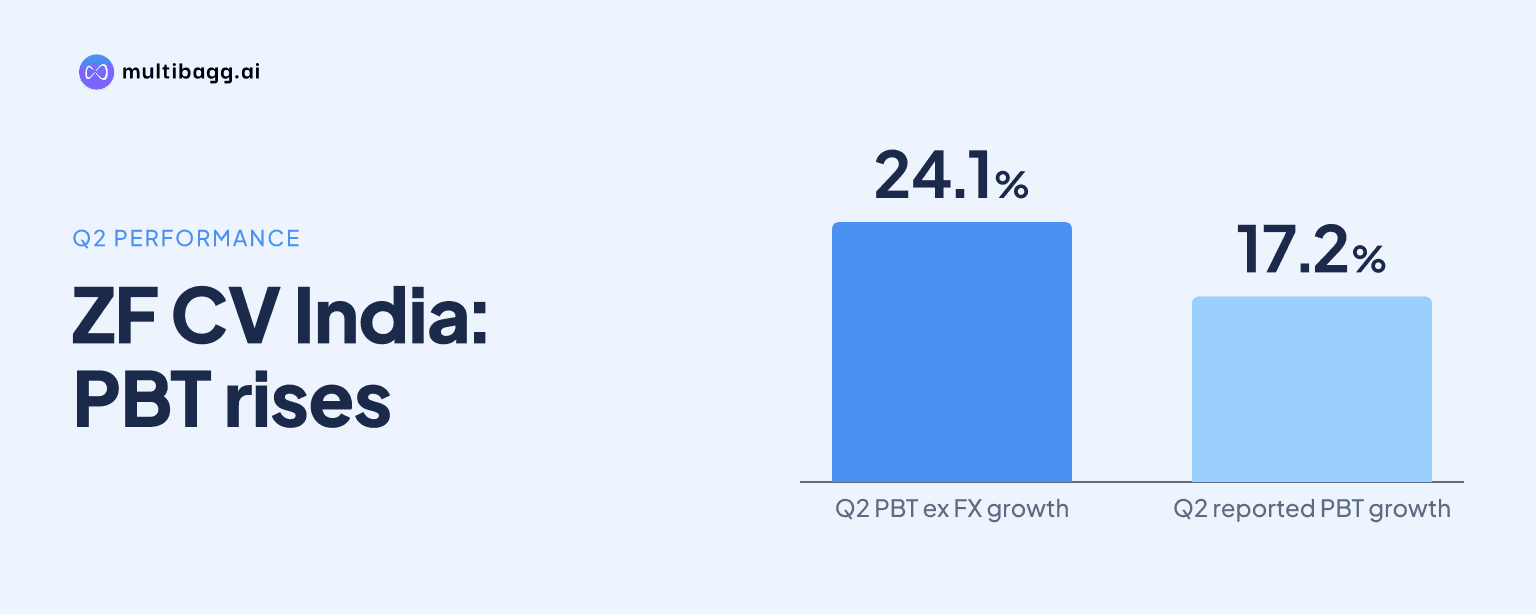
ZF CV India reported PBT excluding foreign-exchange gains and losses of Rs 170.10 crore in Q2 FY 2026-27, up 24.1% year on year, while reported PBT rose 17.2% to Rs 171 crore because the prior-year quarter had an Rs 8.80 crore FX gain versus Rs 0.90 crore in the latest quarter.
Know ZF Commercial Vehicle Control System India inside out
Results, valuation, peers and who's buying, in one view.
Why did ZF CV India’s reported PBT lag underlying growth?
ZF CV India’s reported PBT growth was lower because FX gains were substantially smaller than in the comparable quarter. PBT for the quarter ended 30 September 2026 was Rs 171 crore, a 17.2% increase from Q2 of the previous financial year. Excluding foreign-exchange, or FX, gains and losses, PBT was Rs 170.10 crore and increased 24.1%, according to management.
The difference reflects the FX comparison between the two periods. Q2 of the previous financial year included an FX gain of Rs 8.80 crore, while Q2 FY 2026-27 included an FX gain of Rs 0.90 crore. The Rs 7.90 crore year-on-year reduction in FX gains lowered reported PBT growth relative to the PBT measure excluding FX.
Profit after tax, or PAT, was Rs 127.80 crore, up 18% from Q2 of the previous financial year. Management distinguished this reported result from PBT excluding FX when describing the performance of its core operations.
What drove ZF CV India’s Q2 revenue increase?
ZF CV India’s total income rose 30.7% to Rs 1,252.30 crore in Q2 FY 2026-27, led by product sales and domestic original-equipment demand. Product sales increased 37.2% to Rs 1,073.90 crore, while service income rose 8.6% to Rs 135.70 crore. Other operating revenue was Rs 6.79 crore, up 1%, and other income was Rs 42.60 crore, up 2.9%.
Domestic original equipment, or OE, grew 51.6%, ahead of aftermarket growth of 27% and goods-export growth of 20.3%. Domestic OE was therefore the fastest-growing disclosed business channel, while aftermarket and export sales also contributed to the 30.7% increase in total income.
Management linked aftermarket growth to fleet utilisation, replacement-spare demand and preventive-maintenance practices. During the quarter, ZF CV India added 120 branches to a network that already included about 550 dealers and distributors and around 270 authorised service partners. Through Project SPARK, it launched disc brake rotors, diesel exhaust fluid, wheel-bearing grease and a clutch master cylinder.
How did ZF CV India’s first-half profitability compare?
ZF CV India’s H1 FY 2026-27 PBT excluding FX rose 19% to Rs 312.10 crore from Rs 262.20 crore, and the related margin improved to 13.3% from 13.1%. Total income increased 17.7% to Rs 2,354 crore from Rs 2,000 crore in H1 FY 2025-26. The 17.7% first-half income growth was below the 30.7% growth reported for the September quarter.
The first-half comparison also had a material FX component. Management said profitability in the previous year was helped by an FX gain of Rs 47.80 crore. It attributed the increase in PBT excluding FX and the 0.2 percentage-point margin improvement to revenue growth, cost management and favourable business mix.
The transcript does not disclose reported H1 PBT or profitability by segment. The available figures therefore support comparison of first-half PBT excluding FX and margin, rather than a calculation of reported first-half PBT by domestic OE, aftermarket, exports or services.
Got a follow-up? Ask IRIS
What operating actions supported ZF CV India’s growth?
ZF CV India commissioned seven production lines between July and September 2026 to meet higher commercial-vehicle demand. The additions included a crankshaft-machining line for internal-combustion-engine compressors at Oragadam, as well as brake-actuator and valve assembly lines at Ambattur, Jamshedpur, Lucknow and Pantnagar. It also inaugurated a high-capacity compressor test rig for domestic and export programmes.
The company engaged with more than 70 suppliers during the quarter to prepare for higher volumes and address potential constraints. At its Chennai plant, ZF CV India reached its target level of asset connectivity on the Digital Manufacturing Platform and implemented more than 15 digital use cases, with rollout under way at Jamshedpur.
Goods exports returned to growth, supported by recovery in the United States after tariff-related disruption and sustained momentum in Europe. Management cited higher volumes of double-diaphragm spring brake actuators, Uni Stop disc and cam brake chambers, and air compressors. An additional ASP cartridge line for export customers was commissioned, with validation expected during the current quarter and start of production planned for early Q4 FY 2026-27.
What growth plans has ZF CV India disclosed?
ZF CV India plans to increase domestic OE value per vehicle by approximately 30% over the next three years through product and technology additions. Management identified OPR compressor and high-force-actuator upgrades, electronic stability control, or ESC, door-control systems, the OptiDrive automated-manual-transmission kit, and electrification products including e-compressors, electronic braking systems and electronically controlled air suspension.
Management said the ESC mandate alone is expected to add nearly Rs 10,000 per vehicle. ZF CV India also said it doubled e-compressor output over the last year. Its dedicated ESC test track was booked in advance until Q2 FY 2027-28, with close to 200 OE vehicles queued for testing ahead of ESC regulations.
Services are another growth channel identified by management. ZF CV India’s engineering centre in India has more than 800 engineers working on local and global projects, while its testing services are being extended beyond commercial vehicles to passenger vehicles, two-wheelers, three-wheelers and special vehicles. In September 2026, its hemi-anechoic chamber received NABL accreditation for noise, vibration and harshness testing, and ZF CV India had raised its first invoice for that service.
Conclusion
ZF CV India’s Q2 performance showed that PBT excluding FX grew faster than reported PBT because the comparable prior-year quarter benefited from a larger currency gain. Total income of Rs 1,252.30 crore, domestic OE growth of 51.6% and a first-half PBT-excluding-FX margin of 13.3% provide the operating context for the 24.1% quarterly increase.
The next disclosed milestones are validation and early Q4 FY 2026-27 production at the ASP cartridge export line, as well as further capacity investment across brake-system aggregates. Management’s approximately 30% domestic OE value-per-vehicle objective over three years and the close to 200 vehicles queued at the ESC test track through Q2 FY 2027-28 are further measures to watch.

