










Zota Health Care Limited Q2 Revenue Rises 54.6% to ₹199.33 Crore
Key highlights
- Zota Health Care reported Q2 FY27 consolidated revenue of ₹199.33 crore, up 54.6% year on year.
- Dawa India sales rose more than 76% year on year to ₹168 crore and contributed about 82% of consolidated revenue.
- EBITDA turned positive at ₹7.92 crore in Q2 FY27, compared with a ₹9.55 crore loss in Q1 FY27.
- The Dawa India network reached 2,840 stores and generated approximately ₹188 crore of quarterly GMV.
powered by IRIS
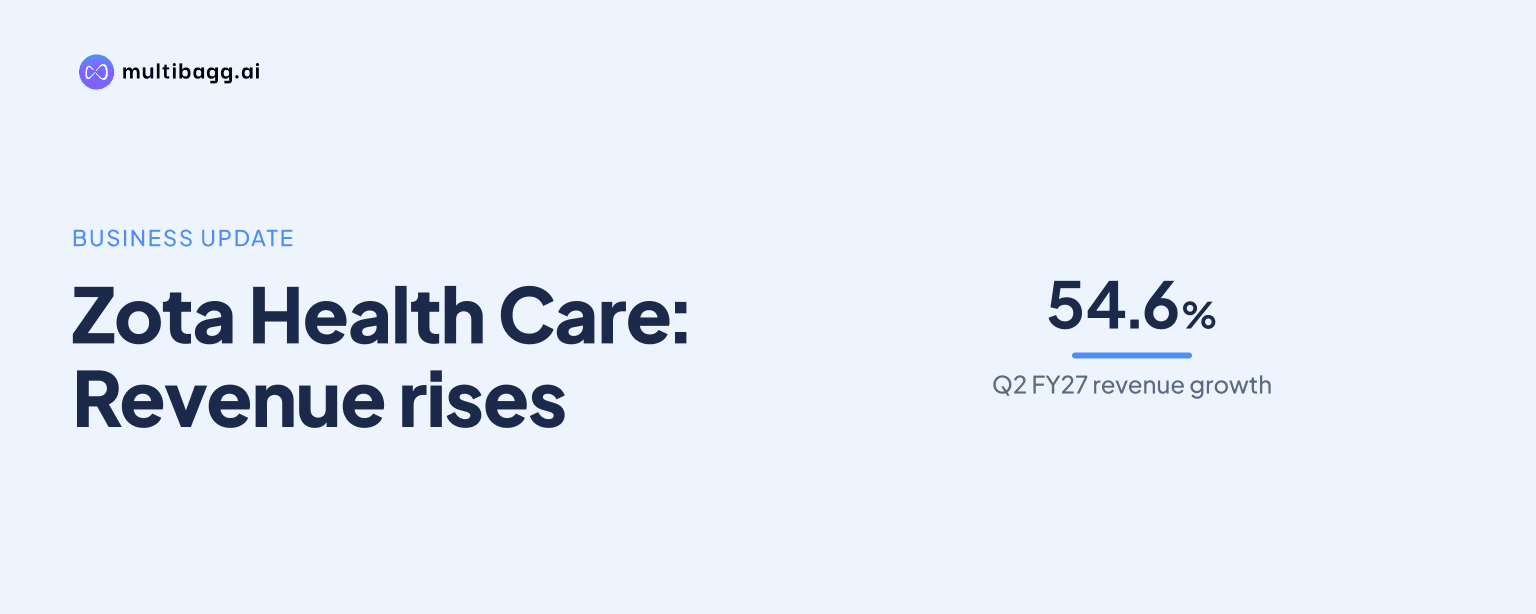
Zota Health Care Limited reported consolidated revenue of ₹199.33 crore in Q2 FY27, up 54.6% year on year, led by a 76% rise in Dawa India sales to ₹168 crore. The company also returned to positive EBITDA of ₹7.92 crore, although its consolidated net loss was ₹25.96 crore.
Know Zota Health Care inside out
Results, valuation, peers and who's buying, in one view.
What did Zota Health Care report in Q2 FY27?
Zota Health Care reported a marked increase in quarterly revenue and a positive EBITDA turnaround in the September quarter. Revenue from operations rose from ₹128.95 crore in Q2 FY26 to ₹199.33 crore in Q2 FY27. The company said revenue was also up about 14.8% sequentially.
Gross profit was approximately ₹120 crore, translating into a gross margin of 60.17%. EBITDA was ₹7.92 crore, compared with an EBITDA loss of ₹9.55 crore in Q1 FY27. EBITDA margin stood at 3.97% for the quarter.
The improvement at the operating-profit level did not result in a net profit. After depreciation, finance costs and tax, Zota Health Care reported a consolidated loss after tax of ₹25.96 crore. The loss was lower than ₹43.94 crore in Q1 FY27 but wider than the ₹16.19 crore loss reported in Q2 FY26.
How did Dawa India drive quarterly growth?
Dawa India was the main contributor to Zota Health Care's revenue growth, accounting for about 82% of consolidated revenue during Q2 FY27. Its sales reached ₹168 crore, while the company's other businesses together contributed the remaining 18% of revenue.
The pharmacy network's quarterly gross merchandise value, or GMV, rose to approximately ₹188 crore from ₹106 crore in the corresponding quarter a year earlier. Zota Health Care also said it served around 60 lakh customers during the quarter, indicating the scale of transactions across the network.
Management said mature Dawa India stores had reached monthly GMV of around ₹8 lakh per store. It also indicated potential for mature stores to reach monthly GMV of ₹10 lakh to ₹15 lakh over the next two to three years. This is a management outlook, not a reported current network-wide average.
Why did EBITDA turn positive while the company remained loss-making?
Zota Health Care turned EBITDA-positive because its revenue growth and gross-profit generation exceeded operating costs at the earnings-before-interest, tax, depreciation and amortisation level. The ₹7.92 crore EBITDA represented a change from the operating loss recorded in the preceding quarter.
However, EBITDA excludes depreciation, finance costs and tax. Once those items were accounted for, the company remained in a consolidated loss of ₹25.96 crore. The quarterly result therefore shows improvement in operating performance but not a complete move to net profitability.
The difference is relevant for investors assessing the pace of the turnaround. Positive EBITDA can indicate better operating leverage as sales rise, while the continuing net loss shows that non-operating and fixed accounting charges remained material during the quarter. The supplied information does not provide a detailed breakup of these charges.
Got a follow-up? Ask IRIS
What was Zota Health Care's store expansion strategy?
Zota Health Care moderated store additions during Q2 FY27 to focus on consolidation and store-level productivity. The Dawa India network stood at 2,840 stores as of September 30, 2026, according to the earnings-call presentation.
During the quarter, the network added 20 stores, including four company-operated company-owned outlets and 16 franchise-operated outlets. Five franchise-operated stores were closed. The net expansion was therefore limited as management focused on improving performance across the existing base.
Management said it planned to accelerate network additions in the second half of FY27 while retaining its focus on productivity and cash generation. The stated approach links expansion to the ability of individual stores to build GMV and support operating performance rather than relying only on outlet additions.
What does the quarter mean for investors and operations?
The Q2 FY27 outcome shows that Zota Health Care's growth was concentrated in its Dawa India business, which supplied more than four-fifths of consolidated revenue. The rise in GMV, customer count and sales provides the operational backdrop to the improvement in EBITDA.
For investors, the key distinction is between the positive EBITDA result and the continuing consolidated loss. Revenue increased 54.6% year on year, but the net loss widened from the prior-year quarter. No share-price movement or market reaction was provided in the available material, so any immediate stock-market impact cannot be quantified from the disclosed information.
The business also completed a cashless conversion of ₹119.52 crore of unsecured loans and interest from subsidiary Davaindia Health Mart Limited into equity. The conversion involved the allotment of 235,512 equity shares at ₹5,075 per share, according to the supplied company-related disclosure. This was a balance-sheet transaction rather than a fresh cash inflow.
Conclusion
Zota Health Care's Q2 FY27 numbers point to strong top-line growth, driven by Dawa India, and an improvement from an EBITDA loss in Q1 to a positive operating result. Yet the company remained loss-making after depreciation, finance costs and tax, making the gap between operating progress and net profitability important.
The next developments to watch are management's planned acceleration of store additions in H2 FY27 and whether existing stores continue to improve GMV and cash generation. The pace of network growth, store productivity and the movement from positive EBITDA toward lower net losses will remain central measures of execution.