










Remus Pharmaceuticals H1 FY27 Revenue Rises 53.45% to ₹614.12 Crore
Key highlights
- Remus Pharmaceuticals reported H1 FY27 consolidated revenue of ₹614.12 crore, up 53.45% from ₹400.20 crore in H1 FY26.
- Remus Pharmaceuticals' H1 FY27 consolidated profit after tax was ₹24.66 crore, up 14.22% year-on-year.
- Standalone revenue for H1 FY27 was ₹62.08 crore, representing 32.51% year-on-year growth.
- Remus Pharmaceuticals fixed November 7, 2026 as the record date for its first FY27 interim dividend, without disclosing the per-share amount.
powered by IRIS
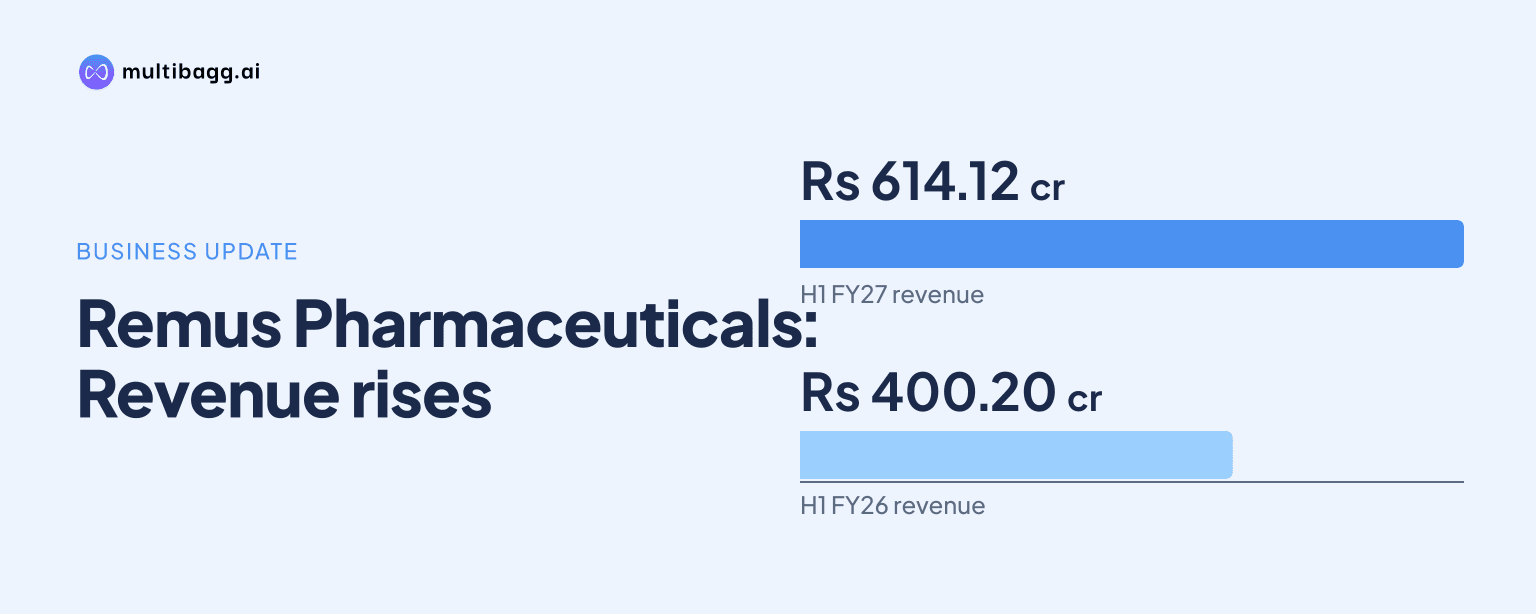
Remus Pharmaceuticals Limited reported consolidated revenue from operations of ₹614.12 crore for H1 FY27, a 53.45% year-on-year increase from ₹400.20 crore, while net profit rose 14.22% to ₹24.66 crore. The results show continued sales growth, although profit growth was moderated by subsidiary setup and operating costs.
Know Remus Pharmaceuticals inside out
Results, valuation, peers and who's buying, in one view.
What did Remus Pharmaceuticals report for H1 FY27?
Remus Pharmaceuticals reported ₹614.12 crore in consolidated revenue from operations for the six months ended September 2026, compared with ₹400.20 crore in H1 FY26. Consolidated profit after tax rose to ₹24.66 crore from the comparable period a year earlier, representing growth of 14.22%.
The company also reported standalone revenue of ₹62.08 crore, up 32.51% year-on-year. The difference between standalone and consolidated revenue reflects the significance of the group’s wider operations in its reported performance. The H1 FY27 announcement followed the board meeting held on November 3, 2026, to consider the half-yearly unaudited financial results and dividend-related matters.
What supported revenue growth during the half year?
Remus Pharmaceuticals said its H1 FY27 media release highlighted new tenders, approvals and portfolio expansion across international markets. These developments were cited alongside the reported growth in consolidated revenue, which exceeded the pace of net profit growth during the period.
The company’s earlier FY26 disclosure had identified the performance of its business-to-consumer entity, Relius, as a major contributor to growth. For H1 FY27, however, the available information does not provide a segment-wise revenue split or quantify the contribution from individual products, geographies, tenders or approvals. Investors therefore have limited disclosed detail on the precise composition of the half-year sales increase.
How does H1 FY27 compare with Remus Pharmaceuticals' FY26 performance?
Remus Pharmaceuticals' H1 FY27 revenue growth follows a stronger FY26, when consolidated total income rose to ₹860.33 crore from ₹625.34 crore in FY25. FY26 consolidated EBITDA increased to ₹56.69 crore, while profit after tax reached ₹46.17 crore.
The H1 FY27 result also compares with ₹453.43 crore of revenue from operations reported in the second half of FY26. Half-year periods are not directly comparable with a full financial year, but the disclosed numbers indicate that the company entered FY27 after reporting higher revenue and profit in FY26 than in the preceding year.
Got a follow-up? Ask IRIS
Why did profit grow more slowly than revenue?
Remus Pharmaceuticals attributed the slower growth in consolidated profit after tax to setup and operating costs at subsidiaries in Bolivia, Guatemala and Espee GCTS. Consolidated revenue increased 53.45%, while profit after tax increased 14.22%, creating a clear gap between sales growth and profit growth for the half year.
The disclosed information does not state the absolute value of these costs or provide a detailed margin bridge. It does establish that international subsidiary-related expenditure affected profitability during the period. Such costs are relevant for investors because they can reduce near-term earnings even when revenue rises, particularly while new operations are being established or expanded.
The company’s FY26 financial data showed EBITDA growth of 24.08%, from ₹45.69 crore in FY25 to ₹56.69 crore in FY26. H1 FY27 therefore needs to be viewed against a recent period of expanding operations, while recognising that the latest half-year profit trend was affected by identified operating expenses.
What dividend actions has Remus Pharmaceuticals disclosed?
Remus Pharmaceuticals declared its first interim dividend for FY 2026-27 at the November 3, 2026 board meeting and fixed November 7, 2026 as the record date to determine shareholder eligibility. The company said payment would be made within the statutory timelines under the Companies Act, 2013.
The filing on the interim dividend did not disclose a per-share amount. This is distinct from the final dividend of ₹0.50 per equity share of face value ₹10 for FY26, for which September 22, 2026 was fixed as the record date. The FY26 final dividend was subject to shareholder approval at the annual general meeting held on September 29, 2026.
How do the results affect investors and operations?
For investors, the main financial takeaway is the divergence between strong consolidated revenue growth and more moderate profit growth. Revenue from operations increased by more than half year-on-year, but costs linked to subsidiaries in Bolivia, Guatemala and Espee GCTS limited the expansion in profit after tax.
The disclosed new tenders, approvals and portfolio expansion indicate continued activity in international markets, though the company has not quantified the financial impact of each initiative. The November 4, 2026 H1 FY27 earnings call is the next disclosed forum where management may provide further context on revenue mix, subsidiary costs and operational priorities.
Conclusion
Remus Pharmaceuticals delivered consolidated revenue of ₹614.12 crore and profit after tax of ₹24.66 crore in H1 FY27. The result extends the company’s recent revenue growth trend, while the slower pace of profit growth highlights the effect of setup and operating costs at identified subsidiaries.
Investors will watch for the company’s H1 FY27 earnings call scheduled for November 4, 2026, particularly for details on international expansion costs, tender and approval-led growth, and the undisclosed per-share amount of the first interim dividend for FY 2026-27.