










Trom Industries Limited H1 FY26 Profit Rises Despite Sales Decline
Key highlights
- Trom Industries Limited reported H1 FY26 revenue of ₹40.73 crore, down 12% year-on-year.
- H1 FY26 EBITDA rose more than 16% year-on-year to ₹6.98 crore.
- H1 FY26 net profit increased more than 6% year-on-year to ₹4.39 crore.
- FY26 revenue was ₹124.86 crore and FY26 net income was ₹6.92 crore.
powered by IRIS
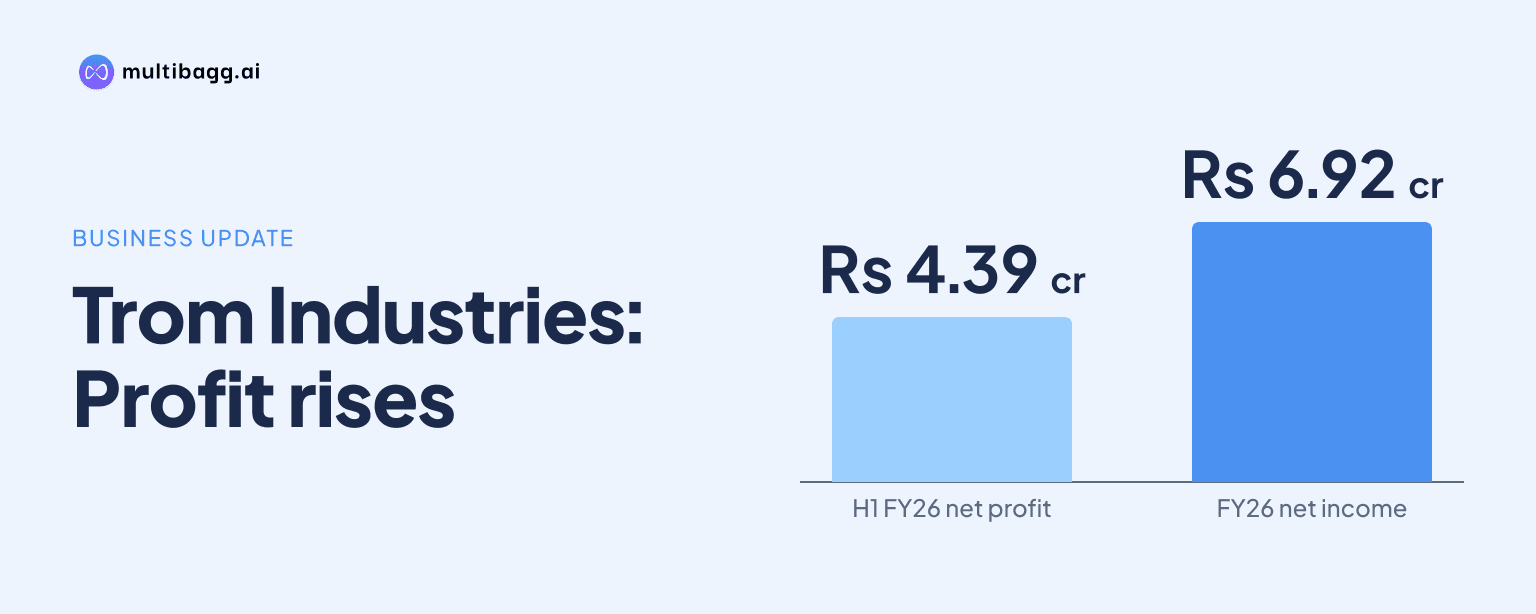
Trom Industries Limited reported H1 FY26 revenue of ₹40.73 crore, down 12% year-on-year, while EBITDA increased 16% to ₹6.98 crore and net profit rose 6% to ₹4.39 crore. The results show that profitability improved despite lower revenue, which the company attributed to invoicing delays and rain-related disruption to project execution.
Know Trom Industries inside out
Results, valuation, peers and who's buying, in one view.
What did Trom Industries Limited report for H1 FY26?
Trom Industries Limited reported revenue of ₹40.73 crore for the half year ended September 2025, compared with ₹46.29 crore in the corresponding period a year earlier. The company described the decline as a 12% year-on-year moderation in revenue.
The solar engineering, procurement and construction company said EBITDA rose by more than 16% year-on-year to ₹6.98 crore. Net profit increased by more than 6% to ₹4.39 crore. The outcome indicates that the company recorded higher earnings at the operating and net-profit levels even as revenue was lower than the previous-year period.
The company operates across residential, commercial and industrial solar projects. Its half-year performance is therefore influenced by the timing of project execution, customer invoicing and site conditions. Trom said rains affected execution during the period, while invoicing delays also affected reported revenue.
Why did revenue decline during the half year?
Revenue declined because invoicing was delayed and rains affected project execution, according to Trom Industries Limited. These factors reduced the value of work reflected in the reported H1 FY26 revenue figure.
The reported revenue figure is consistent with the company's half-year earnings disclosure, which listed revenue of ₹407.32 million for the half year ended September 30, 2025. Converted to crore, this equals ₹40.73 crore. Sales in that disclosure were ₹401.34 million, or ₹40.13 crore, compared with ₹46.24 crore a year earlier.
Project-based solar EPC businesses can show variation between reporting periods because revenue recognition depends on execution milestones and invoicing. In this case, Trom specifically identified operational disruption from rains and invoicing timing rather than a change in its stated business focus.
How did Trom improve profitability despite lower revenue?
Trom improved profitability through stable panel prices and disciplined execution, according to its H1 FY26 statement. EBITDA reached ₹6.98 crore despite the 12% revenue decline, while net profit rose to ₹4.39 crore.
Stable panel prices can help an EPC company manage input costs when projects are being delivered. Disciplined execution refers to the company's stated operational approach during the period. The supplied disclosures do not provide a detailed cost break-up for the H1 FY26 EBITDA figure, so the exact contribution of individual cost items cannot be quantified from the available information.
The improvement follows a profitable FY26. For the full year ended March 31, 2026, Trom reported revenue of ₹124.86 crore, compared with ₹93.91 crore a year earlier. Net income for FY26 was ₹6.92 crore, up from ₹4.61 crore in the prior year, according to the full-year earnings release.
Got a follow-up? Ask IRIS
What is the wider financial context for Trom Industries?
Trom Industries Limited has reported uneven half-year operating-profit figures in the data provided, reflecting the project-led nature of its business. Standalone half-year sales were ₹23 crore in September 2023, ₹31 crore in March 2024, ₹46 crore in September 2024, ₹47 crore in March 2025, ₹40 crore in September 2025 and ₹83 crore in March 2026.
The same standalone table showed operating profit of ₹6.38 crore for September 2025 and ₹4.15 crore for March 2026. The company separately reported H1 FY26 EBITDA of ₹6.98 crore. These measures are presented in different disclosures and should not be treated as identical without a reconciliation from the company.
For investors, the H1 FY26 result places attention on execution and billing conditions. Revenue was affected by the timing of invoices and project disruption, whereas profitability rose. The available disclosures establish these reported movements but do not provide forecasts, an order-book figure or a revenue target for the following period.
How does the H1 FY26 result affect investors and operations?
The H1 FY26 result shows that Trom maintained higher EBITDA and net profit despite lower revenue, but it also highlights the importance of project completion and invoicing schedules to its reported financial performance. Investors evaluating the period can compare the ₹40.73 crore revenue figure with the ₹6.98 crore EBITDA and ₹4.39 crore net profit disclosed by the company.
For customers and operating teams, rain-related execution disruption may affect the timing of project activity during a reporting period. The company has not disclosed specific affected locations, project counts or customer contracts in the supplied material. It has stated that it provides solar energy solutions for residential, commercial and industrial projects.
The company informed the exchange of a board meeting scheduled for November 3, 2026, to consider and approve unaudited half-yearly financial results for the period ended September 2026. That disclosure is separate from the H1 FY26 results discussed here, which the supplied financial information associates with the half year ended September 2025.
Conclusion
Trom Industries Limited's H1 FY26 performance combined a 12% year-on-year revenue decline with improved earnings. Revenue was ₹40.73 crore, while EBITDA rose more than 16% to ₹6.98 crore and net profit increased more than 6% to ₹4.39 crore. The company attributed the revenue moderation to invoicing delays and rain-affected execution, while citing stable panel prices and disciplined execution for the profitability improvement.
The next disclosed event to watch is the board meeting scheduled for November 3, 2026, to consider unaudited results for the period ended September 2026. Investors will also need to monitor whether project execution and invoicing conditions normalise, as the company has not provided a forward revenue target or order-book update in the supplied disclosures.