










63 Moons Technologies Q2 Revenue Rises to ₹150 Crore
Key highlights
- 63 Moons Technologies reported Q2 revenue of ₹150 crore versus ₹20.4 crore in Q2 FY26.
- The Q2 revenue comparison implies a derived year-on-year increase of approximately 635%.
- 63SATS Cybertech reported H1 FY27 provisional billed revenue of ₹218.21 crore and a ₹400 crore order book.
- 63SATS raised its FY27 billed-revenue guidance to ₹600 crore from ₹350 crore.
powered by IRIS
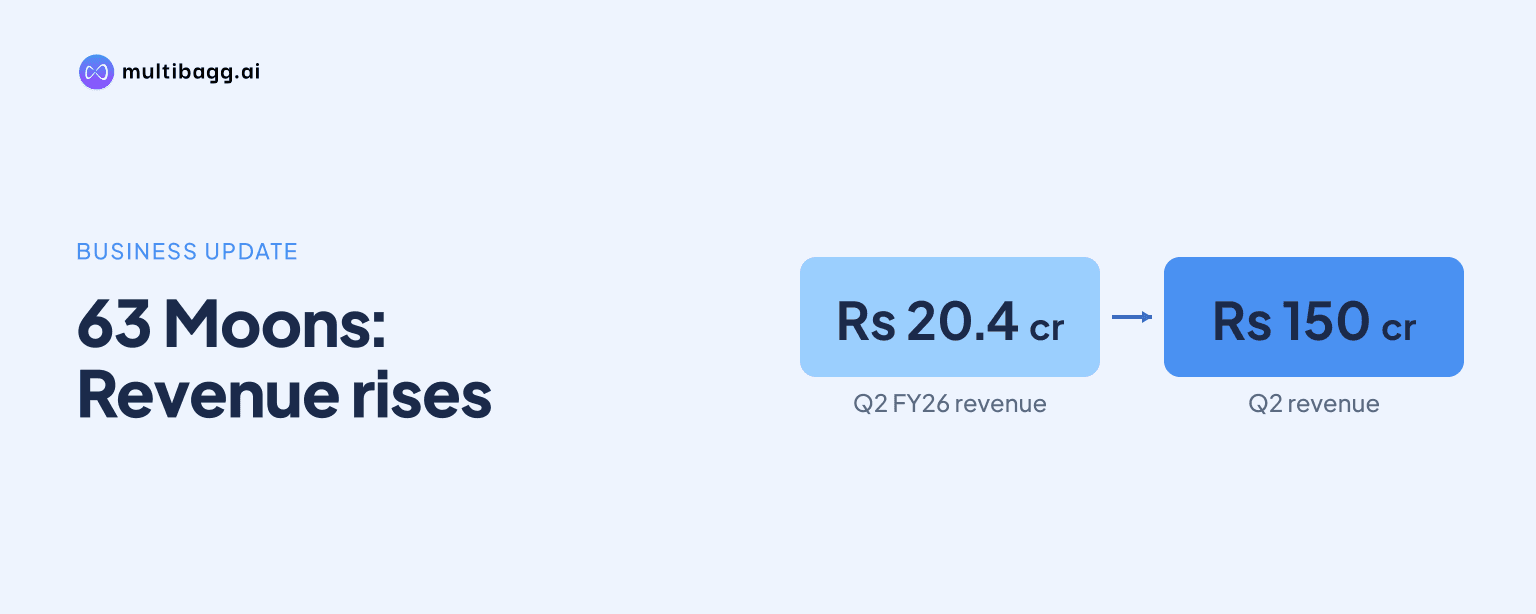
63 Moons Technologies reported Q2 revenue of ₹150 crore, compared with ₹20.4 crore in the year-ago quarter, representing a derived year-on-year increase of about 635%. The sharp increase places attention on the company’s technology and cybersecurity operations, particularly material subsidiary 63SATS Cybertech, which has raised its FY27 billed-revenue guidance to ₹600 crore.
Know 63 Moons Technologies inside out
Results, valuation, peers and who's buying, in one view.
What did 63 Moons Technologies report for Q2 FY27?
63 Moons Technologies reported Q2 FY27 revenue of ₹150 crore, against ₹20.4 crore in Q2 FY26. The comparison indicates that revenue increased by roughly ₹129.6 crore year on year. Based on these figures, the derived growth rate is approximately 635%.
The reported performance follows a strong first quarter for 63 Moons. In Q1 FY27, consolidated revenue from operations was ₹136.32 crore, up 349.5% from ₹30.33 crore in Q1 FY26. However, the company reported a consolidated net loss of ₹39.68 crore in that quarter, compared with a ₹3.08 crore profit a year earlier, as total expenses rose to ₹218.36 crore.
The Q2 revenue figure matters because it suggests that the higher scale seen in the first quarter continued into the July-September period. The available information attributes the broader momentum to the company’s technology and cybersecurity businesses, including operations at 63SATS Cybertech.
What drove the increase in Q2 revenue?
The increase in Q2 revenue was linked to momentum in technology and cybersecurity operations, with 63SATS contributing a substantial volume of billed business during the first half of FY27. 63SATS reported provisional billed revenue of ₹218.21 crore for H1 FY27, compared with ₹87 crore for the full FY26.
Its billed revenue was ₹102.57 crore in Q1 FY27 and ₹115.64 crore in Q2 FY27. The subsidiary said its order book stood at ₹400 crore at the end of the first half, with 55% converted into billed revenue during H1. This order-book conversion is relevant because it provides visibility into work already won and moving into billing.
CYBX AI CyberOps contributed ₹88 crore, or 40%, of 63SATS’ H1 billing. The subsidiary also reported 5.35 lakh paid CYBX subscribers and 107 enterprise clients at the end of H1 FY27. These operating measures show that the cybersecurity business is expanding across both subscriber and enterprise channels.
How did 63SATS revise its FY27 outlook?
63SATS raised its FY27 billed-revenue guidance to ₹600 crore from its earlier target of ₹350 crore. The revised target is ₹250 crore higher than the initial guidance and reflects the subsidiary’s reported H1 billing, order book and pace of conversion.
The guidance revision was disclosed in October 2026, after 63SATS reported H1 FY27 provisional billed revenue of ₹218.21 crore. That H1 figure was about 2.5 times its FY26 full-year billed revenue of ₹87 crore. The company described EBITDA as remaining negative during its stated capture phase, indicating that operating profitability has not moved in line with billing growth.
Got a follow-up? Ask IRIS
What does the revenue growth mean for investors?
The Q2 revenue increase strengthens the revenue narrative for 63 Moons after its corporate restructuring and supports the company’s stated operational visibility for the full year. The combination of higher quarterly revenue and the subsidiary’s expanded guidance gives investors more data points on the scale of current technology and cybersecurity activity.
But revenue growth should be assessed alongside profitability and expenses. In Q1 FY27, 63 Moons recorded a net loss despite a significant rise in consolidated revenue, with total expenses of ₹218.36 crore. The available information does not provide a Q2 profit or loss figure, so the effect of the higher Q2 revenue on consolidated earnings cannot be determined from the reported revenue number alone.
For the cybersecurity segment, the key operational indicators are billed revenue, the ₹400 crore order book, subscriber additions and enterprise-client growth. The H1 numbers show higher business volumes, while the disclosure that EBITDA remains negative means investors will also monitor the cost required to support that expansion.
How does this compare with recent financial performance?
The Q2 revenue of ₹150 crore follows ₹136.32 crore of consolidated revenue in Q1 FY27. In the prior-year comparison, Q1 FY26 revenue was ₹30.33 crore and Q2 FY26 revenue was ₹20.4 crore, indicating that the company has reported materially higher revenue levels in the first half of FY27 than in the comparable period.
Earlier quarterly data also shows that 63 Moons’ reported sales have varied considerably over time. The present figures therefore need to be viewed in the context of the company’s changing business mix, restructuring and greater contribution from the cybersecurity subsidiary. No geographic revenue split was disclosed in the available information.
Conclusion
63 Moons Technologies’ reported Q2 revenue of ₹150 crore marks a substantial increase from ₹20.4 crore a year earlier and extends the higher revenue base reported in Q1 FY27. The performance has been associated with technology and cybersecurity momentum, while 63SATS’ H1 billed revenue of ₹218.21 crore and ₹400 crore order book provide additional context for the group’s operational activity.
The next areas to watch are the conversion of 63SATS’ order book into billed revenue, progress toward its revised ₹600 crore FY27 target, and whether higher revenue is accompanied by improved profitability. The available disclosures show strong billing growth but also indicate that the subsidiary’s EBITDA remains negative during its expansion phase.