










AABL Central Province volume rises 56% as Kultur enters RTD
Key highlights
- AABL reported 56% Q2FY27 volume growth for Central Province and about 25% market share in core markets.
- Kultur launched in June 2026 with five hard-seltzer flavours and entered Madhya Pradesh, Maharashtra and Rajasthan.
- AABL’s IMFL (P) volume was 732,000 cases in Q2FY27, compared with 573,000 cases in Q2FY26.
- AABL acquired SDF Industries for Rs 30.85 crore, and its 4.3 million-case annual bottling plant is expected to start by end-FY27.
powered by IRIS
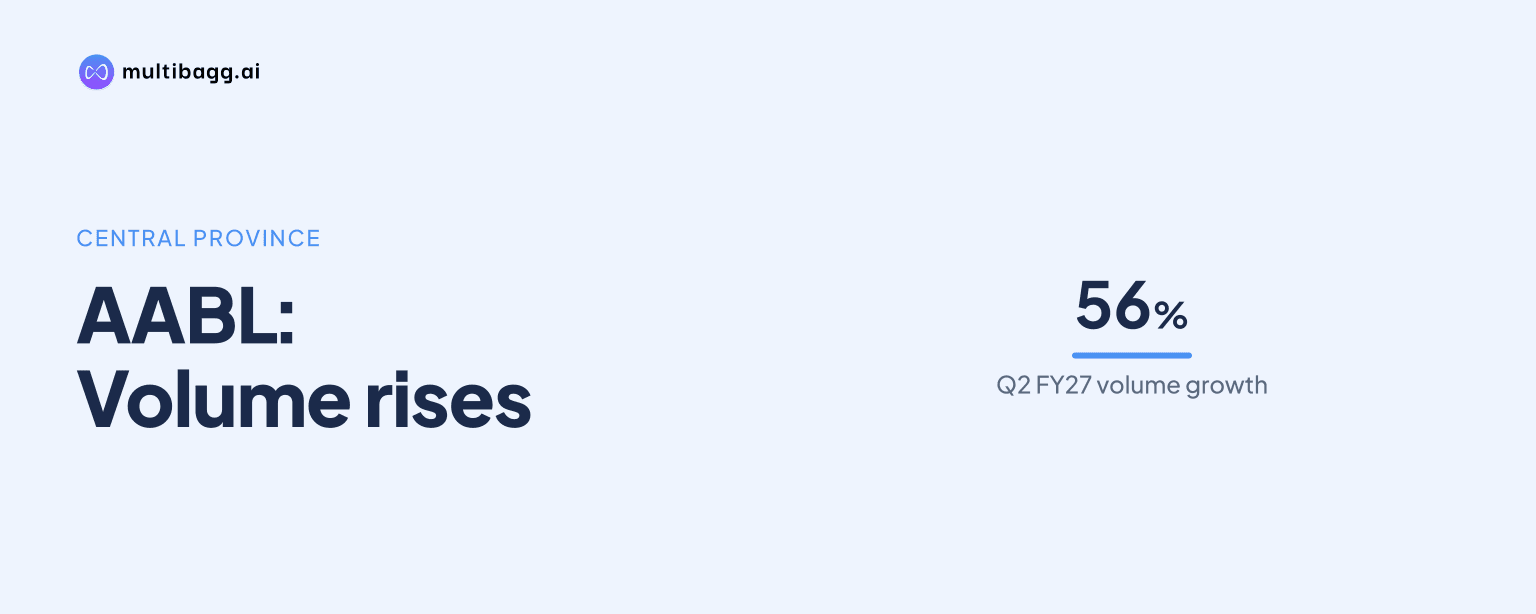
AABL reported 56% volume growth for its Central Province series in the period it labels Q2FY27, alongside a Kultur hard-seltzer rollout that began in Madhya Pradesh and entered Maharashtra and Rajasthan after its June 2026 launch. Central Province has about 25% share in core markets, while Kultur adds a five-flavour ready-to-drink offering.
Know Associated Alcohols & Breweries inside out
Results, valuation, peers and who's buying, in one view.
How fast did AABL’s Central Province series grow?
AABL’s Central Province series recorded 56% volume growth in Q2FY27 and held about 25% market share in its core markets. The presentation identifies Central Province whisky, vodka and rum as the series, but does not identify whether a single product or state drove the reported growth.
Central Province Whisky and Central Province Rum were launched in November 2023, while Central Province Vodka followed in May 2025 with three flavours. AABL describes the whisky as using Indian grain spirits, imported malts and matured Scotch, and the vodka as triple-distilled from selected premium grains. Management is targeting 1 million cases for the franchise during 2027 to 2030, with the stated objective of making it a millionaire brand.
The presentation does not disclose Central Province revenue, current case sales, the states included in its core markets or the comparison base for the 56% figure. It also does not split the approximately 25% market share between whisky, rum and vodka, limiting conclusions on the individual products behind the series performance.
How does Kultur expand AABL beyond spirits?
Kultur marks AABL’s entry into ready-to-drink, or RTD, products through a hard-seltzer launch in June 2026. It was initially launched in Madhya Pradesh, then entered Maharashtra and Rajasthan, while state-registration processes remained under way in four additional states.
The range has five variants: Cranberry, Watermelon Mint, Mai Tai, Lemon and Juniper Triple Sec. AABL said it is using its retail and HoReCa distribution network, meaning hotel, restaurant and catering channels, for the rollout. Unlike Central Province’s whisky, vodka and rum range, Kultur is a packaged RTD product aimed at a different consumption format.
AABL cited a projected 10.9% compound annual growth rate, or CAGR, for the RTD category between 2025 and 2031 and linked the launch to Gen Z and Millennial preferences. That is a category projection cited by AABL rather than a sales forecast for Kultur, for which the presentation provides no revenue, cases sold, price, alcoholic strength or marketing-spend data.
What categories and price points does AABL cover?
AABL lists products across tequila, whisky, gin, rum, brandy, vodka and RTD. Central Province appears in whisky, rum and vodka, while Kultur is listed as a hard seltzer. Other listed brands include Arcana tequila, Nicobar gin, Hillfort whisky, Jamaican Magic rum, Lemount rum and brandy, James McGill rum and brandy, Mood Maker brandy and vodka, and Titanium vodka.
AABL presents four portfolio price bands: prestige and above at maximum retail price, or MRP, of Rs 1,000 and above; popular at Rs 680 to Rs 1,000; economy at Rs 500 to Rs 560; and RTD at Rs 130. The presentation does not assign Central Province, Kultur or any other named brand to a specific band, so it does not establish the exact retail position of each product.
The three-category Central Province range and five-flavour Kultur launch show that AABL is building proprietary brands across both spirits and RTD formats. However, the disclosed Kultur rollout remains phased: the source confirms entry into three states including Madhya Pradesh, Maharashtra and Rajasthan, rather than nationwide availability.
Got a follow-up? Ask IRIS
What do AABL’s IMFL volumes and revenue show in Q2FY27?
AABL’s IMFL (P) segment, a presentation label that is not expanded, reported 732,000 cases in Q2FY27, compared with 573,000 cases in Q2FY26 and 792,000 cases in Q1FY27. IMFL means Indian-made foreign liquor. The segment’s volume was 159,000 cases higher year on year but 60,000 cases below the preceding quarter.
IMFL (P) revenue was Rs 57.7 crore in Q2FY27, compared with Rs 41.4 crore in Q2FY26 and Rs 65.2 crore in Q1FY27. Revenue and volume were therefore higher than a year earlier but lower than the immediately preceding quarter. The 56% Central Province volume-growth figure is a franchise metric and should not be treated as the growth rate for the entire IMFL (P) segment.
The differing movements show that Central Province’s disclosed Q2FY27 growth occurred while total IMFL (P) volume declined sequentially. AABL does not state whether mix, seasonality, distribution timing or state-level conditions explain the 60,000-case quarter-on-quarter segment decline.
How is AABL adding capacity for its brand plans?
AABL acquired SDF Industries for Rs 30.85 crore through an Insolvency and Bankruptcy Code resolution plan approved by the National Company Law Tribunal’s Kochi Bench on April 16, 2026. SDF Industries became a wholly owned subsidiary with Indian-made foreign liquor bottling capacity of 4.3 million cases a year, a licensed distillery and about 10 acres of land near the Thrissur and Palakkad border in Keralam.
AABL said revamping, automation and licence renewal at the SDF site were under way, with operations expected to commence by the end of FY27. The company describes the location as central to Keralam and equidistant from major state depots, a mechanism it says can support operational capacity and consistent quality.
AABL also commissioned a 6,000-litre-per-day malt plant in September 2025, procured French and American casks that month and began malt maturation in November 2025. It expects malt for captive consumption and third-party sales in Q3FY28, while adding about Rs 3 crore of inventory each month for maturation. The malt is intended to replace outsourced supply for Hillfort and other whisky brands, alongside a planned premium single-malt whisky launch.
Conclusion
AABL’s 56% Q2FY27 Central Province volume growth and roughly 25% core-market share place the whisky, vodka and rum series at the centre of its proprietary-brand expansion. Kultur broadens that effort into RTD with five hard-seltzer flavours and a rollout that had reached Madhya Pradesh, Maharashtra and Rajasthan.
The next disclosed milestones are the expected SDF Industries start-up by the end of FY27, malt availability for captive use and third-party sales in Q3FY28, and Central Province’s 1 million-case target for 2027 to 2030. Kultur’s registrations in four further states and the absence of disclosed sales data remain key unresolved measures of its rollout.