










AABL ethanol realisation fell to Rs 57 per litre in H1FY27
Key highlights
- AABL ethanol realisation fell to Rs 57 per litre in H1FY27 from Rs 69 per litre in FY26.
- AABL operated its ethanol plant at 95% capacity utilisation in H1FY27.
- Q2FY27 ethanol revenue was Rs 56.6 crore, down 20% year on year, while volume fell 5% to 9.3 million litres.
- Q2FY27 ethanol EBITDA margin was 2%, compared with 4% a year earlier.
powered by IRIS
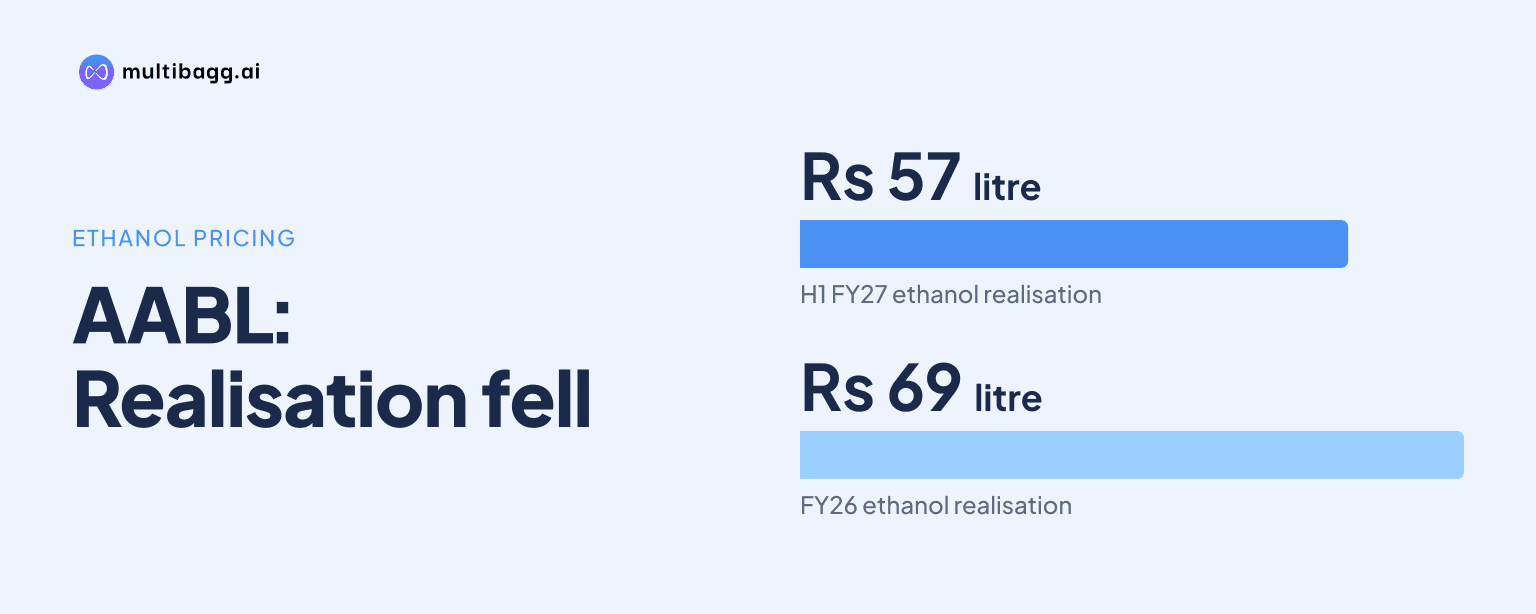
Associated Alcohols & Breweries Limited (AABL) reported ethanol realisation of Rs 57 per litre in H1FY27, down from Rs 69 in FY26, while its ethanol plant operated at 95% capacity utilisation. AABL attributed the decline to industry oversupply, lower oil marketing company allocations and a larger share of sales to private players at lower realisations.
Know Associated Alcohols & Breweries inside out
Results, valuation, peers and who's buying, in one view.
Why did AABL ethanol realisation fall in H1FY27?
AABL says industry oversupply reduced allocations from oil marketing companies (OMCs), resulting in a higher share of ethanol sales to private players at lower realisations. This shift coincided with realisation falling by Rs 12 per litre from Rs 69 in FY26 to Rs 57 in H1FY27. H1FY27 realisation was also below Rs 73 in FY25 and Rs 72 in FY24.
AABL received an additional ethanol allocation of 87.4 lakh litres for Q4 ESY 2025-26, with ESY referring to the ethanol supply year. It also said the ESY 2026-27 tender of about 1,100 crore litres excludes sugar-based ethanol allocation. Management described that structure as beneficial for grain-based ethanol players, but did not disclose AABL's expected allocation, selling price or margin under the tender.
How did AABL ethanol revenue and realisation change over time?
AABL's ethanol revenue rose from Rs 46.9 crore in FY24 to Rs 247.7 crore in FY25, then declined to Rs 201.9 crore in FY26 and Rs 111.6 crore in H1FY27. Realisation increased from Rs 72 per litre in FY24 to Rs 73 in FY25 before falling to Rs 69 in FY26 and Rs 57 in H1FY27. AABL states that its realisation measure excludes revenue reported as Others.
FY26 ethanol revenue was Rs 45.8 crore lower than FY25, while realisation fell by Rs 4 per litre over the same two full-year periods. H1FY27 is a partial period and is therefore not directly comparable with the full-year revenue figures. However, the Rs 57 per litre H1FY27 realisation shows that pricing pressure continued after FY26.
Revenue classified as Others was Rs 31.9 crore in H1FY27, compared with Rs 33.4 crore for all of FY26 and Rs 57.8 crore in FY25. Because AABL excludes Others from realisation, the Rs 57 per litre measure reflects ethanol sales without this reported revenue category. The presentation does not provide the composition of Others for H1FY27.
What did AABL report for Q2FY27 ethanol sales and margin?
AABL reported Q2FY27 ethanol revenue of Rs 56.6 crore, down 20% year on year, on volume of 9.3 million litres, down 5% year on year. Revenue therefore declined faster than volume in Q2FY27, consistent with AABL's explanation that lower OMC allocations increased exposure to lower-realisaton private-player sales. The presentation does not provide a quarterly split between OMC and private-player volumes.
Earnings before interest, tax, depreciation and amortisation (EBITDA) margin from ethanol sales was 2% in Q2FY27, compared with 4% in the year-earlier quarter. The 2-percentage-point change occurred even though AABL reported 95% ethanol-plant capacity utilisation in H1FY27. The disclosure separates production utilisation from the commercial outcome of lower revenue per litre and margin.
Q2FY27 ethanol revenue of Rs 56.6 crore represented about half of the Rs 111.6 crore reported for H1FY27. AABL did not disclose ethanol operating profit in rupees for Q2FY27 or H1FY27, nor did it give an ethanol EBITDA-margin target. Its disclosed quarterly comparison is limited to the 2% Q2FY27 margin and 4% margin a year earlier.
Got a follow-up? Ask IRIS
What flexibility and debt commitments does AABL disclose for ethanol?
AABL says its single manufacturing facility can use rice, maize, jawar, barley and other starch-rich feedstock, and its milestones identify a 40 million litres per annum ethanol plant established during 2022-2024. Its listed outputs include ethanol for OMCs and private players, extra-neutral alcohol for captive use and bottler supply, malt and liquor products. The presentation does not quantify any H1FY27 financial benefit from changing feedstock or product mix.
The reported 95% H1FY27 capacity utilisation shows that the ethanol plant was operating at a high share of available capacity while Q2FY27 EBITDA margin was 2%. AABL does not disclose H1FY27 ethanol production in litres, grain procurement costs or the share of ethanol diverted between OMCs and private players. Those omissions limit an assessment of the cost effect of its feedstock flexibility.
AABL lists debt repayments for funding the ethanol plant of Rs 20 crore in each of FY24-25, FY25-26 and FY26-27, followed by Rs 9.6 crore in FY27-28. The listed repayment schedule totals Rs 69.6 crore over the four financial years. AABL characterises its cash flows as sufficient to meet these obligations, which is management's assessment.
Conclusion
AABL's H1FY27 ethanol disclosure shows that 95% capacity utilisation did not prevent lower commercial returns. Realisation fell to Rs 57 per litre from Rs 69 in FY26, while Q2FY27 revenue declined 20% year on year, sales volume declined 5% to 9.3 million litres and EBITDA margin narrowed to 2% from 4%. AABL identified industry oversupply and the resulting shift from OMC allocations to private-player sales as the mechanism behind the pressure.
The next disclosed developments to watch are the additional 87.4 lakh-litre allocation for Q4 ESY 2025-26 and the approximately 1,100 crore-litre ESY 2026-27 tender excluding sugar-based allocation. Management says the tender structure benefits grain-based producers, but AABL has not disclosed its expected allocation, realisation or margin. The FY26-27 ethanol-plant repayment of Rs 20 crore is also the last of three equal annual instalments before the schedule falls to Rs 9.6 crore in FY27-28.