










Aarti Drugs Ltd. makes 330 filings across 16 regulated markets
Key highlights
- Aarti Drugs submitted about 330 regulatory filings across 16 targeted geographies.
- Aarti Drugs invested Rs 200 crore over 24 months solely in oncology development and pipeline growth.
- Aarti Drugs reported FY26 revenue of Rs 2,568 crore, up from Rs 2,403 crore in FY25.
- Aarti Drugs completed Rs 600 crore of capital expenditure and disclosed a 2.5-times asset-turn objective.
powered by IRIS
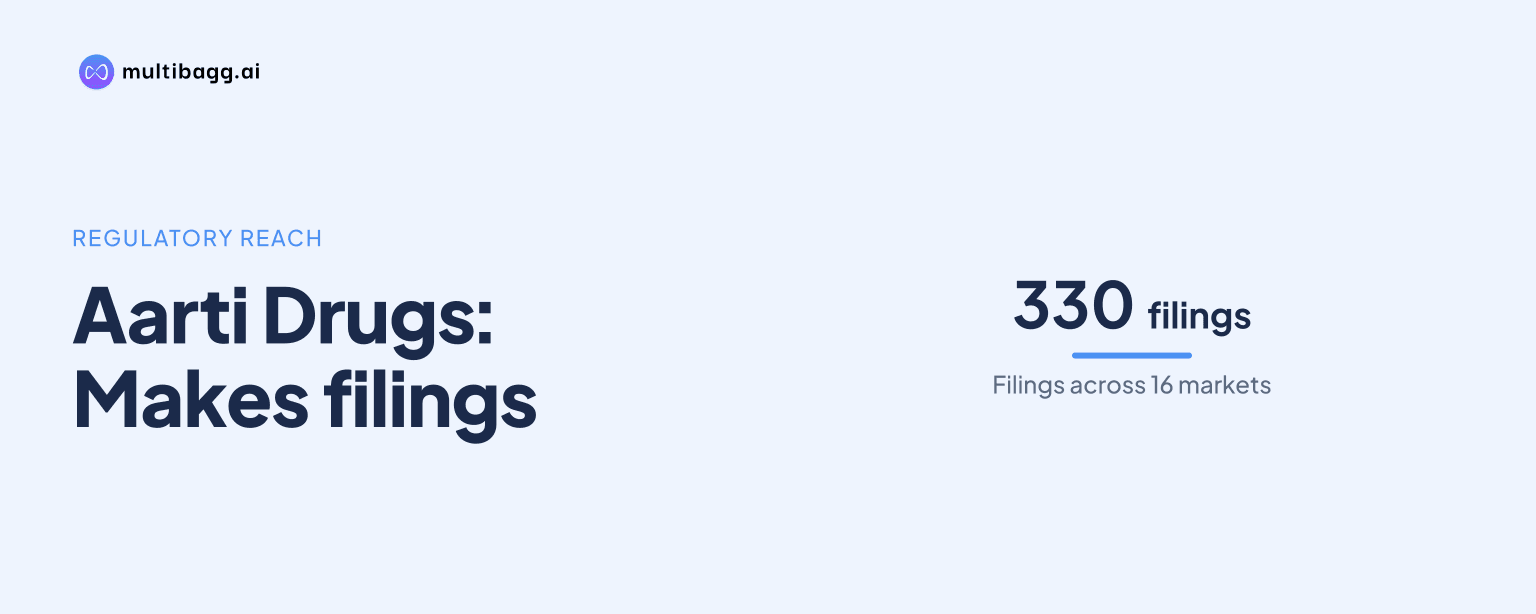
Aarti Drugs has submitted about 330 regulatory filings across 16 targeted geographies while investing Rs 200 crore over the past 24 months solely in oncology development and pipeline growth. The filings form part of its plan to expand formulation sales in regulated markets, supported by oral solid dosage and oncology-facility approvals.
Know Aarti Drugs inside out
Results, valuation, peers and who's buying, in one view.
How is Aarti Drugs entering regulated markets?
Aarti Drugs is entering regulated markets through its formulation business, operated through Pinnacle Life Sciences, which makes oral solid dosage products. The presentation says the oral solid dosage business has European Directorate for the Quality of Medicines & HealthCare (EDQM) approvals, while the oncology facility has approvals from the US Food and Drug Administration (USFDA) and the UK Medicines and Healthcare products Regulatory Agency (UK-MHRA). These approvals are the stated basis for developing products for regulated global markets.
Aarti Drugs has submitted about 330 regulatory filings across 16 targeted geographies and has commenced commercial operations in Latin America and a few African markets. It says it continues registrations in export markets and participation in government tenders. Its stated objective is deeper penetration into regulated markets, where management expects better realisations than from standard active pharmaceutical ingredients (APIs).
What does Aarti Drugs' oncology spending support?
Aarti Drugs has invested Rs 200 crore in the last 24 months solely for oncology development and pipeline growth. The spending accompanies expansion beyond traditional APIs into oncology and other therapeutic medicine categories. The presentation says specialised-chemistry products can carry premium pricing over standard APIs and may have entry barriers, rather than presenting those outcomes as already achieved.
As of 31-Mar-26, the disclosed development list covered 27 API products and 25 finished-dosage products across the listed categories. The API development portfolio was led by nine carboxylation-based products, while the API pipeline was led by 11 intermediates. Finished-dosage development included eight new-age molecules for regulated markets, comprising five anti-diabetic and three anti-coagulant products.
Aarti Drugs reported Rs 66 crore of research and development (R&D) spending in financial year 2026 (FY26) and said it developed more than 30 new and existing APIs in the previous five years. Its Tarapur R&D centre supports API process development and kilo-scale pilot manufacturing, while the Turbhe centre develops complex generic formulations, including oral solids for regulated and emerging markets. The company also plans to expand R&D into semi-solids, such as creams and ointments, and oral liquids.
Got a follow-up? Ask IRIS
How does Aarti Drugs link capacity with backward integration?
Aarti Drugs links capacity expansion with backward integration through two operationalised greenfield facilities, Sayakha Amines and Tarapur Salicylic Acid. Sayakha makes di-methylamine, mono-methylamine and tri-methylamine and their derivatives, which are inputs for APIs such as Metformin. The company describes the plant as a backward-integration facility, while Tarapur operations were still being scaled up.
The presentation says Rs 600 crore of capital expenditure is complete and associates the programme with a 2.5-times asset-turn objective, Rs 1,200 crore of revenue and Rs 300 crore of captive consumption. These are operational objectives shown alongside the capacity programme, rather than reported FY26 financial results. Aarti Drugs also says its land parcels in Maharashtra and Gujarat can support greenfield projects over the next three to four years.
In anti-diabetics, current capacity of about 1,400 tonnes per month (TPM) is planned to rise to 2,000-2,200 TPM at the existing site, alongside an additional 800-TPM brownfield expansion. About 500 TPM is targeted for USFDA markets, and construction was expected to finish in six to eight months. Separately, Aarti Drugs expects selected anti-inflammatory products from a multipurpose facility and brownfield work to generate annual revenue of about Rs 35 crore to Rs 50 crore, depending on product selection.
What financial capacity did Aarti Drugs report for expansion?
Aarti Drugs reported FY26 consolidated revenue of Rs 2,568 crore, up from Rs 2,403 crore in FY25, while earnings before interest, tax, depreciation and amortisation (EBITDA) rose to Rs 312 crore from Rs 303 crore. EBITDA margin moved to 12.1% in FY26 from 12.6% a year earlier. Profit after tax increased to Rs 195 crore from Rs 168 crore, and the corresponding margin rose to 7.6% from 7.0%.
Net operating cash flow increased to Rs 254 crore in FY26 from Rs 245 crore in FY25, after reaching Rs 359 crore in FY24. Net debt declined to Rs 566 crore in FY26 from Rs 605 crore in FY25, while equity increased to Rs 1,549 crore from Rs 1,369 crore and net debt to equity declined to 0.37 times from 0.44 times. Return on capital employed declined to 11.5% in FY26 from 12.5% in FY25 and 20.5% in FY22. The presentation notes that EBITDA includes other income.
Conclusion
Aarti Drugs' disclosed strategy combines formulation development, oncology work and regulated-market registrations with backward integration in API inputs. The product list as of 31-Mar-26 included 27 APIs under development, 24 APIs in pipeline and eight finished-dosage products for regulated markets, while FY26 revenue rose by Rs 165 crore from FY25.
The next disclosed milestones are completion of anti-diabetic construction within six to eight months, the Tarapur Salicylic Acid scale-up and further export-market registrations. Management has also set out existing-site anti-diabetic capacity of 2,000-2,200 TPM, an 800-TPM brownfield addition and a target of about 500 TPM for USFDA markets, but the presentation does not disclose a timetable or sales contribution for the regulatory filings.