










Aarti Drugs says 15% EBITDA margin is sustainable
Key highlights
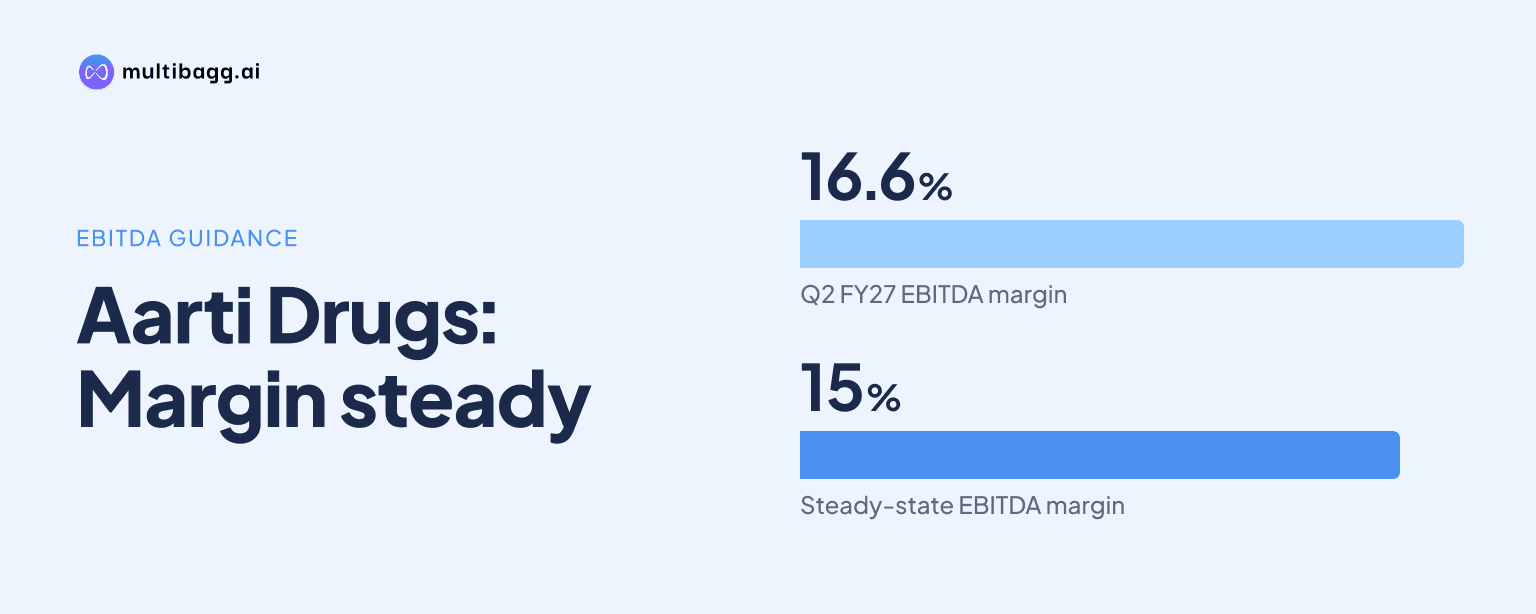
- Aarti Drugs reported a 16.6% consolidated EBITDA margin in Q2 FY27, up 370 basis points year on year.
- Aarti Drugs said a 15% consolidated EBITDA margin should be sustainable on a steady-state basis.
- Aarti Drugs’ formulations revenue rose 58% to Rs 130 crore in Q2 FY27, with exports contributing 74%.
- Aarti Drugs said formulations EBITDA margin was roughly 28% in Q2 FY27 and disclosed more than four months of pending export orders.
powered by IRIS
Aarti Drugs Limited said a 15% consolidated earnings before interest, tax, depreciation and amortisation, or EBITDA, margin should be sustainable after Q2 FY27 reached 16.6%, its highest level in nearly six years. The company based that view on standalone margins above 14% and a larger formulations contribution, despite describing the quarter’s roughly 28% formulations margin as exceptional.
Know Aarti Drugs inside out
Results, valuation, peers and who's buying, in one view.
Can Aarti Drugs sustain a 15% EBITDA margin?
Yes, Aarti Drugs said it believes a 15% consolidated EBITDA margin should be sustainable. The assessment followed a 16.6% EBITDA margin in Q2 FY27, 370 basis points above Q2 FY26, while H1 FY27 EBITDA margin was 15.3%, up 250 basis points year on year.
Management described 15% as a conservative steady-state view rather than an expectation that every quarter will match Q2 FY27. It said the standalone business had delivered EBITDA margins above 14% in each of the previous two quarters and could comprise roughly 84% to 85% of consolidated revenue going forward. Formulations could account for about 15% to 16% of revenue under this mix.
Aarti Drugs illustrated the margin view using a 14% standalone margin and a 20% formulations margin. Management said that combination would result in a consolidated EBITDA margin slightly above 15%, even if formulations profitability fell from the roughly 28% achieved in Q2 FY27. This was management’s scenario analysis, not formal margin guidance.
Why did Aarti Drugs reach 16.6% in Q2 FY27?
Aarti Drugs reached a 16.6% EBITDA margin because profitable formulations exports combined with higher standalone realisations and lower manufacturing costs. Consolidated EBITDA rose Rs 54 crore to Rs 138 crore in Q2 FY27 from Rs 84 crore a year earlier, exceeding the Rs 176 crore increase in consolidated revenue to Rs 829 crore.
The formulations business recorded roughly 28% EBITDA margin in Q2 FY27, which management called exceptional and linked to good export orders. Formulations revenue rose 58% to Rs 130 crore from Rs 82 crore in Q2 FY26, while exports rose 73% year on year and represented 74% of quarterly formulations revenue.
Management said newer-market commercialisation and products under registration in regulated and emerging markets supported formulations revenue and profitability. It disclosed pending export orders for more than four months, giving visibility for more than one quarter. It said formulations margins could remain in the early 20% range if orders continue, while using 20% in its longer-term consolidated-margin illustration.
The other two operating segments also grew in Q2 FY27. Active pharmaceutical ingredients, or APIs, Aarti Drugs’ largest segment, increased 17% to Rs 605 crore from Rs 516 crore. Specialty chemicals revenue increased 92% to Rs 72 crore from Rs 37 crore, adding to the quarter’s revenue growth alongside formulations.
Got a follow-up? Ask IRIS
How did pricing and operations affect Aarti Drugs’ margins?
Aarti Drugs said standalone price growth was roughly 17% to 18% year on year in Q2 FY27, while volume growth for APIs and specialty chemicals together was around 5%. At the consolidated level, management cited a 16% improvement in realisations and 5% volume growth, which accompanied the 63% rise in EBITDA.
Management said developments in West Asia kept API prices firm and increased the importance customers placed on reliable supply. It said pricing was stable at the time of the call: gas-linked products had initially been affected after the conflict began in March, while crude-linked products were also influencing prices later in the period.
Higher selling prices do not necessarily raise gross-contribution margin, according to Aarti Drugs. Management said its API and specialty chemicals business commonly operates on a cost-plus formula, so gross contribution in rupees can rise while margin declines because revenue has a larger base. Manufacturing overheads as a share of sales fall at the same time, which management said supports EBITDA margin.
For standalone operations, management estimated about 50 basis points of margin expansion came from higher gross contribution, with the rest coming from lower manufacturing costs. It cited energy-optimisation projects and said solar projects would begin contributing in the December quarter. The Saykha methylamines plant operated at around 72% utilisation in Q2 FY27, while captive consumption for the antidiabetic portfolio reached around 85%.
What could support or limit Aarti Drugs’ margin outlook?
Aarti Drugs said backward integration, product mix and energy efficiency could support margins if selling prices normalise. Its Saykha methylamines facility was commissioned in September of the previous year, and management said it was making a large share of key metformin intermediates that had previously been bought externally within roughly one year.
The company is raising Sarigam metformin capacity to 1,700 tonnes per month from 1,400 tonnes per month, with commercialisation planned in early FY28. It also plans a dedicated 500-tonnes-per-month United States Food and Drug Administration, or USFDA, compliant block by the end of FY28. Management did not quantify the future margin contribution of either project.
Pricing and demand remain the main variables in the volume outlook. Management said customers curtailed inventory purchases after sudden price increases, contributing to standalone volume growth of 3% in the first quarter and 5% in the second quarter of FY27. Although the original company-level target was roughly 10% volume growth, management said it was assuming a 5% to 10% range.
Order duration can also affect how quickly input-cost changes are passed through. Aarti Drugs said export orders typically provide about two-and-a-half to three months of visibility, compared with less than one month domestically. It said raw-material inventory was about 40 to 50 days and that it did not intend to build inventory at high prices, because a reversal could create losses.
Conclusion
Aarti Drugs’ Q2 FY27 EBITDA margin of 16.6% reflected 17% to 18% standalone price growth, manufacturing-cost reductions and unusually profitable formulations exports. Management’s 15% sustainable-margin view relies on its stated steady-state mix of roughly 84% to 85% standalone revenue at 14% margin and 15% to 16% formulations revenue at 20% margin.
The next indicators are whether formulations export orders extend beyond the disclosed four-month backlog and whether standalone volume growth remains within management’s 5% to 10% assumption. Management also expects solar projects to contribute in the December quarter, Sarigam metformin expansion to begin commercial production in early FY28, and the new USFDA-compliant Sarigam block to be completed by the end of FY28.