










Pinnacle Life Science says Rs 130 crore run rate can hold
Key highlights
- Pinnacle Life Science reported Rs 130 crore of formulation revenue in Q2 FY27, up 58% from Rs 83 crore in Q2 FY26.
- Exports contributed 74% of Pinnacle Life Science formulation revenue in Q2 FY27.
- Management cited pending formulation export orders covering almost four months.
- Pinnacle Life Science reported Rs 212 crore of H1 FY27 revenue, up 30% from Rs 163 crore in H1 FY26.
powered by IRIS
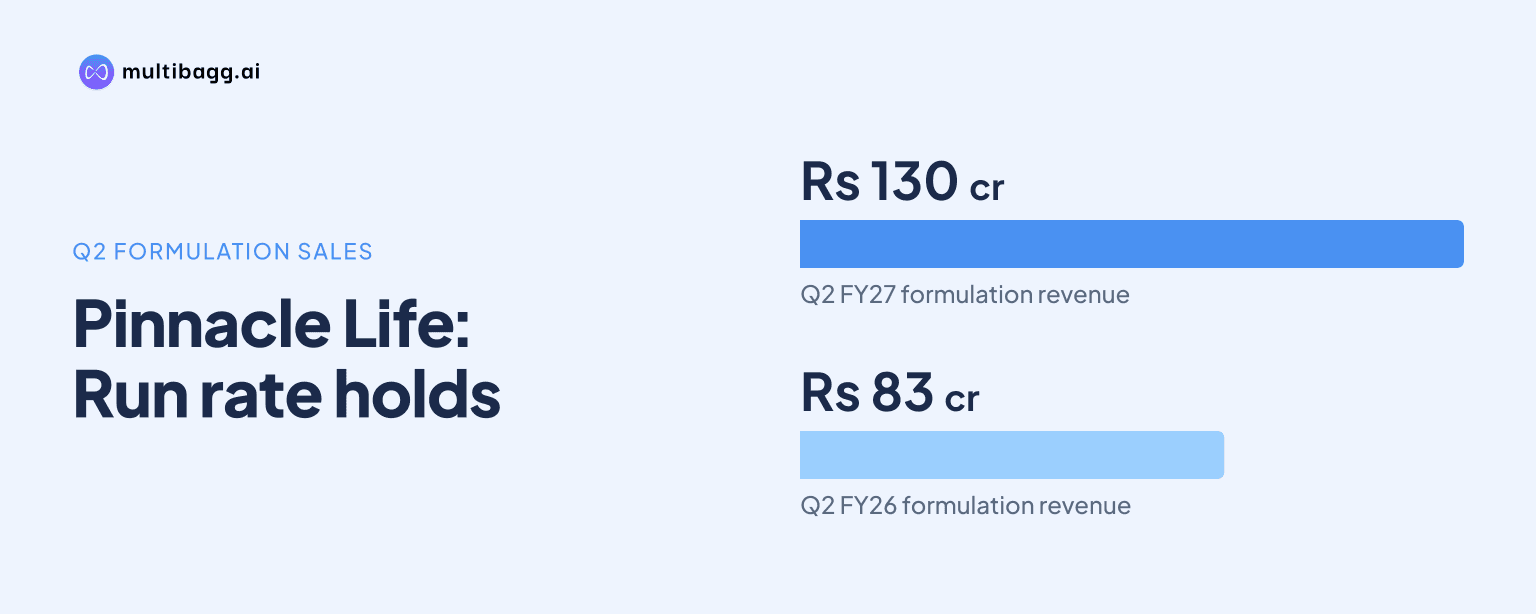
Pinnacle Life Science Pvt. Ltd. said its Rs 130 crore formulation revenue in Q2 FY27 can be sustained, supported by a four-month export order book, product launches in newer markets and registrations across regulated and emerging markets. Revenue rose 58% year on year, while exports contributed 74% of Q2 formulation sales.
Know Aarti Drugs inside out
Results, valuation, peers and who's buying, in one view.
How fast did Pinnacle Life Science formulation revenue grow?
Pinnacle Life Science reported formulation revenue of Rs 130 crore in Q2 FY27, versus Rs 83 crore in Q2 FY26, an increase of 58% year on year. The segment outgrew Aarti Drugs Limited's API business, where revenue increased 17% to Rs 605 crore, although specialty chemicals grew 92% to Rs 72 crore.
The quarterly result was substantially ahead of the first-half growth rate. Pinnacle Life Science generated Rs 212 crore in H1 FY27, compared with Rs 163 crore in H1 FY26, representing 30% growth. Q2 therefore contributed Rs 130 crore of the Rs 212 crore H1 total, implying Rs 82 crore in Q1 FY27.
Exports were the principal contributor to the Q2 increase. Management said exports accounted for 74% of formulation revenue in Q2 FY27, compared with 63% of formulation sales over H1 FY27. Since the H1 measure includes Q2, the higher quarterly share indicates that exports were more important in the June-to-September period than in Q1.
What drove Pinnacle Life Science's export-led Q2 growth?
Management said Q2 FY27 growth came from export expansion rather than a single disclosed order. Vishwa Savla, managing director of Pinnacle Life Science, said the business had spent the past few years opening newer markets and registering products in regulated and emerging markets, leading to product commercialisation in new territories.
The stated mechanism is a wider product and market base moving from registration into commercial supply. Pinnacle Life Science did not disclose country-level revenue, individual products, customers or order values, but management said the newer-market commercialisation contributed to Q2 revenue and profitability.
The US oncology business made only a small contribution in Q2 FY27, management said. One US oncology product had launched only recently, and management expected revenue from that product to increase over the following three to six months; another abbreviated new drug application, or ANDA, was due for approval in the next few months.
That timing means the Rs 130 crore quarter was not attributed primarily to an established US oncology business. Management said the US operation had initiated revenue generation, but needed to ramp up from one product in the market and a second ANDA awaiting approval.
Got a follow-up? Ask IRIS
Can Pinnacle Life Science sustain its Rs 130 crore quarterly revenue level?
Management said Pinnacle Life Science can sustain a similar revenue level after Q2 FY27, citing pending export orders covering almost four months. When asked whether the Q2 revenue level could continue for the rest of FY27, Vishwa Savla agreed and linked that view to multiple new markets and products.
The four-month order book provides visibility beyond one quarter, but management did not disclose a full-year backlog. Aarti Drugs management said formulation earnings before interest, tax, depreciation and amortisation, or EBITDA, margin was roughly 28% in Q2 FY27 because of favourable export orders.
Management said the Q2 formulation EBITDA margin was exceptional and that margins could remain in the early-20% range if export orders continued. In a longer-term consolidated-margin illustration, it used a 20% formulation EBITDA margin assumption rather than presenting it as segment guidance.
The difference between the roughly 28% Q2 margin and the 20% illustrative assumption reflects the importance of export order continuity and product mix. Management said formulations could represent about 15% to 16% of consolidated revenue going forward, while the standalone business could account for roughly 84% to 85%.
What capacity and oncology plans support Pinnacle Life Science's outlook?
Pinnacle Life Science is undertaking a brownfield expansion at Baddi, Himachal Pradesh, that management said should nearly double oral solid dosage capacity by the middle of the following year. The project uses an adjacent plot and is intended to support the formulation business's longer-term revenue expansion.
Management said the expansion, alongside higher utilisation of the oncology facility, could help Pinnacle Life Science reach its Rs 1,000 crore formulation-revenue aspiration earlier than previously published. At the time of the call, only one or two oncology products had been commercialised at the facility.
The oncology portfolio comprises about 25 to 30 molecules at different stages of development and sizing, according to management. Pinnacle Life Science plans to file another four to five oncology products over the rolling 12 months, while some molecules use active pharmaceutical ingredients manufactured within group companies.
Management estimated oncology could contribute a late-30% to early-40% share of formulation revenue by FY30. It said the portfolio includes oral-solid nib and cyclic families, with direct filings in some countries and a business-to-business model involving leading local players in others.
Conclusion
Pinnacle Life Science's Rs 130 crore Q2 FY27 formulation revenue was driven by exports, which represented 74% of sales, and marked 58% growth from Rs 83 crore a year earlier. Management's argument that the run rate can continue rests on new-market launches, registered products entering commercial supply and export orders extending almost four months, rather than on a disclosed one-off transaction.
The next indicators are whether export orders are replenished after the current four-month visibility, whether the roughly 28% Q2 formulation EBITDA margin remains near management's early-20% expectation, and whether US oncology revenue builds over the next three to six months. Management also expects the Baddi project to nearly double oral solid dosage capacity by the middle of the following year and plans four to five additional oncology filings over the rolling 12 months.