










Acetech reports EPF payment delays of up to 219 days in FY25
Key highlights
- Acetech reported a 219-day EPF payment delay for April 2024, paid on December 20, 2024.
- Acetech’s longest FY2025-26 EPF delay was 216 days for April 2025.
- Acetech reported a maximum ESIC delay of 112 days for June 2025.
- Acetech said no show-cause notice had been issued to date over delayed statutory deposits.
powered by IRIS
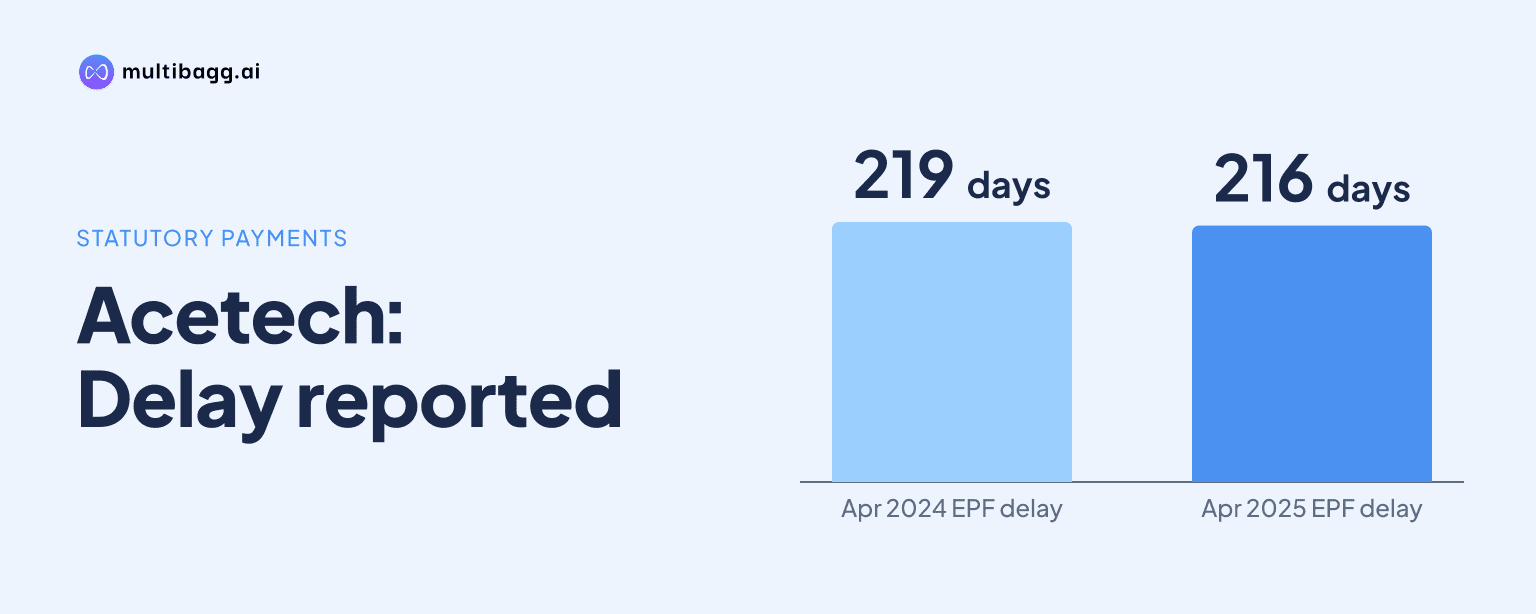
Acetech E- Commerce Limited reported that its April 2024 Employees Provident Fund payment was made 219 days late in FY2024-25, the longest statutory-remittance delay disclosed in its filing. Acetech also recorded Employees’ State Insurance Corporation delays of up to 112 days in FY2025-26 and attributed the instances to payroll reconciliation lapses and banking-system downtime.
Know Acetech E-Commerce inside out
Results, valuation, peers and who's buying, in one view.
What statutory payment delays did Acetech disclose?
Acetech disclosed repeated late payments of Employees Provident Fund, or EPF, and Employees’ State Insurance Corporation, or ESIC, contributions across FY2024-25 and FY2025-26. Its tables list 21 EPF monthly entries and 18 ESIC entries, identifying the payment month, stated due date, payment date and delay in days.
The longest disclosed delay was 219 days for the April 2024 EPF contribution, which was due on May 15, 2024 and paid on December 20, 2024. Seven further EPF payments from May through November 2024 were paid on December 20, with delays ranging from 188 days for May 2024 to five days for November 2024. The December 2024 EPF payment was made on February 14, 2025, 30 days after its stated January 15, 2025 due date.
ESIC delays were shorter in FY2024-25 but remained recurring. The September 2024 ESIC contribution was paid on December 19, 2024, 65 days after the stated October 15, 2024 due date. The October, November and December 2024 payments were delayed by 34, four and 14 days, while the February and March 2025 payments were made on April 30, 2025, with delays of 46 and 15 days.
How did Acetech’s FY2025-26 record compare with FY2024-25?
Acetech’s maximum EPF delay narrowed by three days, from 219 days in FY2024-25 to 216 days in FY2025-26, but substantial early-year delays continued. The April 2025 EPF contribution, due on May 15, 2025, was paid on December 17, 2025, while the May through August 2025 entries were paid on that date after delays of 185, 155, 124 and 93 days.
The later FY2025-26 EPF entries show shorter or zero reported delays. September and October 2025 were paid on December 12, 2025, 58 and 27 days late respectively. November 2025 was shown with zero days of delay, December 2025 was six days late and paid on January 21, 2026, and the January through March 2026 rows each show zero delay.
The ESIC peak delay increased to 112 days in FY2025-26 from 65 days in FY2024-25. Acetech reported that the June 2025 ESIC payment was due on July 15, 2025 and paid on November 4, 2025. July, August and September 2025 ESIC payments were also paid on November 4, with reported delays of 81, 50 and 20 days.
The FY2025-26 ESIC record also included a 40-day delay for April 2025 and a nine-day delay for May 2025, both paid on June 24, 2025. October 2025 was 27 days late, November 2025 showed zero delay and December 2025 was six days late. The January through March 2026 ESIC rows each show zero delay, although the filing presents the due dates in those rows as February 15, March 15 and April 15, 2025.
Why were Acetech’s EPF and ESIC payments late?
Acetech said the delays were primarily caused by internal administrative lapses in reconciling employee payroll data and delays in bank clearance due to server downtime. The filing does not quantify the contributions involved, the duration of the cited downtime, or the respective effect of each cause on the 219-day April 2024 EPF delay.
The disclosed dates show grouped settlements after missed monthly deadlines. Eight EPF entries covering April through November 2024 were paid on December 20, 2024. In FY2025-26, five EPF entries from April through August 2025 were paid on December 17, 2025, while four ESIC entries from June through September 2025 were paid on November 4, 2025.
That grouping differs from the later rows, where Acetech reported zero delays for EPF in November 2025 and January through March 2026, and for ESIC in November 2025 and January through March 2026. The filing does not say whether those zero-delay entries resulted from remedial measures, though it identifies monthly finance checks and the appointment of a chief financial officer as actions taken.
Got a follow-up? Ask IRIS
What compliance action has Acetech disclosed?
Acetech said no show-cause notice had been issued against it to date in relation to delayed statutory deposits. It nevertheless stated that action could be taken against Acetech and its directors if relevant authorities take cognisance of the delays in filings, which could affect business and financial performance.
Acetech also said future failure to submit required disclosures to regulators could result in penalties and affect operating results. This is a risk disclosure rather than evidence of an imposed penalty: the filing identifies no fine, interest amount, demand or proceeding arising specifically from the EPF and ESIC payment record for FY2024-25 or FY2025-26.
The statutory-payment disclosure appears alongside Acetech’s wider litigation summary, which lists four criminal proceedings and two tax proceedings against the company, with an aggregate amount involved of Rs 5.80 crore. The filing does not connect those proceedings to the EPF or ESIC delays, so they cannot be treated as enforcement arising from the remittance record.
What has Acetech said it will do to prevent further delays?
Acetech said it has introduced monthly internal compliance checks under the finance department’s supervision and appointed a professional, highly experienced chief financial officer to support timely filing and remittance. The filing does not disclose the appointment date, the CFO’s identity, a compliance target or a timetable for evaluating the process.
The FY2025-26 table provides the latest disclosed evidence relevant to those measures. It reports zero delay for EPF in November 2025 and from January through March 2026, and zero delay for ESIC in November 2025 and from January through March 2026. December 2025 remained six days late for both EPF and ESIC.
Acetech also cautioned that deficiencies in internal controls may arise in the future and that it may not be able to implement or maintain adequate corrective measures. That internal-controls disclosure is relevant because Acetech identified administrative payroll reconciliation and banking-system issues, rather than a regulatory change, as the reasons for payment delays of up to 219 days.
Conclusion
Acetech’s filing records recurring EPF and ESIC remittance delays over FY2024-25 and FY2025-26, with the largest case being the 219-day delay on the April 2024 EPF payment. The maximum EPF delay reduced modestly to 216 days in FY2025-26, while the maximum ESIC delay increased to 112 days from 65 days, indicating that late remittances continued even as later entries showed zero reported delay.
The next point to watch is whether Acetech’s monthly finance-led compliance checks and chief financial officer appointment prevent further late remittances after the December 2025 six-day delays. The filing leaves unresolved whether authorities will take cognisance of historical delays, while warning that future failures to make required disclosures could result in regulatory penalties.