










Acetech discloses past filing lapses and new compliance controls
Key highlights
- Acetech disclosed four categories of historical corporate-record lapses involving March 31, 2024 and September 30, 2024 documentation.
- Acetech said no regulatory notices had been issued for the identified matters as of the DLOF date.
- A September 12, 2025 UDIN-backed certificate covered free reserves before Acetech’s 90,00,000-share bonus allotment.
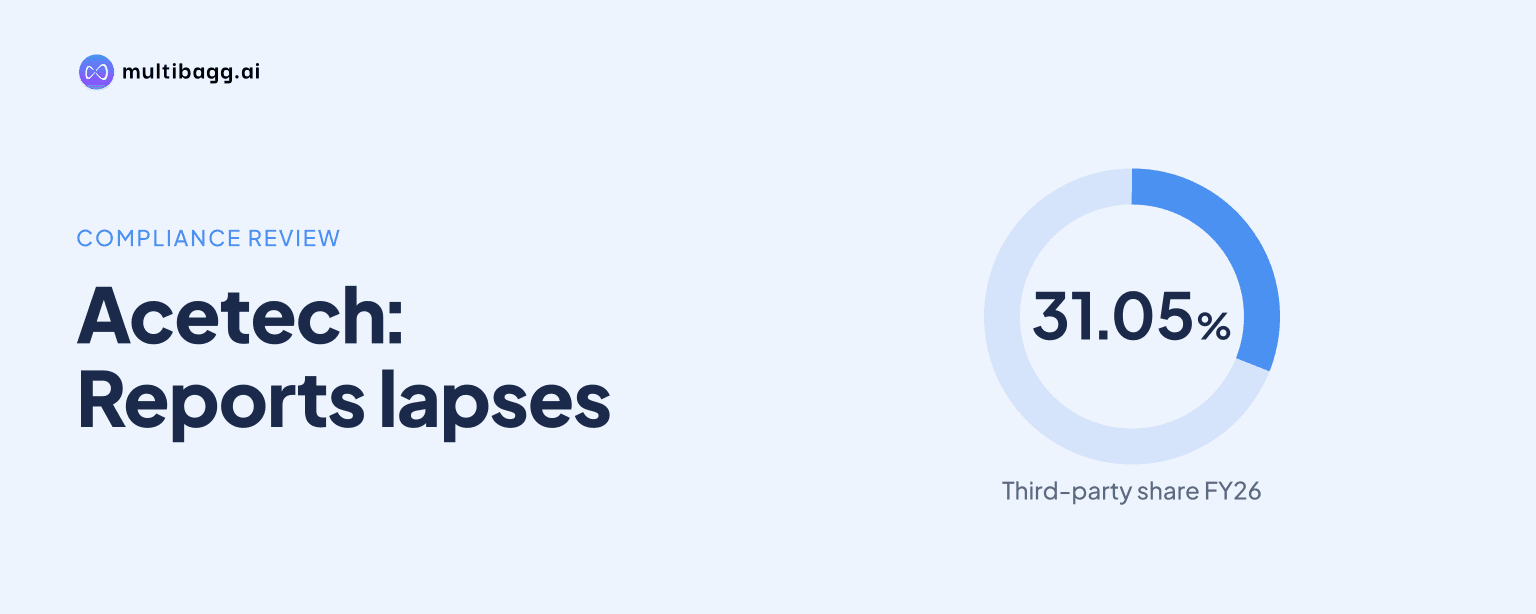
- Third-party platform sales were Rs 25.70 crore, or 31.05% of Acetech’s FY 2025-26 sales.
powered by IRIS
Acetech disclosed four historical corporate-record lapses involving its March 31, 2024 filings, a rights-issue allotment record and a September 30, 2024 auditor identification requirement. Acetech said it regularised the rights-issue records, obtained a September 12, 2025 certificate for a 90,00,000-share bonus allotment and had received no notices as of the DLOF date.
Know Acetech E-Commerce inside out
Results, valuation, peers and who's buying, in one view.
What corporate-record lapses did Acetech disclose?
Acetech disclosed omissions or deficiencies in four areas: its Form MGT-7 annual return, the Form AOC-2 annexure to its directors’ report, Form PAS-3 rights-issue documentation and the Unique Document Identification Number, or UDIN, linked to September 30, 2024 financial statements. The disclosure concerns past Registrar of Companies, or ROC, filings and secretarial records, rather than a stated penalty or enforcement action.
For the financial year ended March 31, 2024, Acetech did not disclose its subsidiary, Conceptive Brains Private Limited, in Form MGT-7 filed with the ROC. Acetech said the subsidiary’s details were included in the notes to its financial statements, but the Version 3 filing system does not currently permit refiling MGT-7 to correct the annual-return omission. The company described this as a procedural lapse and said it did not anticipate a monetary penalty under Section 92 of the Companies Act, 2013.
Acetech also said details of related-party transactions in Form AOC-2 were not attached as an annexure to the directors’ report for the year ended March 31, 2024. The related-party details were stated in the financial statements, according to the company, but the annexure cannot now be refiled through Form AOC-4. Acetech said that any ROC action on this matter could make it liable for a penalty under Section 134 of the Companies Act, 2013.
What was missing from Acetech’s rights-issue and bonus records?
Acetech said the board resolution attached to Form PAS-3 for a rights-issue allotment did not state the number of shares allotted and lacked a signed list of allottees. Form PAS-3 is the filing used to report security allotments. The company said this discrepancy was identified in its secretarial records and that it has since prepared the required documentation.
Acetech said it regularised the PAS-3 records by signing a board resolution with the correct allottee list and preparing a separate list in the format specified by the form’s instruction kit. The resolution and list were subsequently placed before and approved by its board. However, Acetech said the company and its officers could still be liable to penalties under Sections 42(9) and 450, based on previous ROC adjudication orders.
The fourth issue concerned certification of sufficient free reserves before the bonus allotment of 90,00,000 equity shares. Acetech said its statutory auditor had not generated a UDIN for the audited financial statements for the period ended September 30, 2024 when certifying the reserves. The auditor issued a valid certificate with a UDIN on September 12, 2025, certifying that Acetech had sufficient free reserves before the bonus allotment.
Acetech characterised the missing UDIN as a procedural non-compliance. It said the auditor has agreed to generate a UDIN for the September 30, 2024 audited financial results if the Institute of Chartered Accountants of India announces a UDIN amnesty scheme. Acetech also said none of the four identified matters requires a form refiling or a compounding application with the ROC.
Could Acetech face regulatory penalties for these matters?
Acetech said regulatory penalties remain possible despite its corrective actions. It specifically identified potential liability under Section 134 if the ROC acts over the omitted AOC-2 annexure, and possible exposure for the company and officers under Sections 42(9) and 450 in relation to PAS-3. The filing does not quantify any possible fine or disclose an imposed payment for these matters.
As of the DLOF date, Acetech said no notices had been issued in relation to the identified non-compliances. It nevertheless stated that notices may be issued in future and that fines or penalties could affect administrative compliance and financial results. The disclosure therefore distinguishes between past procedural lapses and an unresolved possibility of future regulatory action.
The remedial status differs across the four issues. Acetech said its PAS-3 records have been regularised through an approved resolution and allottee lists, while MGT-7 and AOC-2 cannot be refiled through the routes it identified. The September 12, 2025 certificate addressed the bonus-allotment reserve certification, but a UDIN for the September 30, 2024 financial results remains conditional on a future amnesty scheme.
Got a follow-up? Ask IRIS
What compliance controls has Acetech introduced?
Acetech said it has appointed an in-house company secretary for secretarial compliance after identifying the historical filing deficiencies. The company did not disclose an appointment date or the officer’s name, but said the role forms part of its response to annual, routine and event-based compliance requirements such as MGT-7, AOC-2 and PAS-3.
Acetech also said it has implemented a detailed compliance calendar intended to prevent routine deadlines from being missed. For event-based obligations, it has introduced standard operating procedures, or SOPs, and checklists designed to prevent clerical errors. Those controls directly address deficiencies such as the missing share count and unsigned allottee documentation in the PAS-3 record.
In addition, Acetech said it has retained a team of practising company secretaries. According to the company, the external team is intended to support timely deadlines, accurate filing information and systemic checks and balances. The disclosure provides no later testing result, ROC confirmation or post-control compliance record demonstrating the effectiveness of these arrangements.
How does this compliance disclosure compare with Acetech’s other operating risks?
Acetech’s filing places the corporate-record issues alongside disclosures about dependence on external sales platforms and suppliers. Sales through third-party aggregator platforms were Rs 25.70 crore in the financial year ended March 31, 2026, or 31.05% of total sales, compared with Rs 26.03 crore, or 37.03%, in the year ended March 31, 2025. The rupee value fell by Rs 32.66 lakh and the sales share declined by 5.98 percentage points.
Supplier concentration also declined between the two reported financial years. Acetech’s top 10 suppliers accounted for Rs 34.72 crore, or 50.49% of purchases, in the year ended March 31, 2026, compared with Rs 32.37 crore, or 75.56%, in the previous year. Although the share fell, Acetech said it has not entered into long-term supply arrangements with these vendors.
Acetech also reported workforce attrition of 81.55% for the financial year ended March 31, 2026, compared with 168% for the year ended March 31, 2025. It attributed the earlier higher rate partly to temporary hiring for seasonal demand and the absence of formal screening and retention frameworks in earlier periods. The company said it has introduced Employees’ State Insurance Corporation and Provident Fund coverage and strengthened recruitment and screening processes.
Conclusion
Acetech has identified past gaps in annual-return reporting, directors’ report attachments, rights-issue records and auditor documentation. Its disclosed response includes regularising PAS-3 records, obtaining the September 12, 2025 UDIN-backed certificate for the 90,00,000-share bonus allotment, appointing an in-house company secretary and retaining practising company secretaries. However, the company says regulatory notices, fines or penalties remain possible despite no notices having been issued as of the DLOF date.
The next matters to watch are whether the ROC issues any notice concerning the March 31, 2024 MGT-7, AOC-2 or PAS-3 matters, and whether the Institute of Chartered Accountants of India announces the UDIN amnesty scheme referred to by Acetech’s auditor. Future filings can also show whether the compliance calendar, SOPs, checklists and external secretarial review are followed by timely and accurate corporate reporting.