










Acetech operating cash flow swung to ₹26.31 crore outflow
Key highlights
- Acetech reported a ₹26.31 crore operating cash outflow in FY26, versus a ₹19.89 lakh inflow in FY25.
- Acetech generated ₹45.97 crore from financing activities in FY26 and increased cash and cash equivalents by ₹19.31 crore.
- Acetech attributed FY26 operating cash use to inventory, procurement, trade receivables and other operating requirements.
- Acetech’s top 10 customers accounted for 75.24% of FY26 revenue, down from 92.65% in FY25.
powered by IRIS
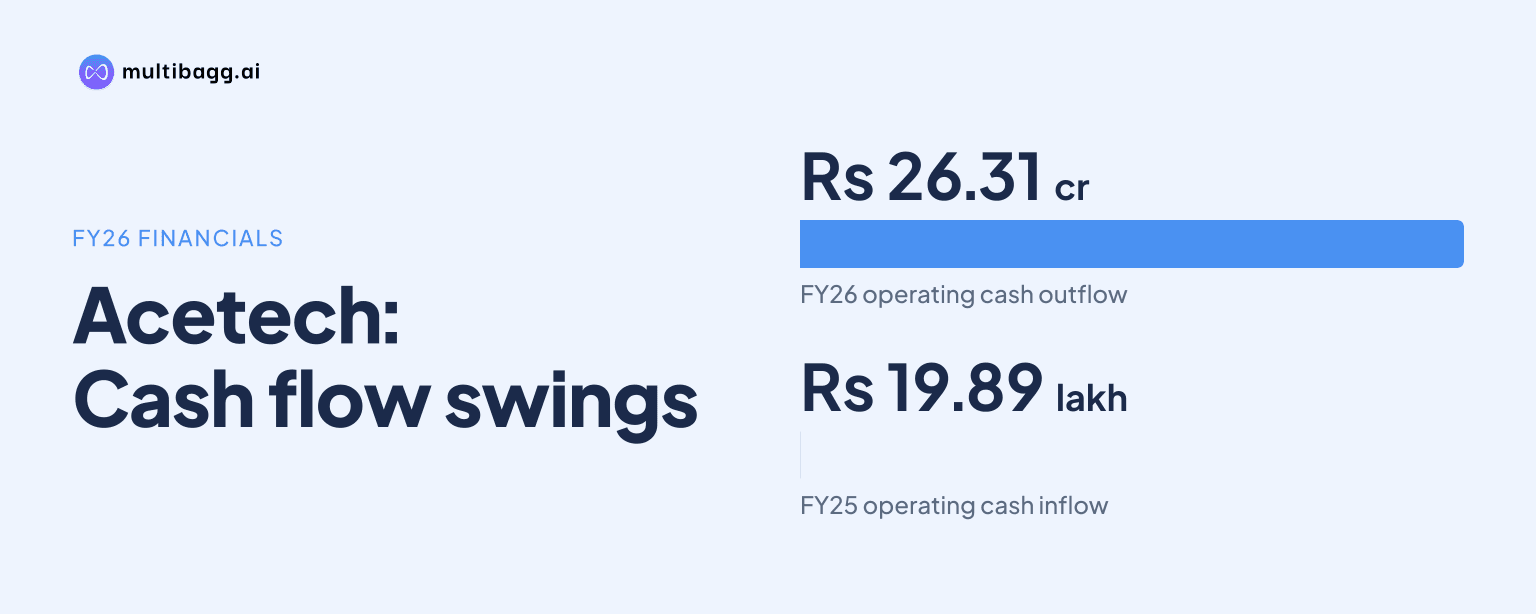
Acetech recorded a ₹26.31 crore net cash outflow from operating activities in FY26, reversing a ₹19.89 lakh inflow in FY25, as more funds were deployed in inventory, procurement, trade receivables and other operating requirements. Net financing inflows of ₹45.97 crore supported liquidity and helped produce a ₹19.31 crore increase in cash.
Know Acetech E-Commerce inside out
Results, valuation, peers and who's buying, in one view.
Why did Acetech’s operating cash flow turn negative in FY26?
Acetech’s operating cash flow turned negative because its FY26 business expansion increased working-capital funding needs before related sales proceeds were collected. It reported ₹26.31 crore of net cash used in operating activities for the year ended March 31, 2026, compared with ₹19.89 lakh of net cash generated in the year ended March 31, 2025.
The year-on-year movement was a reversal from an operating inflow to an outflow of ₹26.31 crore. Acetech attributes the FY26 use of cash to funds deployed for inventory, procurement, trade receivables and other operating needs, rather than identifying a specific exceptional expense in the cash-flow disclosure.
Acetech’s model requires it to spend on procurement and inventory before it receives and collects sales proceeds. The filing says that longer inventory holding periods, slower collection of receivables, lower supplier credit or a further increase in operating scale could increase working-capital requirements beyond the FY26 outflow.
How did Acetech fund its FY26 cash requirement?
Acetech funded its FY26 cash requirement mainly through ₹45.97 crore of net cash generated from financing activities. That financing inflow exceeded the ₹26.31 crore operating outflow and ₹35.35 lakh used in investing activities, resulting in a ₹19.31 crore net increase in cash and cash equivalents.
This was a marked change from FY25, when Acetech used ₹2.10 crore in financing activities and cash and cash equivalents decreased by ₹1.72 crore. The filing attributes the FY25 financing outflow principally to a ₹2.13 crore decrease in long-term borrowings and ₹2.61 lakh of interest paid.
Acetech says the FY26 financing inflow provided liquidity for increased operating and working-capital requirements. The filing also says Acetech subsequently raised capital through an initial public offering, although the supplied disclosure does not state the amount of those proceeds or identify how much was applied to working capital.
What does Acetech’s FY26 cash flow show about working capital?
Acetech’s FY26 cash flow shows that expanding its trading and distribution operations consumed more cash than the business generated from operations during the year. The disclosed ₹26.31 crore operating outflow reflects the timing gap between spending on stock and procurement and receiving payment for sales.
Procurement is a particular consideration because products sourced from China through domestic dealers represented about 28.61% of Acetech’s total procurement in FY26, up from 25% in FY25. The filing says disruption in availability, trade policies, tariffs, logistics, currency movements or regulatory requirements could affect the ability of local vendors to supply products on time and at competitive prices.
Acetech also identifies rapid commercialisation of trending products as a working-capital risk because demand can change quickly and product life cycles can be short. Overstocking could leave funds tied up in unsold inventory, while underestimating demand could cause stock-outs; the filing presents these as potential risks and does not state that either occurred in FY26.
Inventory management also depends on Acetech’s leased warehouse network. Its Bhiwandi registered-office-and-warehouse agreement runs from January 1, 2025 to December 31, 2027, its Bangalore warehouse agreement runs to February 2, 2027, and its Delhi warehouse agreement ran to August 1, 2026.
Got a follow-up? Ask IRIS
Which sales and supplier factors could affect Acetech’s cash conversion?
Acetech’s future cash conversion will depend on inventory turns, trade-receivable collections, supplier credit and the pace of expansion. The filing provides no inventory days, receivable days or payable days, so it does not quantify which working-capital component accounted for the largest share of the ₹26.31 crore FY26 operating outflow.
Customer concentration declined as sales expanded in FY26. Acetech’s top 10 customers contributed ₹62.29 crore, or 75.24% of revenue, in FY26, compared with ₹65.11 crore, or 92.65%, in FY25, while total sales rose to ₹82.76 crore from ₹70.28 crore.
Third-party aggregator platforms generated ₹25.70 crore, or 31.05%, of Acetech’s FY26 sales, compared with ₹26.03 crore, or 37.03%, in FY25. Platform sales fell in rupee terms even as total sales increased, and Acetech says changes in algorithms, commissions, return policies or seller eligibility could affect product visibility, sales volumes and margins.
Supplier concentration also reduced during FY26. Acetech’s top 10 suppliers represented ₹34.72 crore, or 50.49%, of purchases, versus ₹32.37 crore, or 75.56%, in FY25, but the company says it has no long-term supply arrangements with these vendors.
What liquidity risks has Acetech disclosed?
Acetech says sustained negative cash flow could affect its ability to operate its business and implement growth plans. It does not assure investors that future net cash flows will be positive, and says further negative cash flows could adversely affect consolidated results, liquidity, financial condition and growth prospects.
Acetech says the proceeds of its initial public offering and internally generated cash may not meet all future working-capital and growth requirements. If operating cash flow remains negative, it may need additional equity or debt financing, which it says may not be available on favourable terms and could dilute existing shareholders if raised through equity.
The disclosed financing dependence in FY26 was substantial relative to the operating cash deficit: ₹45.97 crore of financing inflows supported a ₹26.31 crore operating outflow. Whether the company can reduce that dependence will be linked to its handling of stock levels, supplier terms and collection of sales proceeds.
Conclusion
Acetech’s FY26 cash-flow position changed sharply from the prior year, moving from a ₹19.89 lakh operating inflow in FY25 to a ₹26.31 crore outflow in FY26. Financing inflows of ₹45.97 crore offset the operating and investing cash uses and left cash and cash equivalents ₹19.31 crore higher at the end of FY26.
The next issue to watch is whether Acetech can manage inventory, receivables and supplier credit as its operations expand, because the filing identifies all three as potential drivers of further working-capital pressure. Its disclosed warehouse agreements also create scheduled milestones, including the Bangalore warehouse agreement ending on February 2, 2027, while Acetech has not assured that operating cash flow will become positive.