










Acme India maps LHB coach refurbishment eligibility through FY38
Key highlights
- Acme India maps 544 LHB coaches built in FY14 to refurbishment eligibility in FY26.
- The largest listed LHB cohort is 7,134 coaches produced in FY25 and mapped to FY37.
- Acme India estimates the annual refurbishment addressable market at Rs 4,080 crore.
- Refurbishment, Upgradation and Conversion generated Rs 8.03 crore, or 11%, of H1 FY27 sales.
powered by IRIS
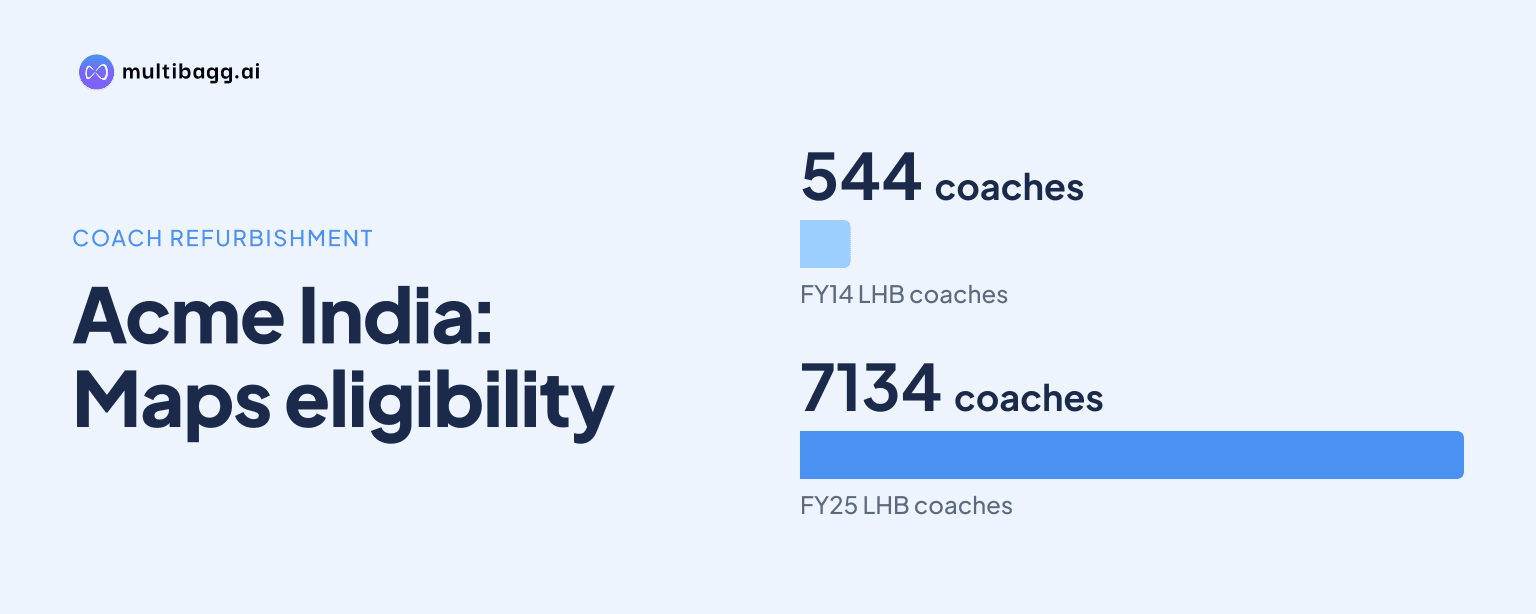
ACME INDIA INDUSTRIES LIMITED maps Indian Railways’ LHB coach production cohorts to refurbishment eligibility from FY26 through FY38, beginning with 544 coaches produced in FY14 and including 7,134 coaches produced in FY25. Acme India says coaches enter a major refurbishment and modernisation cycle after around 12 years of service.
Know Acme India Industries inside out
Results, valuation, peers and who's buying, in one view.
When does Acme India expect LHB coach refurbishment eligibility to begin?
Acme India expects LHB coaches manufactured in FY14 to become eligible for refurbishment in FY26, with subsequent production cohorts becoming eligible annually through FY38. Its schedule links 544 coaches produced in FY14 to FY26, 555 coaches produced in FY15 to FY27, and 1,041 coaches produced in FY16 to FY28. FY26 is therefore the stated starting point for the eligibility cycle.
Acme India describes the timing as a major refurbishment and modernisation cycle after around 12 years of service. Eligibility does not itself represent an order award, contract value or completed work. The mapping nevertheless places larger production cohorts into the potential refurbishment pool from FY29 onward, when the scheduled production cohort rises to 1,547 coaches.
How did Indian Railways’ LHB coach production change over time?
Indian Railways’ LHB coach production in Acme India’s schedule rose from 544 coaches in FY14 to 7,134 coaches in FY25, before declining to 6,677 coaches in FY26. The FY25 cohort is the largest in the table and is mapped to refurbishment eligibility in FY37. This means the scheduled pool is materially larger in the 2030s than in the first three eligibility years, when the linked cohorts range from 544 to 1,041 coaches.
The production increase was not uninterrupted. The schedule shows production rising from 2,160 coaches in FY18 to 4,429 in FY19 and 6,277 in FY20, then falling to 4,323 in FY21. It recovered to 6,291 in FY22, fell to 4,175 in FY23, and increased to 6,541 in FY24. Under Acme India’s mapping, those movements produce varying annual eligibility volumes from FY31 to FY36 rather than a straight-line increase.
What work could the LHB refurbishment cycle include?
Acme India says refurbishment requirements can include interior furnishing, technological modernisation of toilets, panelling, flooring, ceilings, berths and broader coach upgrades. These listed activities are the mechanisms through which coaches entering the 12-year cycle could generate demand. The presentation does not assign a separate tender value, revenue pipeline or market share to each activity.
Technological modernisation of toilets is one disclosed area of related work. Indian Railways had targeted 25,000 coaches for toilet modernisation, of which 10,000 had been awarded and Acme India had won 6,300 coaches. Acme India’s awarded count equals 63% of the awarded total, while the awarded total represents 40% of the stated target.
Got a follow-up? Ask IRIS
How large is Acme India’s stated railway addressable market?
Acme India estimates the annual addressable market for refurbishment at Rs 4,080 crore, compared with Rs 3,908 crore for new coach furnishing. Repair and maintenance is its largest listed category at Rs 24,500 crore, while toilet modernisation is estimated at Rs 8,741 crore and video surveillance system installation at Rs 6,183 crore. Acme India labels the toilet-modernisation, video-surveillance and coach voice recorder estimates as company estimates.
The presentation cites a September 2026 Dun & Bradstreet Industry Report for the Rs 3,908 crore new-coach-furnishing estimate and the Rs 4,080 crore refurbishment estimate. It describes the new-furnishing calculation as 8,684 coaches multiplied by Rs 45 lakh and refurbishment as 8,588 coaches multiplied by Rs 30 lakh. These annual market estimates are separate from the FY26-to-FY38 eligibility schedule, and Acme India does not state that every eligible coach will be refurbished in its mapped year.
What reported activity connects Acme India with refurbishment work?
Acme India reported Rs 8.03 crore of H1 FY27 sales from Refurbishment, Upgradation and Conversion, equal to 11% of total sales of Rs 73.56 crore. The company says it has established credentials in new coach furnishing, refurbishment and coach modernisation. Management says those credentials position Acme India to benefit from the emerging opportunity.
Toilet modernisation was Acme India’s largest H1 FY27 sales segment at Rs 44.36 crore, or 60% of sales, compared with Rs 15.69 crore from Supply and Rs 5.48 crore from New Coach Furnishing. Total sales rose 204% year on year from Rs 24.22 crore in H1 FY26 to Rs 73.56 crore in H1 FY27. These figures show current activity in related areas, but they do not establish how much future revenue will arise from the LHB eligibility schedule.
What railway spending and plans provide the wider backdrop?
Acme India cites Union Budget 2026-27 railway capital expenditure of Rs 2.93 lakh crore, of which about 39% had been utilised by July 2026. The presentation also cites Rs 11,972 crore for passenger amenities under Plan Head-53 in 2026-27 and Rs 20,389 crore earmarked for safety. These are Indian Railways spending figures rather than revenue guidance for Acme India.
The presentation refers to plans to manufacture 17,000 new non-air-conditioned general and sleeper coaches over the next five years and to upgrade 40,000 coaches to Vande Bharat standards. It also cites 162 Vande Bharat services, 72 Amrit Bharat services as of July 2026, and 120 Vande Bharat trainsets being built at MCF, Latur. These initiatives indicate continued fleet and passenger-amenity activity alongside the separately mapped LHB refurbishment cohorts.
Conclusion
The production schedule creates a dated sequence of potential LHB refurbishment eligibility, starting with 544 coaches from the FY14 cohort in FY26 and extending to 6,677 coaches from the FY26 cohort in FY38. The scheduled volumes become larger after FY30, while Acme India already reports revenue from refurbishment, new coach furnishing and toilet modernisation activities that it identifies as relevant to coach upgrades.
The next issue is whether eligible coach cohorts convert into tenders and awards, including the 7,134-coach FY25 cohort mapped to FY37. Investors can also watch whether Acme India discloses railway-related work within its Rs 727 crore order book as of September 30, 2026, and how Indian Railways progresses with its stated 40,000-coach upgrade plan.