










Acme India toilet modernisation drove 73% of H1 sales growth
Key highlights
- Toilet modernisation added Rs 36.64 crore, or 73%, of Acme India’s Rs 50.21 crore H1 FY27 sales increase.
- Acme India won 6,300 of 10,000 awarded toilet-modernisation coaches, equal to 63% of awards.
- Toilet-modernisation revenue rose 5.7 times to Rs 44.36 crore in H1 FY27 and represented 60% of sales.
- Management’s Rs 380 crore FY27 revenue guidance implies about Rs 306.44 crore of H2 revenue after Rs 73.56 crore in H1.
powered by IRIS
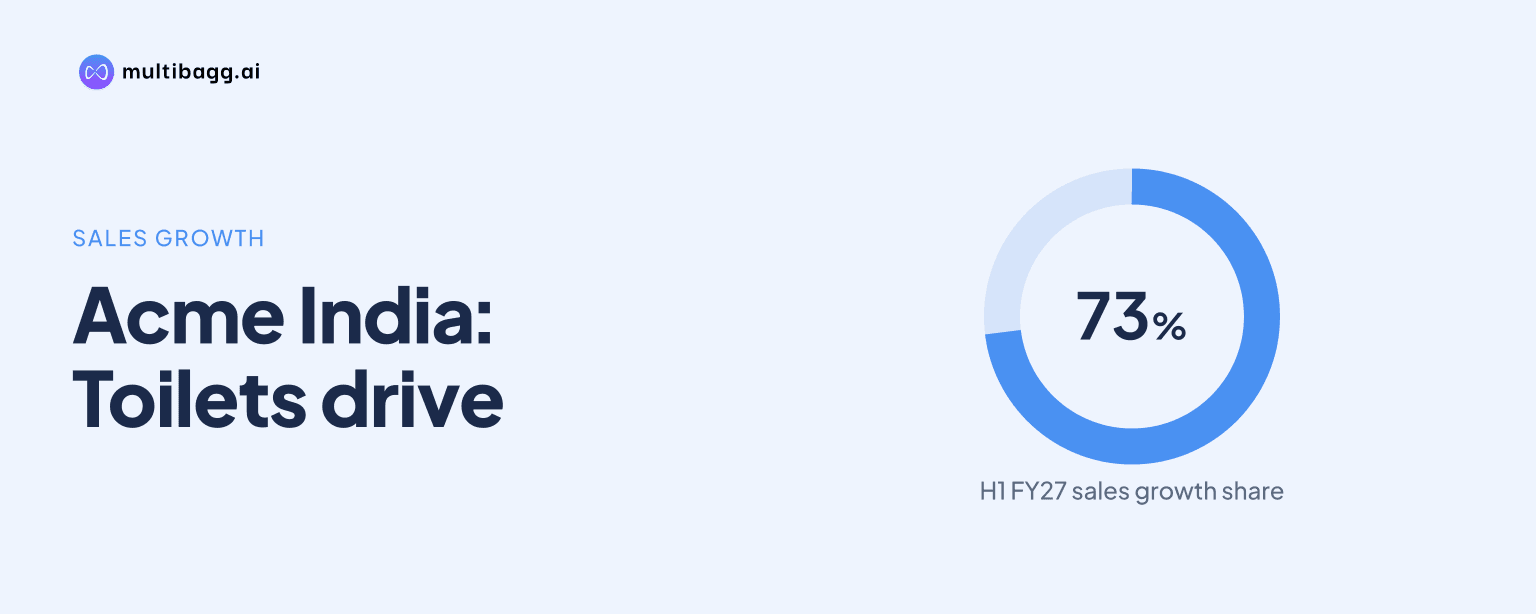
In H1 FY27, Acme India Industries Limited’s toilet-modernisation business drove 73% of sales growth, adding Rs 36.64 crore as segment revenue rose to Rs 44.36 crore from Rs 7.72 crore a year earlier. Acme India also reported winning 6,300 of the 10,000 coaches awarded in the category to date.
Know Acme India Industries inside out
Results, valuation, peers and who's buying, in one view.
How did Acme India’s toilet-modernisation business drive H1 FY27 growth?
Acme India’s toilet-modernisation business was the main contributor to H1 FY27 sales growth, adding Rs 36.64 crore of the Rs 50.21 crore year-on-year increase in revenue from operations. Segment sales increased 5.7 times to Rs 44.36 crore in H1 FY27 from Rs 7.72 crore in H1 FY26, according to the presentation.
Revenue from operations rose to Rs 73.56 crore in H1 FY27 from Rs 24.22 crore in H1 FY26, an increase of 203.7%. Toilet modernisation represented 60% of H1 FY27 sales, compared with 32% in the prior-year half, making it Acme India’s largest reported segment in the period.
The mix changed from H1 FY26, when supply generated Rs 8.30 crore and was the largest individual line on the segment-share chart at 34%. In H1 FY27, supply rose to Rs 15.69 crore but its share was 21%, while toilet modernisation’s Rs 44.36 crore revenue put it ahead of every other reported activity.
What share of toilet-modernisation coach awards has Acme India won?
Acme India has won 6,300 of the 10,000 toilet-modernisation coaches awarded to date, equivalent to 63% of awards shown in the presentation. The company identifies a target of 25,000 coaches, so its 6,300 wins equal 40% of that stated target.
The 63% figure measures Acme India’s share of awards made, rather than its share of the full 25,000-coach target. Only 10,000 coaches, or 40% of the target, had been awarded on the figures presented, leaving the timing and allocation of awards for the remaining targeted coaches undisclosed.
Acme India estimates the addressable market for toilet modernisation at Rs 8,741 crore, compared with Rs 6,183 crore for video surveillance system installation. The presentation labels the estimates for coach enhancement, video surveillance systems and coach voice recorders as company estimates, while its fleet and furnishing market data cite a September 2026 Dun & Bradstreet Industry Report.
Got a follow-up? Ask IRIS
How does toilet modernisation compare with Acme India’s other businesses?
Toilet modernisation was Acme India’s largest H1 FY27 segment at Rs 44.36 crore, ahead of supply at Rs 15.69 crore, refurbishment, upgradation and conversion at Rs 8.03 crore, and new coach furnishing at Rs 5.48 crore. Its 60% sales share was higher than the combined 32% contribution from supply and refurbishment, upgradation and conversion.
New coach furnishing had the fastest stated percentage increase, rising 16.1 times from Rs 0.34 crore in H1 FY26 to Rs 5.48 crore in H1 FY27. Its absolute increase was Rs 5.14 crore, however, compared with Rs 36.64 crore for toilet modernisation and Rs 7.39 crore for supply; refurbishment, upgradation and conversion increased by Rs 0.17 crore.
The H1 FY27 mix also differed from the FY26 full-year revenue mix. Supply was Acme India’s largest FY26 contracts-and-services category at Rs 159.13 crore, or 60.26% of Rs 263.71 crore total revenue, while toilet modernisation generated Rs 57.99 crore, or 22.04%. The H1 FY27 shift to 60% from toilet modernisation concentrated the half-year revenue increase in a segment that had been smaller than supply in FY26.
What could shape Acme India’s revenue delivery after H1 FY27?
Management’s FY27 consolidated revenue guidance is Rs 380 crore, which implies about Rs 306.44 crore in H2 FY27 after the Rs 73.56 crore reported in H1. Acme India describes the business as second-half weighted: H1 accounted for 9.18% of FY26 revenue, while October to March contributed Rs 239.49 crore, or 90.82%, of FY26 revenue.
H1 FY27 growth coincided with gross profit of Rs 15.93 crore, compared with a gross loss of Rs 0.06 crore in H1 FY26, and gross margin of 21.66% against negative 0.24%. Earnings before interest, tax, depreciation and amortisation, or EBITDA, remained negative at Rs 1.33 crore, although this was narrower than the Rs 15.46 crore EBITDA loss a year earlier.
Profit after tax was a Rs 9.38 crore loss in H1 FY27, compared with a Rs 19.74 crore loss in H1 FY26. Finance cost increased to Rs 8.41 crore from Rs 4.02 crore, and other expenses including subcontracting rose to Rs 10.92 crore from Rs 7.49 crore, while Acme India’s order book stood at Rs 727 crore on September 30, 2026.
The presentation also identifies a future refurbishment pipeline linked to Linke Hofmann Busch, or LHB, coach production. It maps 544 coaches produced in FY2013-14 to refurbishment in 2026 and 7,134 coaches produced in FY2024-25 to 2037, based on an expected major refurbishment and modernisation cycle after around 12 years of service.
Conclusion
Acme India’s H1 FY27 revenue increase was led by toilet modernisation, which supplied Rs 36.64 crore of the Rs 50.21 crore increase and reached 60% of sales. The business also held 63% of the 10,000 awarded coaches disclosed, while gross profit turned positive at Rs 15.93 crore even as EBITDA and profit after tax remained negative.
The next disclosed measure is delivery against management’s Rs 380 crore FY27 consolidated revenue guidance, requiring about Rs 306.44 crore in H2 FY27. Other disclosed matters to watch are further awards from the 25,000-coach toilet-modernisation target and the refurbishment cycle mapped from 2026 through 2038 for successive LHB coach-production cohorts.