










Adani Power Limited expects Rs 1 lakh crore peak debt by FY30 or FY31
Key highlights
- Adani Power expects peak debt of about Rs 1 lakh crore in FY30 or FY31 during its expansion.
- Adani Power reported gross debt of about Rs 61,000 crore and net debt of approximately Rs 45,000 crore on 30 September 2026.
- Adani Power plans to expand operating capacity from 18 GW to 42 GW through new additions, with a 3 GW acquisition pipeline potentially taking total capacity to 45 GW by 2032.
- Adani Power received nearly Rs 6,000 crore from GUVNL and cited a credit-rating upgrade from AA to AA+ as support for keeping financing costs largely flat.
powered by IRIS
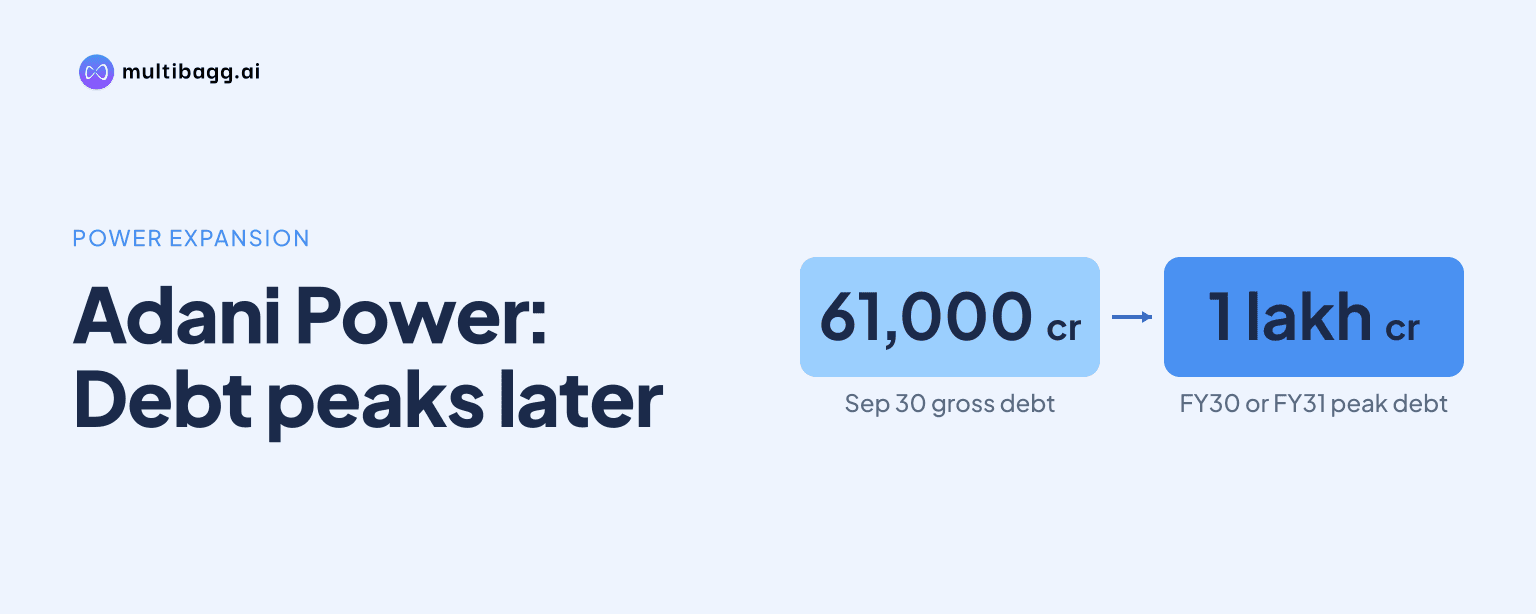
Adani Power expects peak debt of about Rs 1 lakh crore in FY30 or FY31 as it expands towards 45 gigawatts (GW) by 2032. Management said this would be nearly double the debt level at the time of the call, compared with gross debt of about Rs 61,000 crore and net debt of about Rs 45,000 crore on 30 September 2026.
Know Adani Power inside out
Results, valuation, peers and who's buying, in one view.
What peak debt does Adani Power expect during its expansion?
Adani Power expects peak debt of around Rs 1 lakh crore by FY30 or FY31, according to Chief Financial Officer Dilip Jha. He gave the estimate when asked about the highest debt level expected between FY26 and 2032, rather than as a quarterly financing target.
Management agreed with an analyst's characterisation that Rs 1 lakh crore would be nearly double the debt level at the time of the call. The transcript does not specify whether the peak-debt figure refers to gross debt, net debt or another defined borrowing measure, so it is not directly comparable with the reported balance-sheet measures.
Jha said gross debt was about Rs 61,000 crore on 30 September 2026, while net debt was approximately Rs 45,000 crore. He said net debt had remained almost flat during the first half of FY27 because Adani Power retained sufficient liquidity even as gross borrowings increased.
Why does Adani Power expect borrowings to rise?
Adani Power expects borrowings to rise principally to fund capacity expansion from an 18 GW operating portfolio towards 45 GW by 2032. Management said the move to 42 GW would come from new capacity additions, while 3 GW from inorganic acquisitions currently in the pipeline would bring the total to 45 GW.
The 42 GW figure therefore represents the projected operating portfolio after new additions, not 42 GW of additions on top of the existing 18 GW. The additional 3 GW remains conditional on pipeline acquisitions, which management described as not yet completed.
During the rating discussion, analyst Bharat Shah said Adani Power's operating business was funded through internal generation and that borrowings were for new projects. Management said it was making a similar case to rating agencies, while Jha added that borrowings for new capacity could also be serviced from existing profitability.
The expansion includes two 660-megawatt (MW) Korba units. Management said Korba Unit 3 had recently been synchronised and was expected to begin operating in the third quarter, while the second unit was expected around December. Korba has been assigned to Uttarakhand, but management said it would seek medium-term contracts or merchant sales during the four years before Uttarakhand supply starts.
How does Adani Power plan to contain financing costs?
Adani Power aims to keep financing costs largely flat through liquidity management, collections and its improved credit rating. Jha said management was focused on maintaining financing costs at a stable level despite rising market-linked interest rates.
A payment of nearly Rs 6,000 crore from Gujarat Urja Vikas Nigam Limited, or GUVNL, contributed to internal accruals, according to Jha. He said this receipt and other collections helped Adani Power maintain liquidity and avoid a corresponding rise in net debt during the first half of FY27.
An analyst cited interest expense of about Rs 900 crore in the preceding quarter and about Rs 760 crore in the current quarter. Jha said finance costs had reduced slightly on a quarter-to-quarter basis, but management did not provide a formal interest-cost forecast beyond its expectation that costs would remain largely flat.
Adani Power also cited an upgrade in its credit rating from AA to AA+. Jha said management expected the improved rating to offset some impact from higher market rates, alongside tighter deployment of liquidity, but did not state a target borrowing rate or quantify a future saving.
Got a follow-up? Ask IRIS
What is supporting Adani Power's operating cash generation?
Adani Power attributed higher earnings before interest, tax, depreciation and amortisation, or EBITDA, to fuller use of acquired assets, new power purchase agreements and fuel-cost changes. An analyst estimated annualised continuing EBITDA for the first half of FY27 at about Rs 26,000 crore, compared with Rs 21,300 crore in FY26.
Management said capacity acquired during FY26 was included in year-end capacity but was not utilised for the full year. In FY27, those plants were being used more fully, while medium-term power purchase agreements, or PPAs, replaced intermittent merchant-market operation for some capacity and supported revenue at contracted tariffs.
At the Mutiara or Tuticorin plant, management said both 600 MW units had PPAs and were receiving better tariff realisation. The plant had shifted from entirely imported coal to using domestic coal for about 35% to 40% of its requirements, which management said lowered fuel costs and improved margins.
Management also said some PPA tariffs rise with international coal prices. For plants using imported coal under PPAs, fuel costs are passed through, meaning revenue and cost movement can differ from the economics at plants using a greater share of domestic coal.
Which capacity and contract milestones matter next?
Adani Power's near-term capacity milestones are the expected third-quarter start of the first 660 MW Korba unit and the expected December start of the second 660 MW unit. These projects form part of the capacity programme underlying the move from 18 GW to 42 GW, before including the 3 GW acquisition pipeline.
Future projects may be located differently depending on the terms of long-term PPA tenders. Management said the Uttar Pradesh and Gujarat bids allow projects anywhere in India, Rajasthan requires a project within that state, and West Bengal is location-specific and linked to an existing plant.
Management said it expected the power market to remain strong in the following year because demand had been growing, but declined to give granular guidance for the second half of FY27. It also declined to estimate when EBITDA could reach Rs 1 lakh crore, saying such a forecast was too far into the future.
Conclusion
Adani Power has stated an approximate debt ceiling and timing for its expansion, with peak debt of about Rs 1 lakh crore expected in FY30 or FY31. That plan accompanies a 45 GW capacity objective for 2032, compared with 18 GW currently operating, while net debt stood at about Rs 45,000 crore on 30 September 2026.
The next disclosed markers are commissioning of the two 660 MW Korba units, development of the 3 GW acquisition pipeline and progress in PPA tenders with differing location rules. Management's stated objective of keeping financing costs largely flat also leaves collections, liquidity levels and any further rating actions central to the funding plan.