










Adani Power Limited may revisit expansion after demand rise
Key highlights
- India’s Q2 FY27 power demand rose 11.5% year on year to 502 billion units.
- Adani Power’s 24 GW thermal pipeline is 62% covered by long-term power purchase agreements.
- Q2 FY27 PPA sales increased 29.7% to 23.4 billion units, while total consolidated sales rose 11.5% to 26.4 billion units.
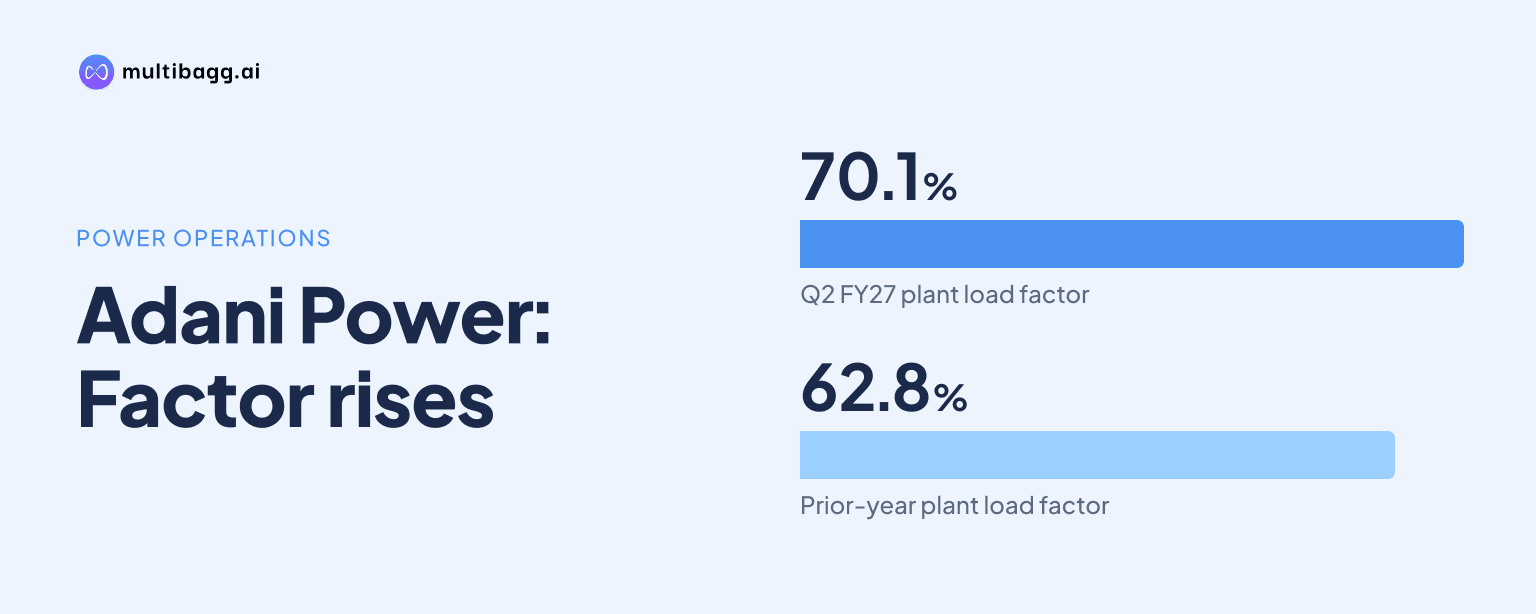
- Adani Power’s Q2 FY27 plant load factor increased to 70.1% from 62.8% a year earlier.
powered by IRIS
Adani Power said it may revisit its capacity-addition strategy after India’s Q2 FY27 power demand rose 11.5% year on year to 502 billion units. Management said 62% of its 24 gigawatt, or GW, upcoming thermal pipeline has long-term power purchase agreements, or PPAs, while new projects approach commissioning.
Know Adani Power inside out
Results, valuation, peers and who's buying, in one view.
Why may Adani Power revisit its capacity-addition strategy?
Adani Power may revisit its capacity-addition strategy because management said a government indication of thermal additions beyond the discussed 97 GW level for 2035 gave it additional comfort. Chief executive Shersingh B. Khyalia said the company had already planned an aggressive addition programme, but did not disclose a revised capacity target or capital-expenditure figure during the call.
Management pointed to Q2 FY27 market conditions, when India’s power demand rose 11.5% to 502 billion units and lower hydropower output followed a weak monsoon. Coal and lignite provided 73% of incremental generation, while the average thermal plant load factor, or PLF, increased to 68% from 62% a year earlier.
Adani Power also expects data centres to add to national electricity demand, although it disclosed no contracted data-centre load. Khyalia said uninterrupted 24-hour power requires thermal baseload capacity, but clarified that Adani Power is not directly signing PPAs with data centres; supply arrangements would instead be handled through the AESL trading platform or distribution companies, known as DISCOMs.
How much of Adani Power's thermal pipeline is contracted?
Adani Power has long-term PPAs for 62% of its 24 GW upcoming thermal pipeline. In Q2 FY27, it received a letter of award from Uttarakhand Power Corporation Limited for a 25-year, 1,320 megawatt, or MW, PPA from Korba Phase-II, with management disclosing a fixed charge of 4.30 rupees per unit.
The pipeline includes Mahan, Raipur, Raigarh, Mirzapur and Anuppur projects under execution. Adani Power also plans a 1,600 MW ultra-supercritical Raipur Phase-III plant, which would take the Raipur site to 4,570 MW and supply a second long-term PPA to Maharashtra DISCOM.
Korba Phase-II is the nearest capacity addition. Its first 660 MW unit has achieved grid synchronisation, and management said commercial commissioning was expected shortly, with an analyst response indicating it should begin operating in Q3 FY27; the second 660 MW unit is planned for Q4 FY27. The 1,600 MW Mahan Phase-II project is at an advanced stage, with commercial operations targeted for early FY28.
Got a follow-up? Ask IRIS
What does Adani Power's state bidding show about demand?
Adani Power is pursuing state procurement opportunities alongside its existing pipeline. Management said bids had been submitted in Uttar Pradesh and were expected to open during the month of the call or early the next month, while a 1,600 MW West Bengal bid and a Rajasthan submission were expected in the first week of the following month, subject to holiday-related extensions.
The processes are at different stages. Management said Gujarat had completed bidder consultations but had not yet approached the regulatory commission, putting it behind Uttar Pradesh, West Bengal and Rajasthan. These tenders do not establish that Adani Power will win further capacity, but they show the company is seeking additional offtake arrangements.
PPA sales were a larger part of Adani Power’s Q2 FY27 output. Long-term and medium-term PPA sales rose 29.7% year on year to 23.4 billion units, compared with total consolidated sales growth of 11.5% to 26.4 billion units. Merchant and short-term volume fell 43% as previously open capacity was tied to medium-term contracts, although merchant tariffs per unit rose 33%.
Korba’s first unit will initially have a different sales route because its PPA starts after four years, according to management. Adani Power said the unit would sell in the medium-term or merchant market until then; a medium-term PPA could bring a coal linkage, whereas merchant sales would require coal purchased through auctions.
Can Adani Power finance expansion mainly from internal accruals?
Adani Power said it intends to fund capital expenditure primarily through internal accruals and use debt only for any gap between cash generation and project-funding needs. Total debt stood at Rs 61,860 crore on September 30, 2026, compared with Rs 53,556 crore on March 31, 2026, while net debt increased to Rs 45,846 crore from Rs 45,022 crore.
Management said some funds drawn near the end of Q2 FY27 remained in cash balances. It linked its funding plan to quarterly operating results, with continuing revenue increasing 29.8% year on year to Rs 17,014 crore and continuing earnings before interest, tax, depreciation and amortisation, or EBITDA, rising 18.5% to Rs 6,321 crore.
Reported EBITDA reached Rs 8,743 crore after Rs 2,422 crore of one-time net prior-period revenue, mainly from revised initial energy charges under Gujarat PPAs. Management said all past-period recovery related to that Gujarat rate revision had been recognised, while the ongoing tariff effect is included in regular revenue.
Fuel costs rose faster than continuing EBITDA, increasing 41.8% to Rs 10,229 crore in Q2 FY27 as sales volumes increased and landed imported-coal costs rose about 50%. Management said most imported-coal projects have fuel-cost pass-through mechanisms, but Gujarat tariff indexation has a lag of more than six months; Bangladesh tariffs adjust immediately to international prices.
Adani Power’s Q2 FY27 PLF was 70.1%, compared with 62.8% in Q2 FY26, while first-half PLF reached 74.1% against 64.8%. Management nevertheless said around 65% is its normal expected PLF, because lower hydro availability lifted thermal dispatch in the quarter and first half.
Conclusion
Adani Power’s potential strategy review is based on higher power demand, active state bidding and a 24 GW thermal project pipeline that is 62% supported by long-term PPAs. Q2 FY27 sales of 26.4 billion units and a 70.1% PLF provided current evidence of greater thermal dispatch, while management described data-centre demand as a future national driver rather than a direct customer pipeline.
The next disclosed milestones are commercial commissioning of Korba Phase-II’s first 660 MW unit in Q3 FY27, the second unit in Q4 FY27, and early-FY28 operations at the 1,600 MW Mahan Phase-II project. The outcomes of Uttar Pradesh, West Bengal and Rajasthan procurement bids, and any formal revision to Adani Power’s capacity-addition plan, are also matters to watch.