










Adani Power Q2 profit included Gujarat catch-up and tax credit
Key highlights
- Adani Power’s Q2 FY27 consolidated profit after tax rose 141.5% year on year to Rs 7,019 crore.
- Continuing EBITDA increased 18.5% to Rs 6,321 crore, while sales volume rose 11.5% to 26.4 billion units.
- Reported earnings included Rs 2,422 crore of one-time Gujarat prior-period revenue and a Rs 231 crore net tax credit.
- Fuel cost increased 41.8% to Rs 10,229 crore as landed imported-coal costs rose approximately 50%.
powered by IRIS
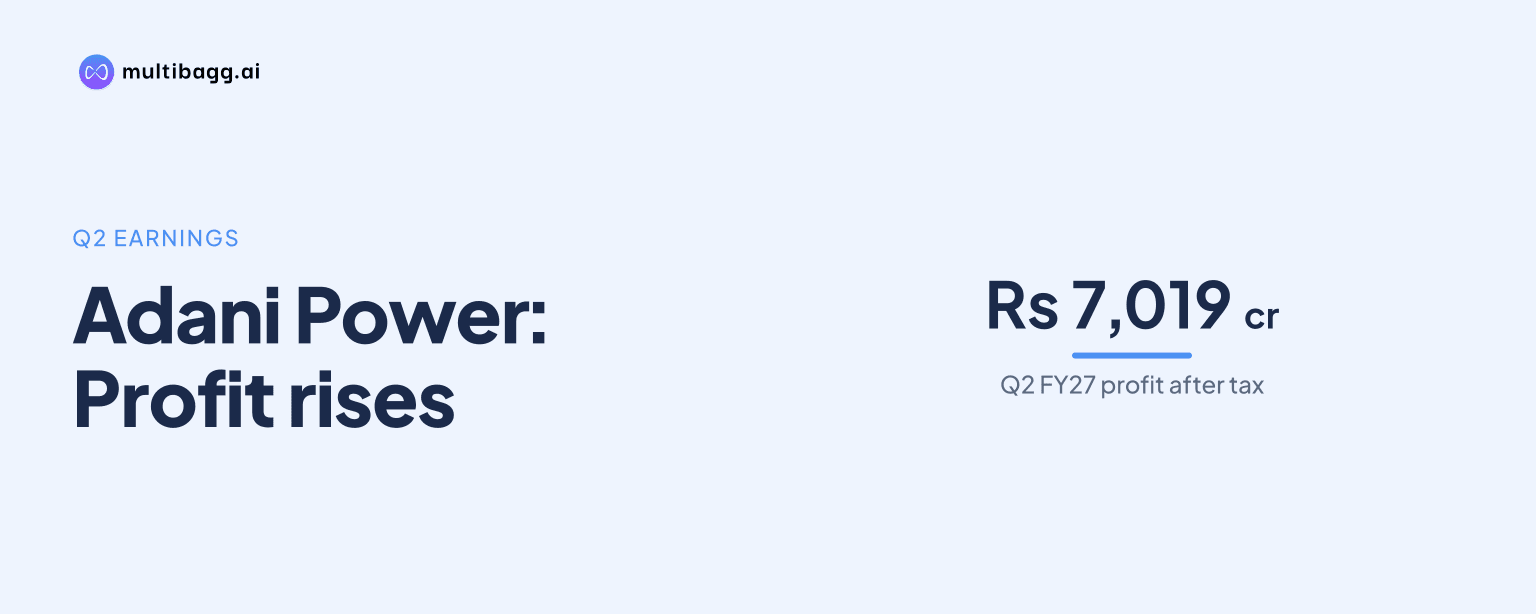
Adani Power Limited reported consolidated profit after tax of Rs 7,019 crore for Q2 FY27, up 141.5% year on year, with operating growth supplemented by Rs 2,422 crore of Gujarat prior-period revenue and a Rs 231 crore net tax credit. Continuing earnings before interest, tax, depreciation and amortisation rose 18.5% to Rs 6,321 crore.
Know Adani Power inside out
Results, valuation, peers and who's buying, in one view.
What lifted Adani Power’s reported Q2 FY27 profit?
Adani Power’s reported Q2 FY27 profit was lifted by higher operating earnings, Rs 2,422 crore of one-time net prior-period revenue and a Rs 231 crore net tax credit. Consolidated profit after tax rose to Rs 7,019 crore from Rs 2,906 crore in Q2 FY26, while reported profit before tax increased 71.2% to Rs 6,792 crore.
The largest disclosed accounting item was recognised as prior-period revenue rather than as continuing quarterly revenue. Total reported revenue reached Rs 19,951 crore in Q2 FY27, compared with total continuing revenue of Rs 17,528 crore. Management said the Rs 2,422 crore difference was one-time net prior-period revenue, compared with Rs 669 crore recorded in Q2 FY26.
Reported EBITDA was Rs 8,743 crore in Q2 FY27, up 45.7% year on year, whereas continuing EBITDA was Rs 6,321 crore. The different growth rates reflect the prior-period revenue recognition alongside the quarter’s operating performance. Finance costs, meanwhile, declined 9.7% to Rs 760 crore from Rs 842 crore a year earlier.
How much did operations improve in Q2 FY27?
Adani Power’s operations improved in Q2 FY27, with consolidated sales volume rising 11.5% to 26.4 billion units from 23.7 billion units in Q2 FY26. Plant load factor, or PLF, increased to 70.1% from 62.8%, while sales under long-term and medium-term power purchase agreements, or PPAs, rose 29.7% to 23.4 billion units.
Continuing revenue from operations increased 29.8% to Rs 17,014 crore from Rs 13,106 crore, supported by greater dispatch and higher realisation across PPA and merchant sales. Management said PPA realisation improved 12.7% on a continuing basis, reflecting imported-coal index pass-through and recent medium-term PPAs.
Merchant and short-term sales volume was 43% lower year on year because previously open capacity was contracted under medium-term arrangements. However, management said short-term merchant tariffs per unit rose 33%. This change in mix coincided with sales growth of 11.5% across the consolidated portfolio.
Fuel cost rose faster than continuing EBITDA, increasing 41.8% to Rs 10,229 crore from Rs 7,216 crore. Management attributed the increase to higher volumes and an approximate 50% rise in the landed cost of imported coal. Even with that cost movement, continuing EBITDA rose by Rs 988 crore, while reported EBITDA included the Gujarat prior-period item.
What was the Gujarat revenue catch-up?
The Gujarat catch-up was Rs 2,422 crore of one-time net prior-period revenue recognised in Q2 FY27, primarily from revision of initial energy charges under Gujarat PPAs and indexation applied in subsequent years. The Q2 FY27 amount was higher than the Rs 669 crore of prior-period revenue recorded in Q2 FY26.
The disclosure separates this catch-up from continuing revenue. Continuing total revenue, including Rs 514 crore of other income, was Rs 17,528 crore in Q2 FY27. Adding the Rs 2,422 crore prior-period item brought reported revenue to Rs 19,951 crore, which explains why reported measures increased more than continuing operating measures.
Management also described a delay in the Gujarat fuel-cost indexing mechanism. It said increased imported-fuel costs would be reflected after more than six months and would not be reflected in the next quarter, because prices in the current quarter would probably be reflected in the third subsequent quarter. Management said Gujarat’s per-unit realisation did not fall below actual fuel cost, although the lag reduced margin from the level it otherwise would have reached.
The timing differed from the Bangladesh PPA mechanism described on the call. Management said Bangladesh tariffs are determined using international prices, so an increase in international prices is reflected immediately in billing. The Gujarat discussion instead concerned the deferred application of an index to the relevant fuel-price movement.
Got a follow-up? Ask IRIS
Why did Adani Power report a tax credit?
Adani Power reported a Rs 231 crore net tax credit in Q2 FY27 because provisions made earlier were reversed following the amalgamation of subsidiaries with Adani Power. The credit contributed to the relationship between reported profit before tax of Rs 6,792 crore and consolidated profit after tax of Rs 7,019 crore.
The tax credit was separate from the Gujarat revenue recognition. Continuing profit before tax rose 32.5% to Rs 4,370 crore from Rs 3,298 crore in Q2 FY26, while reported profit before tax was Rs 6,792 crore after recognition of the Rs 2,422 crore prior-period revenue. The transcript therefore identifies both a revenue item and a reversal of earlier tax provisions in the reported result.
For H1 FY27, Adani Power reported profit after tax of Rs 11,886 crore, up 91.4% year on year, and continuing EBITDA of Rs 13,304 crore, up 20.1%. Reported revenue for the first half was Rs 39,273 crore, compared with total continuing revenue of Rs 35,464 crore, while sales volume rose 14.3% to 55.1 billion units.
Did Adani Power disclose a Haryana coal claim reversal?
The supplied Q2 FY27 call transcript does not identify a Haryana coal claim, a reversal of such a claim, its value or its effect on profit. The disclosed accounting items were Rs 2,422 crore of Gujarat prior-period revenue and a Rs 231 crore tax credit arising from reversal of earlier provisions after subsidiary amalgamations.
The coal-cost discussion on the call concerned imported coal and Gujarat tariff indexation, not Haryana. Fuel cost reached Rs 10,229 crore in Q2 FY27, and management said landed imported-coal cost had increased by approximately 50%. It also differentiated the delayed Gujarat indexation mechanism from immediate price reflection under the Bangladesh PPA.
The call did disclose capacity and contract developments. Adani Power received a letter of award for a 25-year, 1,320-megawatt PPA from Uttarakhand Power Corporation during the quarter, and the first 660-megawatt Korba Phase-II unit achieved grid synchronisation. Those disclosures do not provide a basis to assess a Haryana distribution company coal claim.
Conclusion
Adani Power’s Q2 FY27 outcome combined higher generation and sales with items that materially lifted reported earnings. Sales volume rose 11.5% to 26.4 billion units and continuing EBITDA increased 18.5% to Rs 6,321 crore. The Rs 2,422 crore Gujarat prior-period revenue raised reported EBITDA to Rs 8,743 crore, while the Rs 231 crore tax credit also contributed to profit after tax of Rs 7,019 crore.
The next disclosed markers are commercial commissioning of Korba Phase-II’s first 660-megawatt unit, expected shortly, and the planned commissioning of its second unit in Q4 FY27. Management also targeted commercial operations at the 1,600-megawatt Mahan Phase-II project for early FY28, while indicating that the Gujarat fuel-indexation lag may defer reflection of current-quarter imported-coal prices.