










ADF Foods cuts FY27 revenue target to Rs 850 crore
Key highlights
- ADF Foods reduced its FY27 revenue objective by Rs 50 crore to Rs 850 crore.
- H1 FY27 consolidated revenue rose 24.6% year-on-year to Rs 368.2 crore.
- Middle East transit times increased to 35-40 days from seven-10 days.
- ADF Foods management expects high-teen EBITDA margins in the final two quarters of FY27.
powered by IRIS
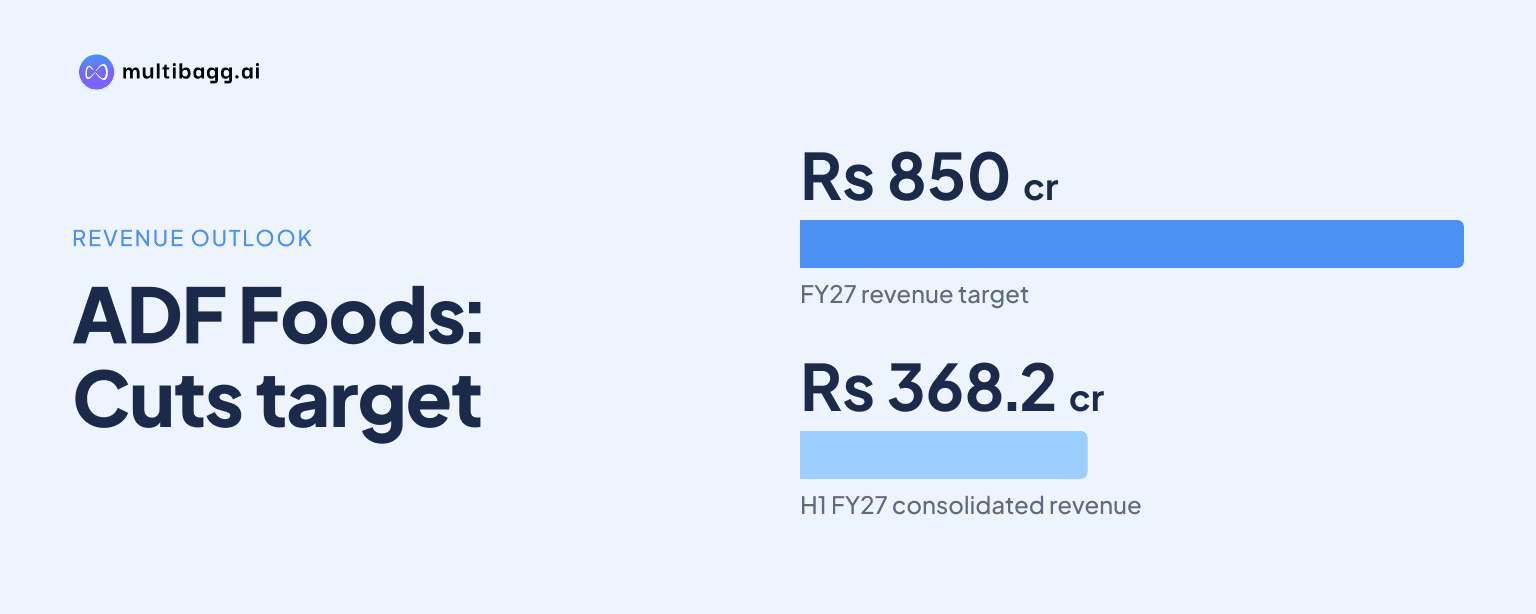
ADF Foods has reduced its FY27 revenue objective to Rs 850 crore from Rs 900 crore after container shortages and vessel constraints limited order execution in the first two quarters. Management said demand remains robust, but Middle East transit times have increased to 35-40 days from seven-10 days and freight rates are seven-eight times higher.
Know ADF Foods inside out
Results, valuation, peers and who's buying, in one view.
Why did ADF Foods lower its FY27 revenue target?
ADF Foods lowered its FY27 revenue objective by Rs 50 crore because shipping disruptions prevented it from executing all orders during the first two quarters. Management said Rs 900 crore had become difficult to achieve because steamer freight and container-availability problems continued, and it was more comfortable pursuing Rs 850 crore in FY27.
The revised objective is based on an execution constraint rather than a management-reported deterioration in demand. Management said demand for ADF Foods products remained robust, but container and vessel availability on certain routes resulted in shipments carrying forward each month. Conditions improved on some routes in October, management said, although they had not returned to pre-war normal levels.
The revision follows consolidated revenue growth of 24.6% year-on-year in H1 FY27, when revenue reached Rs 368.2 crore compared with Rs 295.5 crore in H1 FY26. To meet the Rs 850 crore objective, ADF Foods would need to generate Rs 481.8 crore in the second half, compared with Rs 368.2 crore reported in the first half.
How are shipping disruptions affecting ADF Foods dispatches?
ADF Foods said Middle East dispatches remain difficult because transit times have risen to 35-40 days from seven-10 days and freight rates are seven-eight times higher. Management said it cannot make as many Middle East shipments as it would like, even though some routes have seen better container availability.
The disruption extends beyond the Middle East, according to management, which said freight rates and transit times had risen in other geographies as well. These changes affect ADF Foods' ability to convert demand into reported revenue, while management seeks to maintain growth and margins through shipment planning and cost management.
Longer transit times are also increasing working-capital needs. Management said almost two weeks of inventory days were higher because products were taking longer to reach customers. It expects inventory days to return to the level seen in March if routes clear and transit times normalise during the next two months.
What did ADF Foods report in H1 FY27?
ADF Foods reported consolidated H1 FY27 revenue of Rs 368.2 crore, up 24.6% from Rs 295.5 crore in H1 FY26, while standalone revenue rose 18.2% to Rs 284.2 crore from Rs 240.4 crore. Consolidated revenue therefore grew faster than the standalone business during the first half.
Consolidated earnings before interest, tax, depreciation and amortisation, or EBITDA, increased 15.8% to Rs 68.6 crore in H1 FY27, with an EBITDA margin of 18.6%. Consolidated profit after tax rose 2.4% to Rs 42.6 crore, with a profit-after-tax margin of 11.6%, meaning profit growth trailed revenue growth amid elevated freight and logistics costs.
In Q2 FY27, standalone revenue increased 16.6% year-on-year to Rs 163.3 crore from Rs 140.1 crore. Standalone EBITDA was Rs 31 crore, or a 19.0% margin, while standalone profit after tax was Rs 21.6 crore, or a 13.3% margin. Processed foods revenue increased 22.6% year-on-year to Rs 163.4 crore, and segment EBITDA was Rs 41.2 crore with a 25.2% margin.
Management said roughly 60%-65% of H1 growth came from volumes within overall growth of about 24%. It said this description applied to processed foods and that the company-level position would not differ drastically, indicating that volumes contributed materially alongside pricing and mix.
Got a follow-up? Ask IRIS
Can ADF Foods maintain margins while continuing investment?
ADF Foods management said it expects EBITDA margins to remain in the high teens during the final two quarters of FY27 despite higher freight costs. It attributed that expectation to operating leverage from revenue growth of roughly 24%-25%, while continuing brand and capability investment in the US, India, UK and Europe.
Management said a Rs 3 crore tariff refund was recorded in cost of goods sold through inventory, reducing that cost line in the period. It also said the production-linked incentive, or PLI, programme is in its fifth and final year, but requires spending twice the incentive amount on marketing and advertising in overseas markets. The insurance settlement was gross-margin neutral, with the cash received subsequently in October.
ADF Foods had invested more than Rs 145 crore in capacity expansion over the previous two-and-a-half years using internal accruals. Management said a further Rs 40 crore-Rs 45 crore of capital expenditure remained this financial year at Surat, Nadiad and Nashik, taking total planned investment to about Rs 190 crore.
Management expects the Rs 190 crore investment to generate asset turnover of at least three times, with about Rs 60 crore-Rs 65 crore allocated to new products. The Surat plant used about 15% of installed-line capacity in Q2 FY27 because some lines were still awaiting installation in Q3, and management said it hoped to reach 35%-40% utilisation by the end of FY27.
ADF Foods reported a net surplus of Rs 97.4 crore at the end of H1 FY27, which management said provides flexibility for capacity, brand-building and distribution investment. The board also declared an interim dividend of 30% of face value, while CRISIL upgraded the credit rating to CRISIL A+/Stable from CRISIL A/Positive.
Conclusion
ADF Foods' revised Rs 850 crore FY27 revenue objective reflects a logistics-led limit on dispatches rather than a management-reported decline in demand. The company still delivered 24.6% consolidated revenue growth in H1 FY27, while profit growth was lower as freight, logistics and inventory transit pressures affected costs and working capital.
The next issue is whether shipping conditions improve over the next two months, allowing inventory days to return towards March levels and enabling more complete order execution. Management also plans to raise Surat utilisation from 15% in Q2 FY27 to 35%-40% by the end of FY27 while seeking to maintain EBITDA margins in the high teens.