










ADF Foods Q2 revenue hits Rs 200.9 crore as margins narrow
Key highlights
- ADF Foods reported record consolidated Q2 FY27 revenue of Rs 200.9 crore, up 23.6% year on year.
- Consolidated Q2 FY27 EBITDA margin declined to 19.4% from 22.0% in Q2 FY26.
- Standalone Q2 FY27 EBITDA declined to Rs 31.0 crore from Rs 37.7 crore amid freight and logistics costs.
- Processed foods reported Q2 FY27 revenue of Rs 163.4 crore, compared with Rs 37.5 crore for distribution.
powered by IRIS
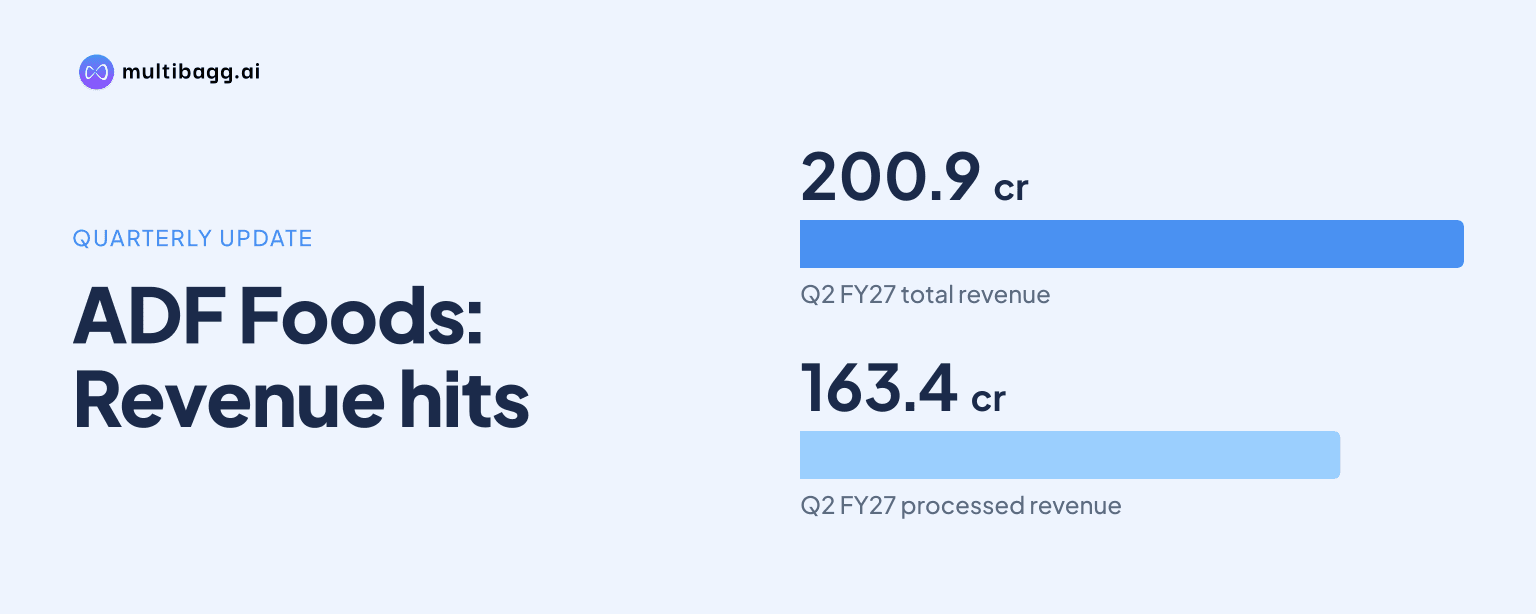
ADF Foods Ltd. reported record consolidated revenue from operations of Rs 200.9 crore in the second quarter of financial year 2027 (Q2 FY27), up 23.6% year on year, while earnings before interest, tax, depreciation and amortisation (EBITDA) margin fell to 19.4% from 22.0% amid elevated freight and shipping disruption.
Know ADF Foods inside out
Results, valuation, peers and who's buying, in one view.
How did ADF Foods perform in Q2 FY27?
ADF Foods delivered its highest quarterly consolidated revenue, crossing Rs 200 crore for the first time in Q2 FY27. Revenue from operations rose from Rs 162.6 crore in Q2 FY26 and Rs 167.3 crore in Q1 FY27 to Rs 200.9 crore. The 23.6% year-on-year increase followed revenue growth of 29.5% in Q3 FY26, 23.7% in Q4 FY26 and 25.9% in Q1 FY27.
EBITDA increased 9.0% year on year to Rs 39.0 crore from Rs 35.8 crore, but growth in EBITDA did not match the increase in revenue. Profit after tax (PAT) was Rs 25.3 crore in Q2 FY27, compared with Rs 26.4 crore a year earlier and Rs 17.3 crore in Q1 FY27. EBITDA margin improved from 17.7% in Q1 FY27 but remained below the 22.0% reported in Q2 FY26.
Why did ADF Foods' margins narrow despite revenue growth?
ADF Foods' consolidated EBITDA margin declined by 2.6 percentage points year on year to 19.4% in Q2 FY27, while PAT margin fell by 3.6 percentage points to 12.6%. Management attributed the pressure to elevated ocean freight and logistics costs, which it said were partly mitigated through pricing, cost optimisation and operational efficiencies.
The company said West Asia conflict-related route disruptions, vessel scarcity and container-availability constraints affected shipment schedules to the Gulf Cooperation Council (GCC) and other key markets during Q2 FY27. Demand remained resilient, according to management, as shown by the 23.6% increase in consolidated revenue. The reported numbers show that sales growth continued despite the disruption, but freight costs reduced the conversion of revenue into profit.
The standalone accounts recorded a larger year-on-year movement in profitability. Standalone revenue rose 16.6% to Rs 163.3 crore from Rs 140.1 crore in Q2 FY26, while EBITDA fell to Rs 31.0 crore from Rs 37.7 crore. Standalone EBITDA margin declined to 19.0% from 26.9%, and standalone PAT fell to Rs 21.6 crore from Rs 29.7 crore.
What do ADF Foods' first-half results show?
ADF Foods reported consolidated revenue of Rs 368.2 crore for the first half of financial year 2027 (H1 FY27), compared with Rs 295.5 crore in H1 FY26. Consolidated EBITDA increased to Rs 68.6 crore from Rs 59.3 crore, while PAT rose to Rs 42.6 crore from Rs 41.6 crore. Revenue therefore grew faster than both profit measures over the six-month period.
Consolidated EBITDA margin declined to 18.6% in H1 FY27 from 20.1% in H1 FY26, while PAT margin decreased to 11.6% from 14.1%. On a standalone basis, revenue increased to Rs 284.2 crore from Rs 240.4 crore, but EBITDA declined to Rs 58.5 crore from Rs 60.2 crore and PAT declined to Rs 39.9 crore from Rs 46.7 crore.
Got a follow-up? Ask IRIS
Which segments drove ADF Foods' Q2 FY27 growth?
ADF Foods' processed foods segment was the larger contributor in Q2 FY27, reporting revenue of Rs 163.4 crore against Rs 37.5 crore for distribution. Processed foods revenue rose from Rs 133.3 crore in Q2 FY26 and Rs 144.0 crore in Q1 FY27. Segment EBITDA increased to Rs 41.2 crore from Rs 39.1 crore a year earlier, while its EBITDA margin declined to 25.2% from 29.3%.
Distribution generated the faster year-on-year revenue increase from a smaller base, rising from Rs 29.3 crore in Q2 FY26 to Rs 37.5 crore in Q2 FY27. Its EBITDA was unchanged at Rs 5.3 crore, resulting in an EBITDA margin of 14.1%, compared with 18.0% a year earlier. Compared with Q1 FY27, distribution revenue rose from Rs 23.2 crore and EBITDA rose from Rs 2.7 crore.
The presentation identifies processed foods and agency distribution as ADF Foods' two core segments, with processed foods accounting for 85% of FY26 revenue and distribution accounting for 15%. Ashoka was described as benefiting from diaspora demand and deeper international-market penetration, while Truly Indian had reached more than 3,500 stores in the US, including new listings at Kroger, Meijer and Sprouts.
What is ADF Foods investing in after Q2 FY27?
ADF Foods said its Surat greenfield facility, whose Phase I commenced operations in Q1, was progressing towards targeted operational performance. Management said the facility would position the company to address growing demand and support scalable growth in coming quarters. The presentation also cited brownfield expansions and debottlenecking at the Nadiad and Nashik plants.
Capital expenditure was Rs 23.2 crore in H1 FY27, after Rs 82.8 crore in FY26 and Rs 41.2 crore in FY25. ADF Foods said it had spent more than Rs 145 crore on capital expenditure in the previous two and a half years through internal accruals. Net surplus was Rs 97.4 crore in H1 FY27, compared with Rs 78.2 crore in FY26 and Rs 118.0 crore in FY25.
ADF Foods also reported a Crisil rating upgrade to Crisil A+/Stable from Crisil A/Positive. The presentation did not provide a quantified FY27 revenue or margin forecast. It linked continuing investment to the Surat ramp-up, existing-plant capacity work and market development through its processed foods and distribution operations.
Conclusion
ADF Foods paired record Q2 FY27 consolidated revenue of Rs 200.9 crore with lower profitability ratios as freight, logistics and shipment disruptions offset part of the benefit from sales growth. Consolidated EBITDA rose to Rs 39.0 crore, but its margin declined to 19.4%; standalone EBITDA fell to Rs 31.0 crore, while processed foods remained the larger Q2 segment.
The next disclosed operational item to watch is Surat's progress towards targeted performance after Phase I began operations in Q1. Management also identified ocean-freight costs, container availability, vessel scarcity and West Asia route disruption as unresolved factors affecting shipments to the GCC and other markets, alongside Rs 23.2 crore of H1 FY27 capital expenditure.