










ADF Foods clears Rs 200 crore quarterly revenue milestone
Key highlights
- ADF Foods reported record consolidated Q2 FY27 revenue of Rs 200.9 crore, up 23.6% year on year.
- Q2 FY27 consolidated EBITDA rose 9% to Rs 39 crore, with a 19.4% EBITDA margin.
- H1 FY27 consolidated PAT increased 2.4% to Rs 42.6 crore as freight and logistics costs remained elevated.
- Truly Indian was available in more than 3,500 US stores, while Surat plant utilisation averaged about 15% in Q2 FY27.
powered by IRIS
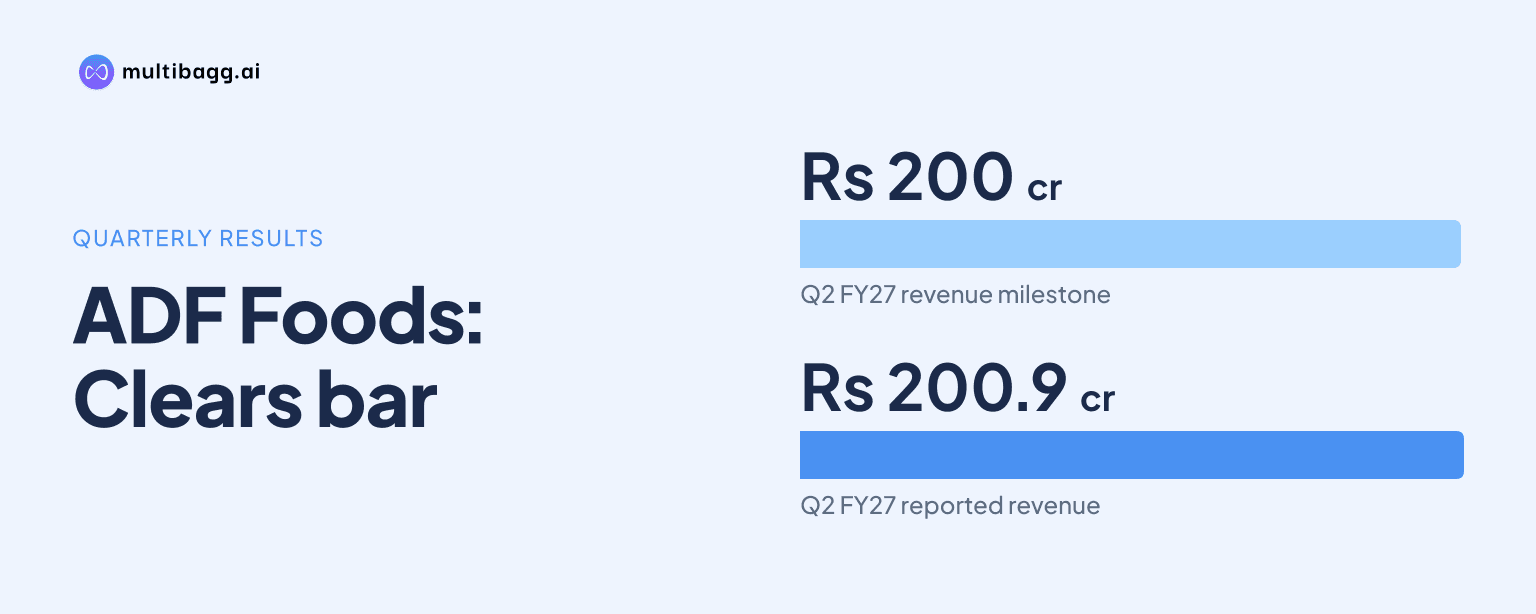
ADF Foods Limited recorded its first Rs 200 crore quarterly revenue in Q2 FY27, with consolidated revenue rising 23.6% year on year to Rs 200.9 crore, while higher ocean freight and logistics costs limited earnings before interest, tax, depreciation and amortisation growth to 9% and H1 profit after tax growth to 2.4%.
Know ADF Foods inside out
Results, valuation, peers and who's buying, in one view.
What drove ADF Foods past Rs 200 crore of quarterly revenue?
ADF Foods crossed the Rs 200 crore threshold because consolidated revenue from operations rose to a record Rs 200.9 crore in Q2 FY27 from Rs 162.6 crore in Q2 FY26. Management attributed the 23.6% increase to demand across its brands, deeper penetration in key markets, added shelf space and execution in processed foods and distribution.
The quarterly result extended double-digit year-on-year revenue growth, although management said limited container availability and disruptions on key shipping routes prevented full conversion of its order book. Standalone revenue increased 16.6% to Rs 163.3 crore from Rs 140.1 crore, meaning the consolidated growth rate exceeded the standalone rate by 7 percentage points.
Management said international demand was supported by consumer interest in convenient Indian food across frozen products, ready-to-eat products, ready-to-cook products and meal accompaniments. Ashoka, ADF Foods' flagship brand, has delivered revenue compound annual growth of more than 20% over the past five years, according to management, which linked that performance to distribution, consumer engagement and innovation.
How did ADF Foods' earnings growth compare with sales growth?
ADF Foods' earnings grew more slowly than revenue year on year, with Q2 FY27 consolidated EBITDA rising 9% to Rs 39 crore while revenue rose 23.6% to Rs 200.9 crore. EBITDA margin was 19.4%, and consolidated profit after tax, or PAT, was Rs 25.3 crore, equal to a 12.6% PAT margin.
For H1 FY27, the gap was wider: consolidated revenue increased 24.6% to Rs 368.2 crore from Rs 295.5 crore, EBITDA rose 15.8% to Rs 68.6 crore, and PAT increased 2.4% to Rs 42.6 crore. The H1 EBITDA margin was 18.6% and the PAT margin was 11.6%, with management identifying elevated freight and logistics costs as the main pressure on profitability.
The quarter improved sequentially despite those costs. Compared with Q1 FY27, Q2 consolidated revenue increased 20.1%, EBITDA rose 31.4% and PAT increased 46.6%. Management said operating efficiencies, cost optimisation and disciplined execution partly offset higher ocean freight and logistics expenses.
Which businesses and brands supported ADF Foods' growth?
ADF Foods' processed foods segment reported Q2 FY27 revenue growth of 22.6% year on year to Rs 163.4 crore, while segment EBITDA reached Rs 41.2 crore. That produced a segment EBITDA margin of 25.2%, above the 19.4% consolidated EBITDA margin reported for the quarter.
Management said approximately 60% to 65% of H1 growth came from volume in processed foods, within overall growth of roughly 24%. It added that the company-level split would be broadly similar, within about 5 percentage points, indicating that shipment volumes accounted for a substantial part of sales growth.
Truly Indian expanded its US mainstream distribution to more than 3,500 stores, securing listings with Kroger, Meijer and Sprouts. Its vegan naan range was recognised in Whole Foods Market's 2027 Food Trend Predictions under the “Dish Reinvention” category, while management said it would pursue further listings and deeper penetration of existing accounts.
In India, Soul launched A2 Gir Cow Danedar Ghee during Q2 FY27, made using the bilona process. Management described the launch as an entry into an everyday kitchen category and said Soul would be developed in a measured manner through product innovation, wider distribution and targeted consumer engagement.
Got a follow-up? Ask IRIS
What is limiting ADF Foods' conversion of demand into profit and sales?
ADF Foods said shipping constraints, rather than a demand shortfall, limited shipments in Q2 FY27. Management reported continuing carry-forward shipments each month because of container and vessel availability on certain routes, although some routes improved in October and remained below pre-war normality.
Higher ocean freight and logistics costs limited the conversion of sales growth into H1 standalone profitability. Standalone H1 revenue rose 18.2% to Rs 284.2 crore from Rs 240.4 crore, while EBITDA was Rs 58.5 crore at a 20.6% margin and PAT was Rs 39.9 crore at a 14.0% margin.
Management also disclosed a roughly Rs 3 crore tariff refund that reduced cost of goods sold, or COGS, through inventory accounting. It said the production-linked incentive, or PLI, was in its final fifth year and did not materially affect profitability because ADF Foods must spend twice the incentive amount on overseas marketing and advertising. An insurance settlement was described as neutral at the gross-margin level, with cash received subsequently in October.
What capacity and capital plans has ADF Foods set out?
ADF Foods has invested more than Rs 145 crore in capacity expansion over the past two-and-a-half years, funded through internal accruals, and reported a net surplus of Rs 97.4 crore at the end of H1 FY27. Management said the funds support manufacturing capacity, brand building and distribution infrastructure, while the Board declared an interim dividend of 30% of face value.
The Surat greenfield plant was partly operational in Q2 FY27, as some lines were still due for installation in Q3. Average utilisation of installed Surat lines was about 15% in Q2, and management said it aimed for 35% to 40% utilisation by the end of FY27; Nadiad and Nashik are the other facilities identified as supporting future scale.
Management estimated that another Rs 40 crore to Rs 45 crore of capital expenditure remained in the current financial year, taking the total programme to about Rs 190 crore. It said Rs 60 crore to Rs 65 crore of that total was directed to new products and stated an expectation of at least three times asset turnover on the investment. CRISIL upgraded ADF Foods' rating to CRISIL A+/Stable from CRISIL A/Positive.
Conclusion
ADF Foods combined record Q2 FY27 revenue of Rs 200.9 crore with demand across processed foods, international distribution and brands including Ashoka and Truly Indian. However, the comparison between 23.6% quarterly revenue growth, 9% EBITDA growth and 2.4% H1 PAT growth shows that freight, logistics and shipping disruption remained material constraints on earnings conversion.
The next points to watch are the Q3 installation of remaining Surat lines, management's target of 35% to 40% Surat utilisation by FY27 end, and the planned Rs 40 crore to Rs 45 crore of remaining capital expenditure. Management also identified vessel availability, ocean freight costs and geopolitical developments affecting shipping routes as near-term monitorables.