








Adisoft EBITDA rose nearly fourfold as FY26 margin reached 19.4%
MAX Plan at ₹4,999/yr

Find your next multibaggerBe a Pro Investor
Research stocks and track your picks on the go. Download the app.
Key highlights
- Adisoft’s FY26 consolidated EBITDA was Rs 32.8 crore, compared with Rs 8.7 crore in FY23.
- Adisoft’s consolidated EBITDA margin increased from 11.4% in FY23 to 19.4% in FY26.
- Adisoft reported FY26 consolidated profit after tax of Rs 22.8 crore and a 13.5% margin.
- Adisoft generated Rs 17.3 crore of cash from operations in FY26 after negative operating cash flow in FY24 and FY25.
powered by IRIS
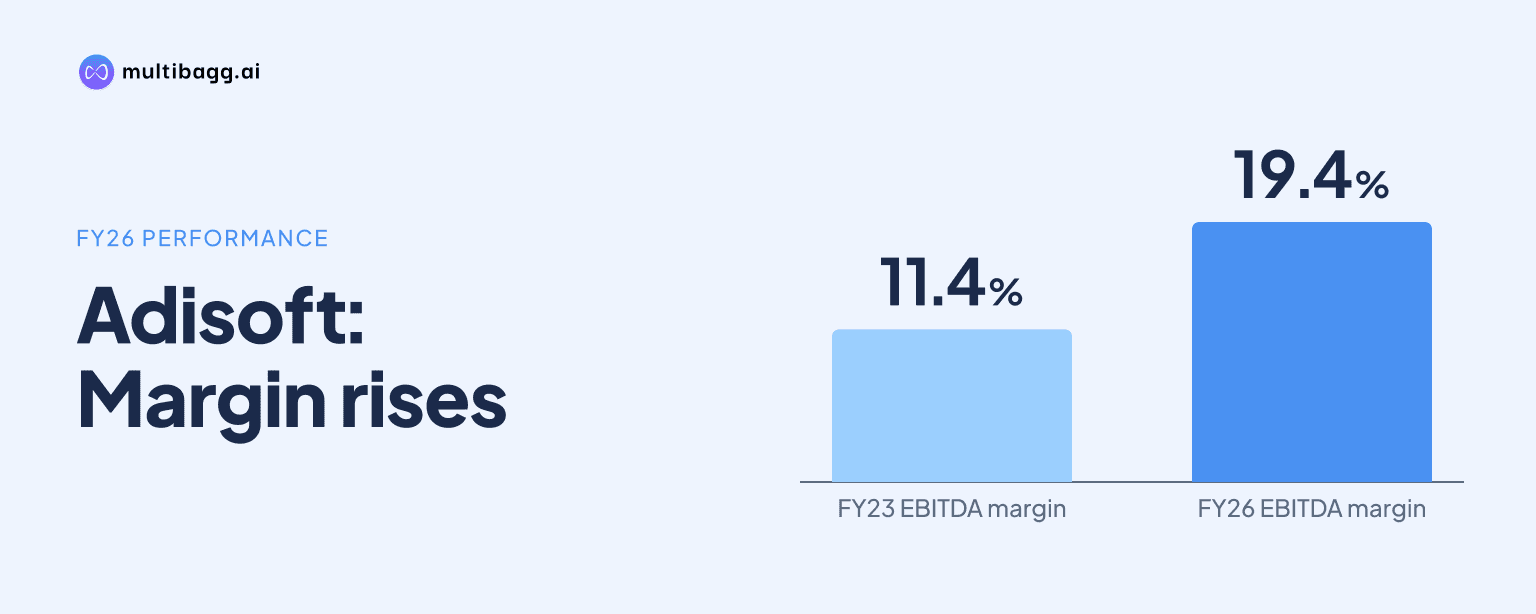
Adisoft Technologies lifted consolidated EBITDA, or earnings before interest, tax, depreciation and amortisation, to Rs 32.8 crore in FY26 from Rs 8.7 crore in FY23, nearly fourfold, and raised its EBITDA margin to 19.4% from 11.4%. Total income reached Rs 169.3 crore, while profit after tax was Rs 22.8 crore and cash from operations was Rs 17.3 crore in FY26.
Know Adisoft Technologies inside out
Results, valuation, peers and who's buying, in one view.
How did Adisoft’s income and EBITDA change from FY23 to FY26?
Adisoft increased total income to Rs 169.3 crore in FY26 from Rs 76.2 crore in FY23, while EBITDA rose to Rs 32.8 crore from Rs 8.7 crore. Income was therefore more than twice its FY23 level, whereas EBITDA was nearly four times the FY23 amount, alongside an 800-basis-point increase in EBITDA margin.
Adisoft reported higher total income and EBITDA in each of the four reported financial years. Total income increased by Rs 27.9 crore in FY24, Rs 29.6 crore in FY25 and Rs 35.6 crore in FY26; EBITDA increased by Rs 8.1 crore, Rs 6.3 crore and Rs 9.7 crore respectively. The FY26 EBITDA increase was the largest absolute annual rise in the period.
Adisoft’s EBITDA margin moved from 11.4% in FY23 to 16.1% in FY24, 17.3% in FY25 and 19.4% in FY26. The widening margin means the difference between total income and total expenditure grew from Rs 8.7 crore in FY23 to Rs 32.8 crore in FY26.
What changed in Adisoft’s FY26 cost structure and operating profit?
Adisoft’s total expenditure rose by less than total income in FY26, allowing EBITDA to increase to Rs 32.8 crore from Rs 23.1 crore in FY25. Total expenditure grew by Rs 25.9 crore to Rs 136.5 crore, while total income rose by Rs 35.6 crore to Rs 169.3 crore.
Raw-material expenses remained Adisoft’s largest cost line, rising to Rs 111.4 crore in FY26 from Rs 90.6 crore in FY25. Employee costs increased to Rs 12.8 crore from Rs 9.8 crore, and other expenses rose to Rs 12.3 crore from Rs 10.2 crore. These three cost lines accounted for Rs 136.5 crore of FY26 total expenditure.
Management provided a more specific explanation for the margin change in H1 FY27 standalone results, rather than for the FY23-FY26 consolidated period. It attributed the 653-basis-point EBITDA-margin increase to 23.19% from 16.66% to a richer mix of high-value smart-factory solutions, reusable in-house design and software intellectual property, and operating leverage.
Adisoft reported H1 FY27 standalone total income of Rs 73.52 crore, up from Rs 49.63 crore in H1 FY26, and EBITDA of Rs 17.05 crore, up from Rs 8.27 crore. Management described the first half as seasonally lighter, while noting that H1 FY27 standalone EBITDA was more than half of FY26 consolidated EBITDA of Rs 32.8 crore.
Got a follow-up? Ask IRIS
Did Adisoft’s profit and cash generation improve in FY26?
Adisoft’s profit after tax increased to Rs 22.8 crore in FY26 from Rs 5.8 crore in FY23, and cash from operations rose to Rs 17.3 crore after negative operating cash flow in FY24 and FY25. The profit-after-tax margin increased by 580 basis points to 13.5% in FY26 from 7.7% in FY23.
Cash from operations was Rs 3.0 crore in FY23, negative Rs 6.4 crore in FY24 and negative Rs 0.8 crore in FY25 before becoming positive at Rs 17.3 crore in FY26. Net cash flow remained positive in all four years, at Rs 2.7 crore in FY23, Rs 0.7 crore in FY24, Rs 9.2 crore in FY25 and Rs 5.7 crore in FY26.
Adisoft’s FY26 cash flow also included Rs 3.0 crore used in investing activities and negative Rs 8.7 crore from financing activities. In FY25, financing cash flow was positive Rs 9.1 crore, showing that the composition of cash movements changed even as net cash flow remained positive.
Trade receivables rose to Rs 82.5 crore in FY26 from Rs 56.1 crore in FY25, while the receivable-turnover ratio declined to 2.02 times from 2.32 times. Adisoft says 65% to 70% of its business is generally weighted to the second half and that 90% of receivables are usually received within 45 days of billing.
How did Adisoft’s balance sheet change by FY26?
Adisoft reported net worth of Rs 72.3 crore in FY26, up from Rs 49.4 crore in FY25 and Rs 21.4 crore in FY23, while its debt-to-equity ratio fell to 0.30 times from 0.58 times in FY25. The presentation attributes the balance-sheet change to the initial public offering and its proceeds.
Adisoft states that Rs 74.1 crore of initial public offering proceeds fund the new facility, debt repayment and working capital. Cash and bank balances were Rs 29.4 crore in FY26 versus Rs 23.8 crore in FY25, while non-current borrowings fell to nil from Rs 5.7 crore; current borrowings were Rs 21.6 crore in FY26.
Current assets increased to Rs 138.2 crore in FY26 from Rs 104.1 crore in FY25, while current liabilities rose to Rs 80.3 crore from Rs 61.2 crore. Trade payables increased to Rs 44.3 crore from Rs 27.2 crore, and the current ratio moved to 1.72 times from 1.70 times.
Interest coverage rose to 18.21 times in FY26 from 16.35 times in FY25, despite finance costs increasing to Rs 1.8 crore from Rs 1.4 crore. Fixed-asset turnover was 12.83 times in FY26 compared with 12.54 times in FY25, alongside fixed assets of Rs 13.0 crore.
Conclusion
Adisoft’s FY23-FY26 consolidated record combines revenue growth with higher reported profitability: total income rose from Rs 76.2 crore to Rs 169.3 crore, EBITDA increased from Rs 8.7 crore to Rs 32.8 crore, and EBITDA margin reached 19.4% from 11.4%. Profit after tax rose to Rs 22.8 crore, while cash from operations turned positive at Rs 17.3 crore in FY26 after two negative years.
The next items to watch are management’s FY27 targets of around 25% revenue growth, a sustainable profit-after-tax margin of 13% to 14%, and a debt-free balance sheet by year-end. Management also expects the Bhosari integrated facility to be partially operational from the end of Q3 FY27; it says the facility is designed to support four to five times the current revenue base.

