








Adisoft says concentration reflects embedded production systems
MAX Plan at ₹4,999/yr

Find your next multibaggerBe a Pro Investor
Research stocks and track your picks on the go. Download the app.
Key highlights
- Adisoft said its main automotive customer has more than 50% to 55% market share and roughly 17 to 20 production lines.
- Management said one vehicle leaves each of the main customer’s production lines every 50 seconds.
- Adisoft reported a pipeline-to-order conversion rate above 95%, with approximately Rs 50 crore of orders in hand.
- Management plans for non-automotive activities to represent 15% to 20% of Adisoft’s business basket within three to four years.
powered by IRIS
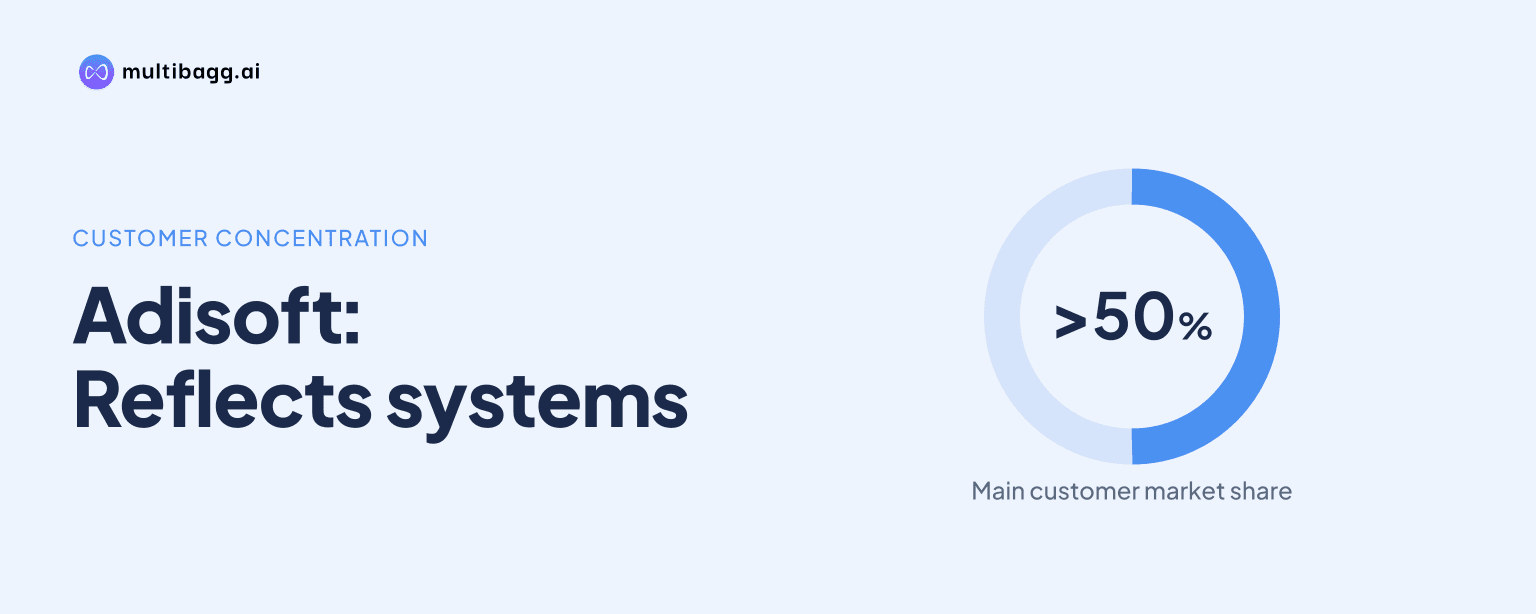
Adisoft says its concentration around a dominant automotive customer reflects an embedded production-systems partnership, supported by roughly 17 to 20 production lines where one vehicle leaves each line every 50 seconds. Management said the customer has more than 50% to 55% market share and repeatedly expands production facilities in India.
Know Adisoft Technologies inside out
Results, valuation, peers and who's buying, in one view.
Why does Adisoft rely on one dominant automotive customer?
Adisoft says the relationship has persisted through its 13-year history because its systems are embedded in the customer’s production operations and support repeat orders. Management described the customer as a market leader with more than 50% to 55% market share, whose planned growth and additional shop floors create demand for Adisoft’s installations.
Adisoft provides a complete package of hardware, software, service and support, according to management. It said production at the main customer is controlled by these systems, which combine factory-automation equipment with software for shop-floor operations, data capture and quality analysis.
The company said its systems also integrate enterprise resource planning, or ERP, and information-technology systems with the shop floor. In the main customer’s environment, where management said one vehicle comes off each of roughly 17 to 20 lines every 50 seconds, it argued that production speed and quality requirements make such integrated systems necessary.
Can Adisoft replicate this model with other automotive makers?
Adisoft says it cannot replicate the same model at every automotive maker because its systems are most relevant where production volumes, mixed models and quality-analysis requirements are high. Management compared the main customer’s 50-second vehicle output with an example of a lower-volume high-end vehicle maker that may have 10 to 15 minutes available for each vehicle.
Management said lower production volumes can limit the need for an installation of comparable intensity. It also identified vehicle complexity as a factor, saying a smaller vehicle may not require the same solution depth as a larger vehicle even when production speed is relevant.
Adisoft said it is already working with two-wheeler customers, but did not provide revenue from that segment or a target for scaling it to the level of the main automotive relationship. Management also did not disclose the revenue contribution of its largest customer or a split between automotive and non-automotive revenue at the time of the call.
Got a follow-up? Ask IRIS
How is Adisoft widening its customer base?
Adisoft says it is focusing on auto ancillaries, customer partners and pharmaceuticals, with management planning for non-automotive activities to form 15% to 20% of its business basket over the next three to four years. Management said the company had worked with a couple of automotive partners in the prior year and is continuing that effort.
The auto-ancillary approach centres on traceability and production-end data capture. Management said recall-policy requirements have made traceability reports and data capture mandatory, creating a potential need at customers that may not have the main customer’s volumes or multiple-model production lines.
In pharmaceuticals, Adisoft said it is initially pursuing manufacturing-data capture and reports required at the end of production cycles. Management plans to use that data-focused work to establish customer confidence, then seek further work involving special-purpose machines, or SPMs, and jigs and fixtures.
Management did not name pharmaceutical competitors, saying many players, including machine manufacturers, offer related services. Adisoft said its proposed advantage is capturing data irrespective of machine type, a capability it is applying from its automotive work rather than through building its own manufacturing capacity.
What supports Adisoft’s near-term project conversion?
Adisoft says its pipeline-to-order conversion rate is more than 95%, with approximately Rs 50 crore of orders in hand and around Rs 40 crore under discussion. Management said the normal project cycle is three to four months and expected the orders in hand and discussed opportunities to be implemented in the same financial year.
For larger orders of about Rs 2 crore to Rs 4 crore, Adisoft said it normally takes about 15 days after a purchase order to prepare detailed designs and approval documents. Management said customer approval can take another week, followed by 45 to 60 days to make the solution ready for dispatch, or roughly three months in total.
Adisoft said 80% to 85% of billing can occur before dispatch, while site installation remains after the equipment is proven to the customer. The company said it can redeploy 50% to 60% of an existing software solution on some new orders, reducing service effort relative to developing every solution from the beginning.
Trading represents roughly 20% to 25% of Adisoft’s activity and has margins of approximately 10%, while solutions represent around 75% to 80%, management said. Mitsubishi factory-automation components, including programmable logic controllers, human-machine interfaces, servos, drives and robots, account for roughly 25% to 35% of the value of Adisoft’s overall solutions.
Conclusion
Adisoft’s explanation of customer concentration rests on the production intensity of its main automotive relationship: more than 50% to 55% market share, roughly 17 to 20 production lines and a vehicle leaving each line every 50 seconds. Management says its hardware, software, service and support package is embedded in that environment, while its stated conversion rate above 95% points to a project pipeline built around specified production requirements.
The next measure of diversification will be progress toward management’s planned 15% to 20% non-automotive business share over three to four years, particularly in auto-ancillary traceability and pharmaceutical data projects. Readers can also watch execution of approximately Rs 50 crore of orders in hand and around Rs 40 crore under discussion, which management said generally carry a three- to four-month project cycle.

