










Aeroflex targets nearly Rs 1,500 crore FY30 revenue and 25% margins
Key highlights
- Aeroflex expects FY30 revenue close to Rs 1,500 crore, compared with its earlier FY29 target of Rs 1,000 crore.
- Aeroflex expects FY30 margins of about 25% and slightly higher.
- Aeroflex plans to complete its expansion by March 2028 and expects peak capacity utilisation in FY30.
- Aeroflex expects current-year sales of about Rs 715 crore to Rs 725 crore, representing almost 60% growth.
powered by IRIS
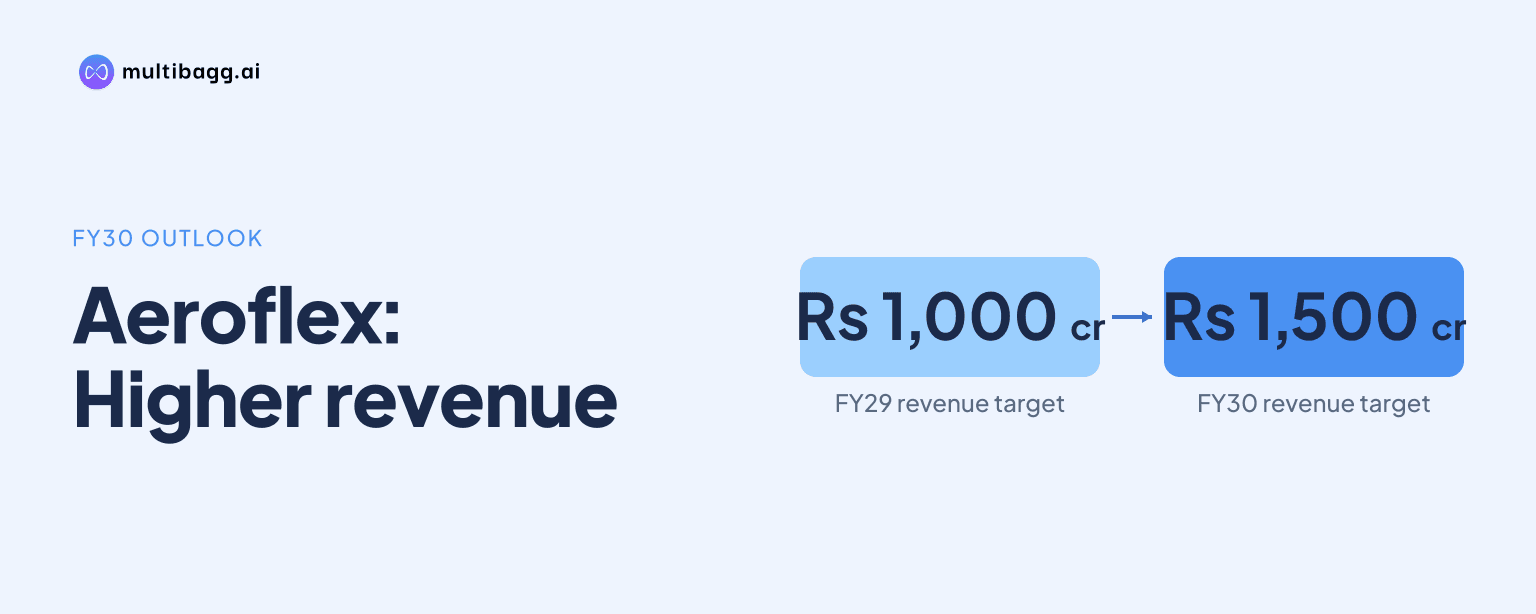
Aeroflex Industries Limited expects FY30 revenue close to Rs 1,500 crore and margins of about 25% or slightly higher, based on an expansion due for completion by March 2028 and planned peak capacity utilisation in FY30. The outlook is Rs 500 crore above its earlier FY29 revenue target of Rs 1,000 crore.
Know Aeroflex Industries inside out
Results, valuation, peers and who's buying, in one view.
What is Aeroflex’s new FY30 revenue and margin target?
Aeroflex expects revenue close to Rs 1,500 crore in FY30 and margins of about 25% or slightly higher. Management gave the outlook after an analyst asked whether the earlier FY29 revenue ambition of Rs 1,000 crore and 25% operating margin remained applicable following an upgrade to the FY27 baseline outlook. Management said the FY29 target would “definitely” be exceeded.
The FY30 revenue objective is Rs 500 crore, or 50%, above the earlier Rs 1,000 crore FY29 goal, although the two targets refer to different financial years. Management did not provide an annual revenue bridge from FY27 to FY30 or segment-specific revenue targets for that period. It based the FY30 figure on the expansion under way, its expected completion by March 2028, and peak capacity utilisation in FY30.
What capacity expansion supports Aeroflex’s FY30 target?
Aeroflex linked the Rs 1,500 crore FY30 ambition to capacity expansion that management expects to complete by March 2028 and operate at peak utilisation in FY30. The company is expanding hose-assembly capacity from 20 million metres to 30 million metres. At peak utilisation, management estimated hose-segment revenue of about Rs 850 crore to Rs 900 crore, assuming 70% to 75% of capacity is used for hose assemblies.
Management said overall stainless-steel hose capacity was operating at about 80% utilisation, while the newly commissioned skid-assembly capacity was still in ramp-up. For the current financial year, Aeroflex expects skid capacity utilisation of about 40% to 50%, while its target is to reach peak utilisation of commissioned skid capacity in FY28. The differing levels indicate that hose capacity is more fully used than the newer skid capacity.
Aeroflex disclosed capital expenditure of Rs 124 crore for hose assemblies and Rs 78 crore for skid assemblies, totalling Rs 202 crore across those two product areas. Management did not identify how much of the Rs 1,500 crore FY30 target would come from hoses, skids, bellows or other operations. It named data centres, firefighting, and ports and terminals as its three main near-term growth drivers.
Got a follow-up? Ask IRIS
How could data centres and exports contribute to Aeroflex’s growth?
Aeroflex said data centres had become its largest vertical, supported by liquid-cooling sales and demand for hose assemblies from data-centre customers. Management described ports and terminals as another business with significant demand, followed by oil and gas and steel. In the mix discussed on the call, data centres and ports and terminals together accounted for about 26% to 27% of business, while firefighting, steel and oil and gas together contributed about 30%.
Exports are expected to be the larger market for hose assemblies, according to management. It said the greatest traction for hose assemblies should come internationally, particularly in data centres, firefighting, and ports and terminals. Aeroflex is in advanced discussions with its existing domestic customer on international skid supply, but management gave no timing for first supply because overseas projects require country-specific designs, controls, checks and audits.
Skid pricing can vary materially by project complexity rather than following a fixed upward or downward trend. An analyst cited average quarterly realisation of Rs 3.39 lakh per skid, while management said Aeroflex had sold skids at values ranging from Rs 1.50 lakh to Rs 5 lakh. Management said the quarterly average depends on the particular data-centre projects supplied during that period.
Can Aeroflex maintain margins as it scales capacity?
Aeroflex expects margins of about 25% and slightly higher in FY30 rather than forecasting a large increase solely from scale. Management said economies of scale could provide benefits as volumes rise, but pricing pressure may also emerge as the company scales its verticals. Its margin expectation incorporates both factors rather than assigning a quantified uplift to capacity expansion.
Management said the subsidiary’s turnover was about 3% of Aeroflex’s quarterly turnover, indicating that its direct effect on group-wide margins would be minimal. It also declined to quantify the margin effect of two welding-automation lines. Aeroflex said automation is intended to reduce dependence on manual work, expand production capacity and lower product rejections through improved quality.
The nearer benchmark is management’s current-year sales outlook of about Rs 715 crore to Rs 725 crore, representing growth of almost 60%. Aeroflex also raised the skid-assembly revenue target to Rs 150 crore to Rs 200 crore, from an initial target of about Rs 125 crore that management said would be achieved in the quarter under discussion. These operating targets do not assure the FY30 result, but they provide the stated context for the higher long-term ambition.
Conclusion
Aeroflex has raised its long-term revenue reference point to close to Rs 1,500 crore in FY30 from the earlier Rs 1,000 crore target for FY29, while retaining a margin expectation around 25%. The plan depends on expanded hose-assembly capacity, ramp-up of liquid-cooling skid assemblies, and management’s expectation of demand from data centres, firefighting, and ports and terminals, including international hose-assembly sales.
The disclosed milestones are completion of the expansion by March 2028, peak utilisation of commissioned skid capacity in FY28, and peak utilisation of the broader expanded capacity in FY30. Investors will also watch whether advanced discussions for international skid supply result in commercial orders, as management said overseas designs, sampling, pricing, controls and audits remain to be completed.