










Aeroflex Industries Limited earmarks Rs 202 crore for skid doubling
Key highlights
- Aeroflex plans Rs 202 crore of capex, comprising Rs 124 crore for hose capacity and Rs 78 crore for skid assemblies.
- Skid-assembly capacity is targeted to reach 30,000 units per annum by March 2028, from a 15,000-unit programme due in December 2026.
- Stainless-steel flexible flow-solutions capacity is planned to rise from 20 million to 30 million metres per annum by March 2028.
- Management estimates the added capacities could generate Rs 500 crore to Rs 550 crore of annual incremental revenue at peak utilisation.
powered by IRIS
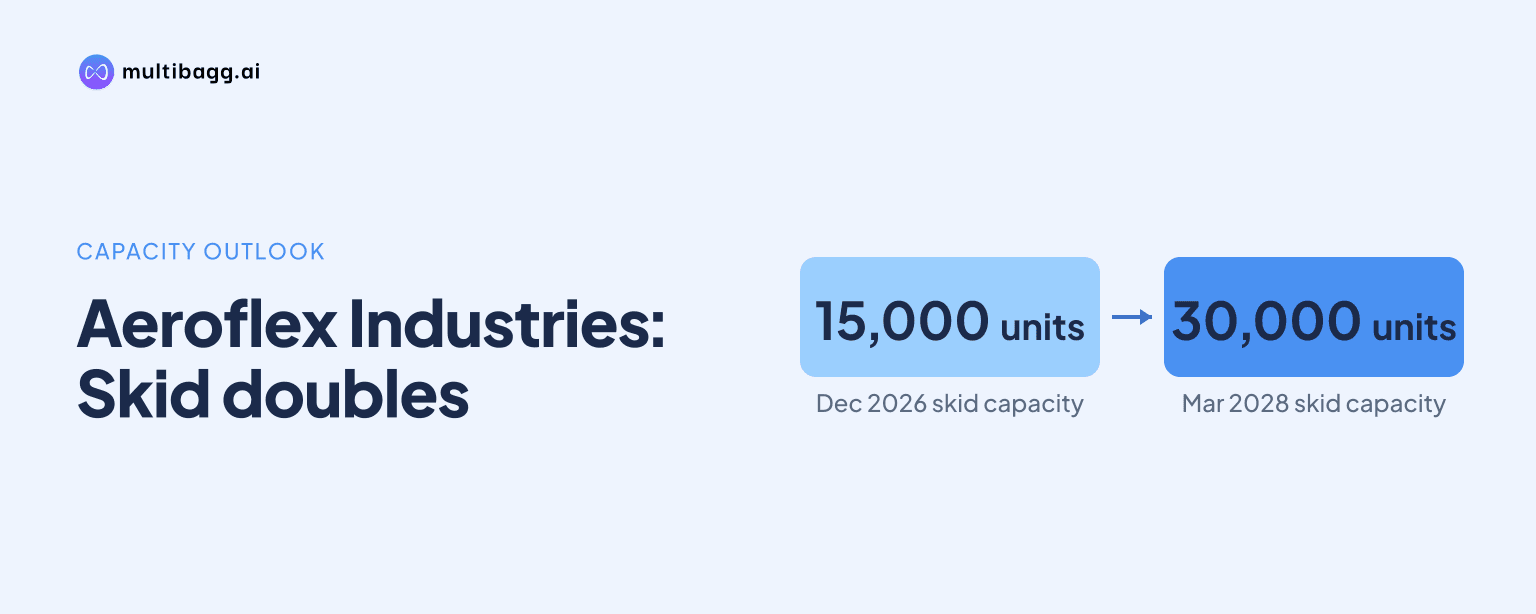
Aeroflex Industries Limited has earmarked Rs 202 crore to expand stainless-steel flexible flow solutions and raise skid-assembly capacity to 30,000 units a year by March 2028, with management estimating Rs 500 crore to Rs 550 crore of annual incremental revenue potential when the added capacities reach peak utilisation.
Know Aeroflex Industries inside out
Results, valuation, peers and who's buying, in one view.
What is Aeroflex spending Rs 202 crore on?
Aeroflex is allocating Rs 124 crore to add 10 million metres of annual stainless-steel flexible flow-solutions capacity and Rs 78 crore to lift skid-assembly capacity from the planned 15,000 units to 30,000 units annually. Management said both additions are expected to be completed by March 2028 and are intended to address demand visibility in flexible flow solutions and skid assemblies.
The company said the Rs 202 crore programme will be funded primarily through internal accruals and bridge-loan financing, with an equity fund raise considered if required. In the October 29, 2026 call, management also said that internal accruals would be the first funding source, followed by interim or long-term financing, with equity as a later option.
How will Aeroflex hose and skid capacity change by 2028?
Aeroflex has completed expansion of its stainless-steel flexible flow-solutions manufacturing capacity to 20 million metres annually and plans another 10 million metres, taking total capacity to 30 million metres a year by March 2028. The Rs 124 crore hose programme will combine brownfield expansion at the existing Taloja facility with a proposed new manufacturing facility for hose assemblies.
Skid capacity is set to double from 15,000 to 30,000 assemblies a year in the next phase, after the current expansion reaches 15,000 units by December 2026. Of that nearer-term 15,000-unit programme, 12,000 units of annual capacity had already been commissioned at the time of the call, leaving 3,000 units to be completed before the December 2026 target.
Management described the programme as phased rather than a single commissioning event. In response to a question on whether capacity could prove insufficient if Indian data-centre projects grow rapidly, management said Aeroflex would increase capacity based on requirements seen from the market; it noted that capacity had moved from 2,000 to 15,000 units over roughly the previous 1.5 years and is now planned to move to 30,000.
What revenue could the added capacity generate?
Aeroflex estimates that the added hose and skid capacities could generate Rs 500 crore to Rs 550 crore of annual incremental revenue at peak capacity utilisation. This is a management estimate tied to utilisation of the additional facilities, not a disclosed order book or a forecast for a specified financial year.
The company said the expansion is meant to support larger customer programmes across data centres and other high-growth industries. For liquid-cooling skids, management said it generally has a confirmed supply pipeline for at least the next three months, covering the current quarter and the start of the following quarter, but it did not disclose an order-book value because of customer confidentiality.
The revenue opportunity follows reported Q2 FY27 growth. Aeroflex recorded total income of Rs 207.68 crore, up 87% year on year, while earnings before interest, tax, depreciation and amortisation, or EBITDA, rose 94% to Rs 50.34 crore. In H1 FY27, total income was Rs 353.66 crore, up 81% year on year, and EBITDA increased 103% to Rs 83.83 crore, with the EBITDA margin rising to 23.77% from 21.19% in H1 FY26.
Got a follow-up? Ask IRIS
Why is Aeroflex expanding liquid-cooling capacity?
Aeroflex is expanding skid capacity because management sees higher computing requirements, rack density and heat generation accelerating the move from conventional air cooling to liquid cooling in data centres. Its SFN skid assemblies are designed to facilitate controlled coolant circulation, while its engineered assemblies and flexible connection solutions serve the flow-control needs of liquid-cooling infrastructure.
Liquid cooling contributed 24% of Aeroflex revenue in H1 FY27, according to management, alongside 40% year-on-year growth in the metal flexible hose business and 44% growth in assemblies and other value-added products. Management presented those figures as evidence that the company is broadening from flexible hoses into integrated flow-control and cooling solutions.
For the Indian liquid-cooling business, Aeroflex said it works exclusively with one large U.S. multinational customer rather than bidding directly with data-centre end users. The company also said it is speaking with a couple of international players about supplying liquid-cooling solutions, although management said it would provide further details only once discussions are finalised. It has earmarked part of the expanded capacity for international markets as well as India.
How do the expansion plans fit Aeroflex's wider strategy?
Aeroflex said its three priorities are to strengthen metallic flexible hoses and assemblies through capacity, automation, product innovation and deeper market penetration; scale liquid-cooling solutions through manufacturing and engineering capabilities; and invest in technology, research and development, or R&D, and advanced manufacturing. During the call, it also disclosed a patent for a system and method that automatically generates three-dimensional computer-aided design models for braided hose assemblies.
The company is also merging wholly owned Hyd-Air Engineering into Aeroflex to integrate operations and use Hyd-Air facilities for products used by Aeroflex. Management did not quantify savings, though it said the merger could increase margins by at least a couple of percentage points on account of costs; it later said an exact figure would be shared only after the merger is completed.
Reported H1 FY27 profit after tax was Rs 55.35 crore, with a 15.65% margin. Comparability requires attention because Aeroflex changed its depreciation method from written-down value to straight-line method effective April 1, 2026, reducing depreciation expense by Rs 8.41 crore in both Q2 FY27 and H1 FY27.
Conclusion
The Rs 202 crore programme gives Aeroflex defined capacity targets in both flexible flow solutions and liquid-cooling skids: 30 million metres of hose capacity and 30,000 skid assemblies a year by March 2028. Management's Rs 500 crore to Rs 550 crore annual incremental-revenue estimate depends on the new capacity reaching peak utilisation, while H1 FY27 showed liquid cooling contributing 24% of revenue and growth in both hoses and value-added assemblies.
The next disclosed milestone is completion of the current skid programme to 15,000 units annually by December 2026, followed by the hose and next skid phase by March 2028. The funding mix, progress in international liquid-cooling discussions and the operational effects of the Hyd-Air merger remain matters to watch as the programme advances.