










Aeroflex keeps new skid capacity open for overseas sales
Key highlights
- Aeroflex said liquid-cooling exclusivity applies only in India, not international markets.
- Aeroflex plans to raise annual skid capacity to 30,000 units by March 2028.
- Aeroflex has commissioned 12,000 units of its planned 15,000-unit skid capacity due by December 2026.
- The Rs 202 crore expansion programme has estimated incremental annual revenue potential of Rs 500 crore to Rs 550 crore at peak utilisation.
powered by IRIS
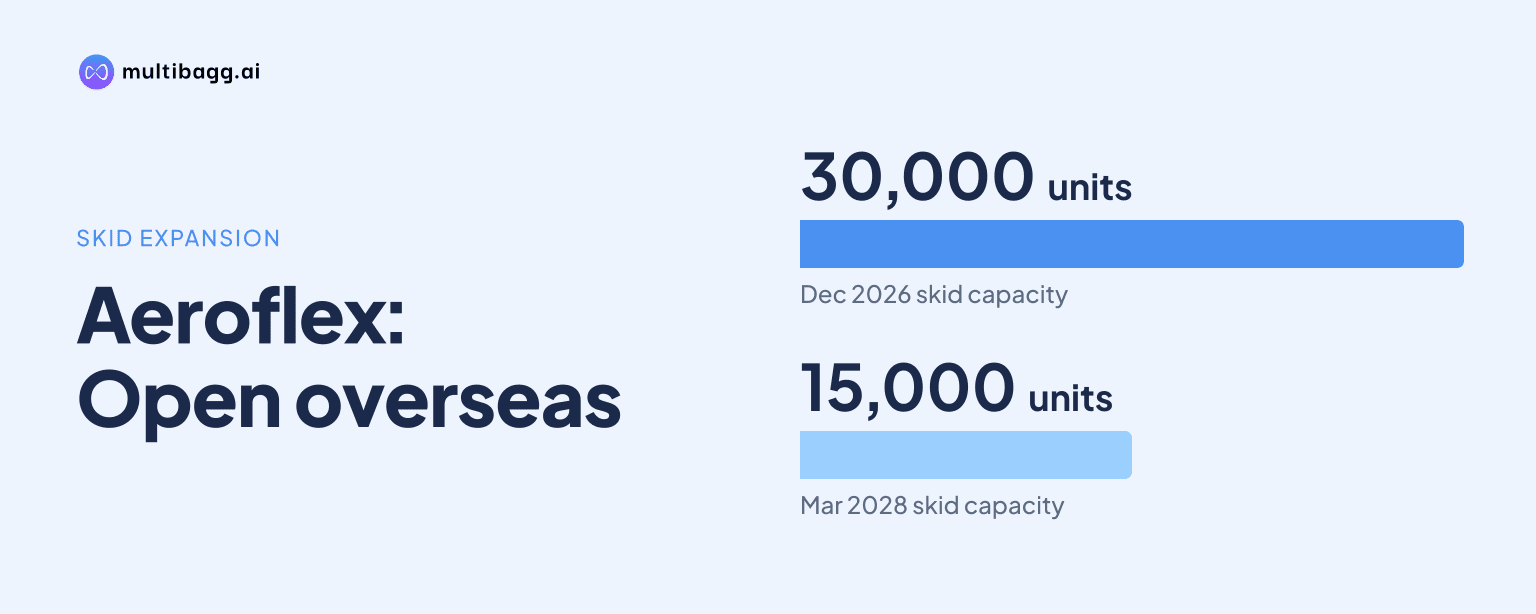
Aeroflex Industries said its planned 30,000-unit annual liquid-cooling skid capacity will serve India and overseas customers because its exclusivity arrangement with a large US multinational applies only in India. Aeroflex has earmarked part of the expanded capacity for international business, with the full 30,000-unit target due by March 2028.
Know Aeroflex Industries inside out
Results, valuation, peers and who's buying, in one view.
Does Aeroflex's India exclusivity restrict overseas liquid-cooling sales?
No. Aeroflex said the exclusivity remains intact only for the Indian market, while there is no exclusivity internationally. The company can therefore allocate liquid-cooling skid capacity to overseas customers while continuing its India supply arrangement with the large US multinational.
Management clarified that exclusivity is not assigned plant by plant. Aeroflex earmarks specified manufacturing capacity for customers regardless of which unit produces the skid assemblies, rather than treating an existing facility as exclusive and a new facility as non-exclusive.
The distinction leaves the company able to pursue export programmes without changing its India arrangement. Aeroflex said it works exclusively with one customer for liquid cooling in India and does not bid directly to data-centre end users, while it is speaking with a couple of international players about supplying liquid-cooling solutions.
How much Aeroflex capacity is available for international customers?
Aeroflex has not disclosed the number of skid units earmarked for overseas buyers. Management said certain capacity from the additional expansion would be devoted to international customers and the rest would support India, but it gave no numerical allocation between those markets.
The production mix will depend on demand rather than a fixed export allocation. Management said it would add capacity as market requirements emerge, noting that its skid capacity moved from 2,000 units to 15,000 units and is now planned to rise to 30,000 units over about 1.5 years.
Aeroflex said it generally has confirmed supply visibility for a minimum of three months, including a frozen pipeline for the current quarter and the beginning of the next quarter. It did not disclose its liquid-cooling order book or bid pipeline, citing customer confidentiality.
When will Aeroflex's liquid-cooling skid capacity reach 30,000 units?
Aeroflex expects annual liquid-cooling skid capacity to reach 30,000 units by March 2028. It has commissioned 12,000 units of the initially planned 15,000-unit annual capacity, whose first phase is expected to be completed by December 2026.
The move from 15,000 to 30,000 skid assemblies annually requires an additional investment of Rs 78 crore. That phase is part of Aeroflex's Rs 202 crore expansion programme, including Rs 124 crore to lift stainless-steel flexible flow solutions capacity from 20 million metres to 30 million metres a year by March 2028.
At peak utilisation, management estimates the added capacities could generate incremental annual revenue of about Rs 500 crore to Rs 550 crore. This is a revenue-potential estimate for the combined expansion programme, rather than a forecast of booked sales or a disclosed split between skids and flexible flow solutions.
Got a follow-up? Ask IRIS
What must happen before Aeroflex can begin overseas supply?
Aeroflex must complete sampling, pricing, controls, checks and audits before international supply begins. Management said discussions with its existing customer about overseas supply started a couple of months before the call and had reached an advanced stage, but it did not provide a first-shipment date or confirm a commercial order.
The international liquid-cooling design is not the same as the Indian design. Aeroflex said overseas flexible flow network designs account for local requirements, installation capabilities, geography and topography, while each Indian data centre can also require a separate design.
Management expects international realisations to be higher than in India but said it was too early to quantify the difference before the first supply. Discussions with other international customers are at an earlier stage, and Aeroflex gave no timetable for converting those discussions into customer programmes.
How does the expansion fit Aeroflex's performance and funding plan?
Aeroflex reported total income of Rs 207.68 crore in Q2 FY27, up 87% year on year, and profit after tax of Rs 36.56 crore, up 157%. In H1 FY27, total income was Rs 353.66 crore, up 81%, while profit after tax was Rs 55.35 crore; management cited increasing liquid-cooling solutions contribution as part of its business momentum.
Earnings before interest, tax, depreciation and amortisation margin was 24.27% in Q2 FY27 and 23.77% in H1 FY27, compared with 21.19% in H1 FY26. However, Q2 and H1 depreciation expense fell by Rs 8.41 crore after Aeroflex changed its depreciation method from written-down value to straight-line method, effective April 1, 2026.
Management said the Rs 202 crore programme would be funded first through internal accruals, followed by bridge financing or long-term financing, with an equity fund raise only if needed. For the skid business, management expects total capacity utilisation of roughly 40% to 50% during the financial year and said it reviews projections monthly or quarterly as the market develops.
Conclusion
Aeroflex has set a defined geographic boundary around its liquid-cooling arrangement: exclusivity applies in India, while international sales remain open. The planned increase to 30,000 skid assemblies annually by March 2028 can therefore support domestic supply to its existing customer as well as potential overseas programmes, without allocating capacity by plant.
The next developments to watch are completion of the 15,000-unit first phase by December 2026, progress toward 30,000 units by March 2028, and the outcome of advanced overseas sampling and pricing discussions. Management has not disclosed the number of units reserved for international buyers, the timing of a first export shipment, or commercial terms for any international supply arrangement.