










Varroc says war inflation cut H1 EBITDA by 0.4 percentage points
Key highlights
- Varroc reported H1 FY2027 revenue of Rs 5,582.2 crore, up 31.8% year-on-year.
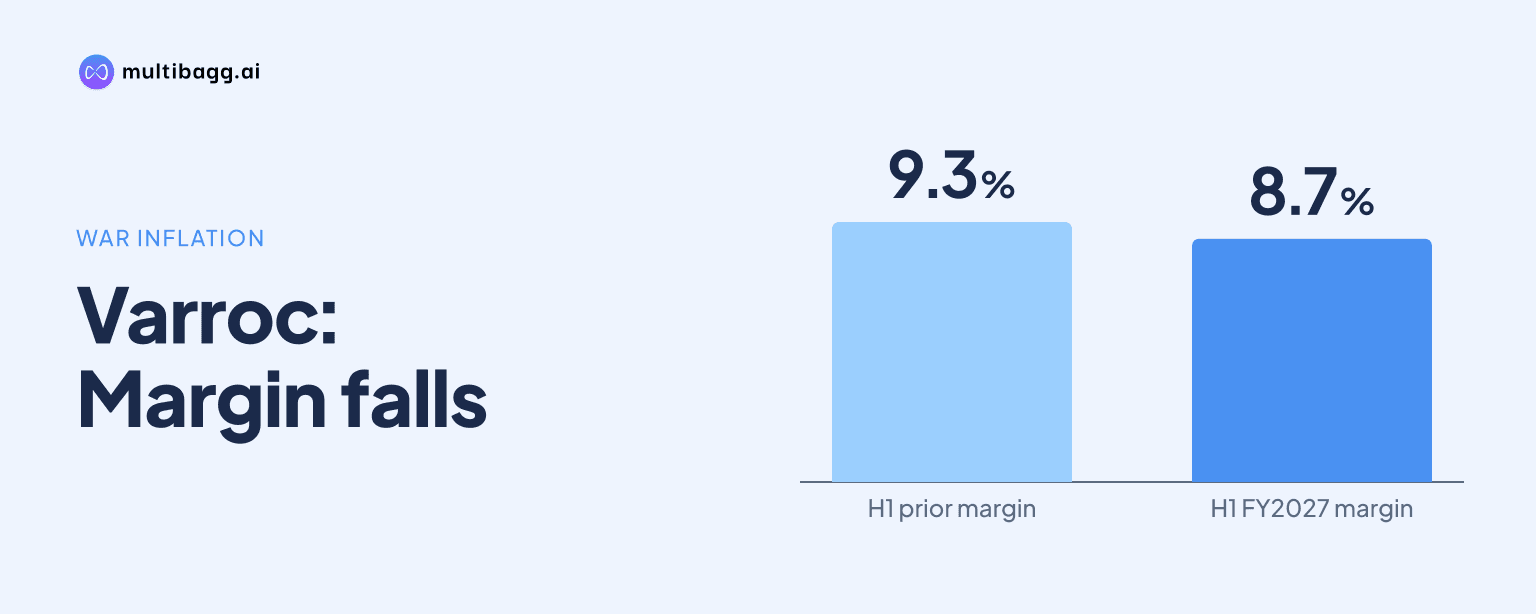
- H1 FY2027 EBITDA margin was 8.7%, compared with 9.3% a year earlier.
- More than Rs 114 crore of agreed customer recoveries remained uncollected at September 30, 2026.
- Net debt increased Rs 59.9 crore from March 31, 2026, to Rs 554.7 crore.
powered by IRIS
In H1 FY2027, Varroc Engineering Limited said war-linked input under-recoveries reduced EBITDA, or earnings before interest, tax, depreciation and amortisation, by 0.4 percentage points, while more than Rs 114 crore of agreed customer recoveries remained uncollected at September 30, 2026. The cash gap contributed to net debt rising Rs 59.9 crore from March.
Know Varroc Engineering inside out
Results, valuation, peers and who's buying, in one view.
Why did Varroc's H1 EBITDA margin decline?
Varroc's H1 FY2027 EBITDA margin declined to 8.7% from 9.3% a year earlier as commodity and input-cost inflation outpaced customer price recoveries. Management said the under-recovery reduced H1 EBITDA by 0.4 percentage points, although it also described the year-on-year under-recovery effect as close to 0.6% during the question-and-answer session. Consolidated revenue rose 31.8% year-on-year to Rs 5,582.2 crore.
The company said geopolitical uncertainty and the war had renewed commodity inflation, creating a timing gap between higher input costs and customer recovery. It is addressing that gap through customer discussions, value engineering, localisation and cost-productivity measures. Management said the recovery process is not automatic in practice because Varroc requires firm customer confirmation before recognising amounts in an unusual inflationary environment.
The Q2 comparison showed sequential improvement but a year-on-year margin shortfall. Q2 FY2027 EBITDA margin was 8.9%, compared with 8.5% in Q1 FY2027 and 9.1% in Q2 FY2026, while Q2 revenue increased 33.6% year-on-year to Rs 2,947.9 crore. Management said India-business margin softened on under-recovered war-related costs, while shifts in business mix, including higher electric-vehicle content, also affected overall margins.
Higher sales nevertheless supported profitability below EBITDA. Profit before tax before joint-venture profits and exceptional items reached 4.5% of H1 FY2027 revenue, compared with 4.1% a year earlier. India operations grew 29.5% year-on-year in H1 and overseas operations grew 104.1%, although management noted that overseas growth was measured against a lower base after earlier declines.
How much cash does Varroc still need to collect from customers?
Varroc had more than Rs 114 crore of customer-approved price recoveries that had not been realised in cash during H1 FY2027. Management distinguished this amount from the broader margin pressure: the Rs 114 crore relates to price revisions already agreed with customers, while under-recovery concerns input-cost increases not yet fully offset through pricing.
That distinction matters because collection of the agreed amount is principally a cash-flow event rather than an equivalent addition to EBITDA. When asked whether receiving Rs 114 crore would raise EBITDA by the same amount, management said no. It added that inflation increases revenue without necessarily generating a margin, and estimated that commodity inflation accounted for about 5% to 6% of reported growth.
Varroc said it expects recovery pressure to moderate as customer recoveries progressively flow through, but it did not provide a collection date for the pending Rs 114 crore. Management said it would continue to pursue recoveries in the near term. Its assessment of a potential return to earlier India margins was conditional on macroeconomic conditions not worsening.
Got a follow-up? Ask IRIS
What does this mean for Varroc's debt and capital spending?
Varroc's consolidated net debt stood at Rs 554.7 crore at September 30, 2026, compared with Rs 495.2 crore at March 31, 2026. The Rs 59.9 crore increase reflected the cash-flow effect of pending recoveries, while management said the increase from March was primarily attributable to a capital-expenditure-heavy year. Net debt to equity was 0.29 and net debt to annualised adjusted EBITDA was 0.57 times.
Management said it does not expect a significant reduction in debt by the end of FY2027 and aims to keep it broadly around current levels in the coming quarters. It cited the pending customer recoveries, government incentives yet to be received and ongoing investment needs. Management said a more significant reduction should occur by the end of the following financial year.
Capital expenditure is the other near-term call on cash. Varroc spent almost Rs 290 crore in H1 FY2027 and maintained its indicated full-year capital-expenditure range of Rs 500 crore to Rs 550 crore. That indicates more than Rs 200 crore of further spending in H2, while management continues to prioritise free-cash-flow generation, leverage reduction and funding of organic and selective inorganic opportunities.
Can overseas operations and restructuring improve Varroc's margins?
Varroc expects overseas profitability to improve as Romania production ramps up and Italy two-wheeler-lighting manufacturing is shifted to Romania and Vietnam. Overseas revenue grew about 138% year-on-year in Q2 FY2027, supported by new programme conversion, engineering income and lower research-and-development losses because of higher capitalisation. Management cautioned that Q2 included design income and should not be treated as a recurring run rate.
Management's internal target is for the Romania business to reach EBITDA break-even by the end of FY2027. It said the Romania ramp-up and Italy restructuring should begin to improve performance from Q4, with much of the effect visible next year. The restructuring is intended to remove an underutilised manufacturing footprint in Italy while retaining customer programmes and technology.
The Italy restructuring is expected to be completed in about six months. Management said savings should begin from the next financial year and the shutdown-related investment should have a three-year payback, but it did not disclose the investment or annual saving. Q2 FY2027 exceptional items totalled Rs 63 crore, reflecting the Italy decision and settlement of old tax disputes; profit before tax after exceptional items was Rs 78 crore, compared with Rs 140.1 crore before exceptional items.
Conclusion
Varroc's H1 FY2027 results show that revenue growth and operating leverage partly absorbed war-linked input inflation, but did not prevent EBITDA margin from falling to 8.7% from 9.3%. The margin effect and cash-flow effect are separate: under-recovery reduced H1 EBITDA by 0.4 percentage points, while more than Rs 114 crore of agreed recoveries remained unpaid and constrained cash conversion.
The next items to watch are customer collections, the planned Rs 500 crore to Rs 550 crore FY2027 capital expenditure and management's expectation that debt will remain near current levels this year before declining more materially by the end of the following year. Management also targets Romania EBITDA break-even by FY2027-end and expects savings from the Italy restructuring to start in the next financial year.