










Varroc seeks control through €4.5 million Forsee India deal
Key highlights
- Varroc proposes €4.5 million of upfront consideration for a 45% stake and operating-control rights in Forsee Power India.
- Up to €2 million is contingent, split between a €1 million operational milestone and a €1 million revenue or gross-margin milestone.
- Varroc would appoint the chief executive officer and chief financial officer, while its chair would have a casting vote on a four-member board.
- E-mobility was 8.6% of Varroc’s H1 FY27 product-group mix, and electric-vehicle supplies were about 19% of Q2 FY27 revenue.
powered by IRIS
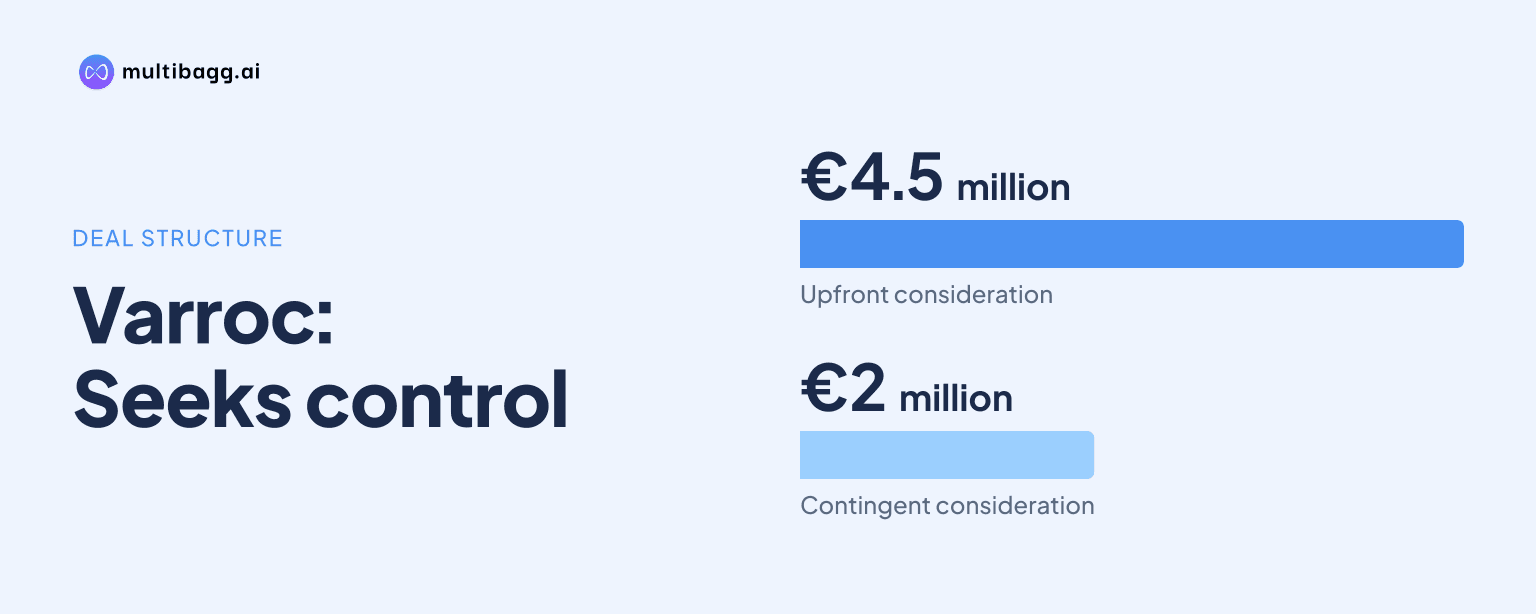
Varroc proposes to gain operating control of Forsee Power India through €4.5 million of upfront consideration, a 45% equity stake and governance rights including a casting board vote. The proposal also makes up to €2 million conditional on operational, revenue or gross-margin outcomes, while an additional 6% ownership is contemplated on a fully diluted basis.
Know Varroc Engineering inside out
Results, valuation, peers and who's buying, in one view.
What is Varroc acquiring through the Forsee Power India proposal?
Varroc is proposing to acquire a controlled entry into battery systems through an operating India platform rather than build battery-pack capability from scratch. The presentation says the arrangement would add battery packs and battery-management systems (BMS) to Varroc’s lighting, electronics and electrical portfolio, beginning with two-wheeler and three-wheeler traction applications.
The proposed initial focus matches Varroc’s existing vehicle exposure in H1 FY27, when two-wheelers and three-wheelers accounted for 75% of revenue and four-wheelers accounted for 25%. E-mobility represented 8.6% of product-group revenue in H1 FY27, while supplies to electric vehicles were about 19% of Q2 FY27 revenue, according to the presentation.
Varroc says the platform would combine Forsee technology with its original-equipment-manufacturer access, localisation, sourcing and manufacturing execution. Beyond the initial two-wheeler and three-wheeler traction market, the disclosed plan is to extend battery-system applications toward buses, trucks, off-highway equipment and industrial uses.
The proposal remains subject to final transaction documentation rather than representing a completed acquisition. Varroc says the final shareholder agreement, share-purchase agreement, technology-licence agreement, manufacturing-services agreement, capitalisation table and adviser conclusions will determine the final mechanics of the proposed 45% stake and control structure.
How would Varroc control Forsee Power India with 45% equity?
Varroc would seek operating control through board and management rights while holding 45% equity at closing. The proposed four-member board would comprise two Varroc directors and two Forsee directors, with the Varroc chair holding a casting vote where a board decision is tied.
Varroc would also appoint the chief executive officer and chief financial officer under the proposed arrangement. The presentation says reserved matters would protect both shareholders, so the stated model combines Varroc’s operating role with specified protections for both sides in a business governed by a four-member board.
The presentation identifies an additional 6% ownership on a fully diluted basis through conversion of subscription instruments and agreed call-put mechanisms. Varroc says those mechanisms are intended to preserve majority economics and targeted control, but it does not disclose a final post-conversion ownership percentage or a closing date.
This separates the proposed 45% legal stake at closing from the wider economic and governance design. The two board appointments, casting vote and right to appoint the chief executive officer and chief financial officer are the disclosed mechanisms through which Varroc would exercise operating control before considering the additional 6% fully diluted ownership.
How is the €4.5 million Forsee Power India consideration structured?
The disclosed transaction begins with €4.5 million of upfront consideration through a primary subscription and a secondary acquisition. Varroc would also subscribe to two instruments, identified as OCRPS I and II, although the presentation does not allocate the €4.5 million between the primary subscription, secondary acquisition and those instruments.
Up to €2 million would be contingent rather than paid at closing. One €1 million payment is linked to an operational milestone, while a separate €1 million payment is tied to a revenue or gross-margin milestone, making the maximum disclosed amount €6.5 million if both conditions are met.
Varroc describes the staged payment approach as performance-linked downside protection because €2 million depends on stated outcomes. The presentation does not disclose the timing, thresholds, measurement methodology or baseline for either the €1 million operational milestone or the €1 million revenue or gross-margin milestone.
Got a follow-up? Ask IRIS
Why does the proposed battery platform fit Varroc’s EV business?
The proposed platform fits Varroc’s electric-vehicle strategy because it would add battery packs and BMS alongside its existing e-mobility, electronics and electrical products. In H1 FY27, e-mobility was 8.6% of Varroc’s product-group revenue mix, compared with 34.0% for body parts and 22.9% for internal-combustion-engine powertrain products.
Varroc’s new business wins also show a nearly even customer split between electric and internal-combustion vehicle markets. Of Rs 1,012.7 crore in net new annual peak revenue wins in H1 FY27, 48% came from electric-vehicle customers and 52% from internal-combustion-engine customers.
The source places the battery proposal alongside, rather than in place of, Varroc’s existing vehicle product lines. Varroc separately identifies high- and low-voltage electronics, electric passenger-vehicle inverter electronics, lighting, connectivity and smart-mobility applications, while the Forsee Power India proposal specifically concerns battery packs and BMS.
The sequence of applications also follows Varroc’s present revenue mix. With two-wheelers and three-wheelers representing 75% of H1 FY27 revenue, Varroc proposes to establish traction capability in that segment first and subsequently pursue buses, trucks, off-highway equipment and industrial applications without disclosing a revenue target or launch timetable.
What remains unresolved before the Forsee Power India transaction closes?
The principal unresolved matters are the final agreements and transaction conclusions that govern the proposed €4.5 million arrangement. Varroc says the shareholder agreement, share-purchase agreement, technology-licence agreement, manufacturing-services agreement, final capitalisation table and adviser conclusions remain to be executed or concluded.
Technology continuity is a stated protection within the proposed structure, not a completed result. Varroc says contractual technology-continuity protections support its plan to combine Forsee technology with its localisation and manufacturing capabilities, but the presentation does not specify a licence term, technology scope or transfer obligation.
The two €1 million contingent payments also create the disclosed operational and financial tests after closing. However, Varroc does not state the date by which the operational, revenue or gross-margin milestones must be achieved, whether partial performance earns a payment, or the relevant revenue and margin baselines.
The industrial expansion path remains unquantified as well. Varroc identifies two-wheeler and three-wheeler traction as the starting market and buses, trucks, off-highway equipment and industrial applications as later opportunities, but does not disclose production capacity, customer programmes, programme start dates or expected revenue contribution.
Conclusion
Varroc’s proposal is a planned controlled entry into battery systems, structured around €4.5 million at closing, a 45% equity stake and operating rights rather than a simple minority investment. The proposed board casting vote, management appointments and possible additional 6% ownership are designed to support targeted control, while the €2 million contingent component links part of the total €6.5 million potential consideration to delivery.
The next disclosures to watch are the execution of the final agreements, the confirmed capitalisation table and the definitions and timing of the two €1 million milestones. Varroc’s subsequent updates will also show whether it establishes the disclosed two-wheeler and three-wheeler traction platform and progresses its stated plan toward buses, trucks, off-highway equipment and industrial applications.