










Varroc reports Romania electronics sales rise but no overseas EBITDA
Key highlights
- Varroc reported Electronics Romania revenue of Rs 73.4 crore in Q2 FY27 versus Rs 46.9 crore in Q1 FY27.
- The Romania electronics facility has infrastructure prepared for 7 SMT lines and 10 backend lines.
- Varroc’s bidirectional Level 2 version 2 charger handles up to 11.5 kilowatts and has stated efficiency above 97%.
- The supplied presentation does not disclose overseas EBITDA, overseas margin or overseas profit.
powered by IRIS
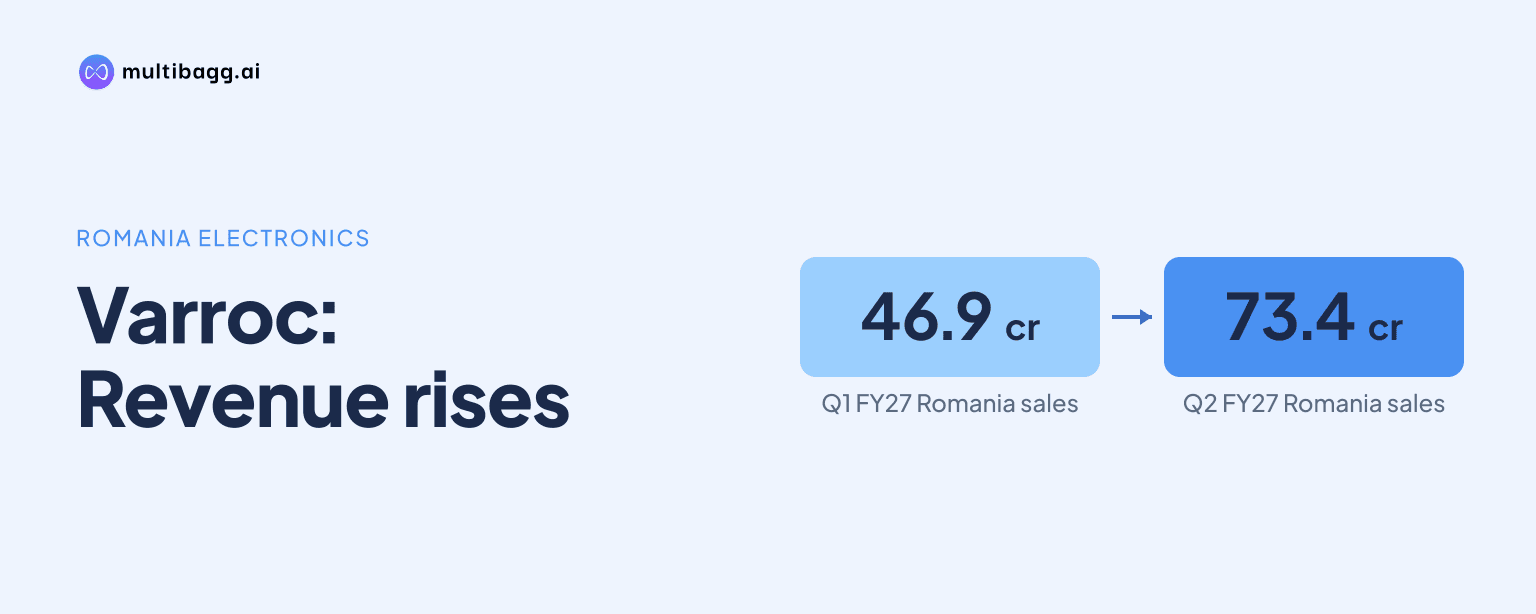
Varroc reported Electronics Romania revenue of Rs 73.4 crore in Q2 FY27, up Rs 26.5 crore from Rs 46.9 crore in Q1 FY27, but the presentation provides no overseas earnings before interest, tax, depreciation and amortisation, or EBITDA, figure to support a near-break-even claim. The disclosed evidence is sales growth, capacity and product capability rather than overseas profitability.
Know Varroc Engineering inside out
Results, valuation, peers and who's buying, in one view.
Did Varroc’s overseas business nearly break even at EBITDA level?
No, Varroc does not disclose overseas EBITDA, an overseas operating margin, or overseas profit and loss figures for Q1 FY27, Q2 FY27 or another reported period in the supplied presentation. The available financial disclosure for its Romania operation is revenue of Rs 46.9 crore in Q1 FY27 and Rs 73.4 crore in Q2 FY27.
The Q2 FY27 revenue figure was Rs 26.5 crore higher than the Q1 FY27 figure, and the two quarters total Rs 120.3 crore based on the reported quarterly values. This shows a sequential sales increase at Electronics Romania, but it does not establish break-even because Varroc does not provide the operation’s costs, depreciation, finance charges, profit or EBITDA.
What changed at Varroc’s Romania electronics operation?
Varroc’s Electronics Romania revenue rose 56.5% sequentially to Rs 73.4 crore in Q2 FY27 from Rs 46.9 crore in Q1 FY27. The presentation describes the Romania facility as a platform for integrating electronics manufacturing and increasing vertical integration, although it does not identify the customers, volumes or product mix behind the increase.
The Romania site is described as serving global original equipment manufacturers, or OEMs, for electric-vehicle platforms. Varroc says it is prepared to support automotive electrical and electronic, or E/E, architecture through contract manufacturing, joint development, or end-to-end development and manufacturing, but it gives no order value or production schedule for those activities.
Varroc says the facility has infrastructure prepared for seven surface-mount technology, or SMT, lines and 10 backend lines, with 50% free production space for further SMT or backend installation. The stated theoretical placement capacity is 90,000 components per hour per SMT line, while active line count, utilisation and expansion timing are not disclosed.
Which overseas products does Varroc identify for electronics growth?
Varroc identifies high- and low-voltage electronics, lighting, infotainment, camera systems and vehicle-monitoring products in its international offering. Its manufacturing map lists electronics production in Romania, Vietnam and India, while Romania is also listed for exterior and interior lighting production.
For electric passenger vehicles, Varroc presents front-drive and rear-drive inverter electronics that convert direct current, or DC, from a battery into alternating current, or AC, for an electric motor. The presentation says these products must withstand heat, humidity and thermal cycles, as well as electromagnetic compatibility, or EMC, tests such as electrostatic-discharge and conducted-emissions testing.
Varroc also lists interior ambient-lighting uses in steering wheels, doors, roof lamps, glove boxes and footwells. It cites standardised light engines and flexibility across applications, while its broader lighting list includes head and rear lamps, lighting control units, lighting driver modules and adaptive driving beam systems; no overseas revenue split is provided for these products.
Got a follow-up? Ask IRIS
What high-voltage projects and charger specifications has Varroc disclosed?
Varroc has disclosed a recent high-voltage awarded project, but it has not named the customer, award value, production start date or expected revenue. The project list includes an Atlas Alpha shunt-current-sense inverter printed circuit board assembly, or PCBA, a daughter board, a power electronics unit, low-voltage control, an Atlas Rohm inverter main board, a thermal sensing unit PCBA and a high-voltage power PCBA.
The disclosed functions include current measurement, on-board charging, power conversion and high-voltage battery control. Varroc says its inverter main board converts battery DC power into AC power for vehicle propulsion, while its definition of low voltage refers to systems typically below 1,000 volts AC or 1,500 volts DC.
Varroc also presents a bidirectional Level 2 version 2 charger for wall-mounted home or public charging. The charger manages AC power of up to 11.5 kilowatts, has stated efficiency above 97% and a continuous current rating of 48 amperes, with PCBAs designed for automotive environmental, EMC and product-handling requirements.
How do Varroc’s technical network and India e-mobility compare?
Varroc lists research and development, or R&D, locations in Poland, Italy, India and China. Poland is listed for connectivity and advanced driver-assistance systems, or ADAS; Italy for lighting and connectivity; and India and China for lighting, connectivity and ADAS, but the presentation does not disclose R&D spending, headcount or programme-level revenue.
The network also covers driver-monitoring systems, or DMS, surround-view camera systems and internet-of-things applications such as vehicle telematics and fleet management. Varroc describes its infotainment and surround-view offering as a touchscreen display ready to integrate DMS and surround-view functions, without stating whether these products have entered volume production.
India e-mobility reported revenue of Rs 277.3 crore in Q2 FY27, compared with Rs 194.1 crore in Q1 FY27, based on the presentation’s quarterly figures. That business includes chargers, 48-volt battery and battery-management systems, motors, controllers, vehicle control units and LED headlamps, making it a different product and geographic business from Electronics Romania.
Conclusion
Varroc’s supplied disclosure supports a sharp sequential rise in Electronics Romania revenue, from Rs 46.9 crore in Q1 FY27 to Rs 73.4 crore in Q2 FY27, alongside manufacturing capacity for seven SMT lines and products spanning lighting, inverters, charging and vehicle electronics. It does not support the assertion that the overseas business nearly broke even at EBITDA level because no overseas earnings figure is disclosed.
The next points to watch are whether Varroc converts the Romania site’s 50% free production space and prepared seven-SMT-line infrastructure into additional output, and whether it discloses commercial details of the recent high-voltage project. The presentation also leaves unresolved whether the Q2 FY27 Romania revenue level can be sustained and how much of the product pipeline reaches volume production.