










Varroc EV customers supplied 48% of H1 FY27 order wins
Key highlights
- Varroc recorded Rs 1,012.7 crore of H1 FY27 net new annual peak revenue wins.
- EV customers accounted for 48% of Varroc’s H1 FY27 order intake, versus 52% for ICE customers.
- Varroc’s outstanding order book was Rs 3,699.1 crore at the end of H1 FY27.
- E-mobility represented 8.6% of H1 FY27 revenue, while supplies to EV vehicles were about 19% of Q2 FY27 revenue.
powered by IRIS
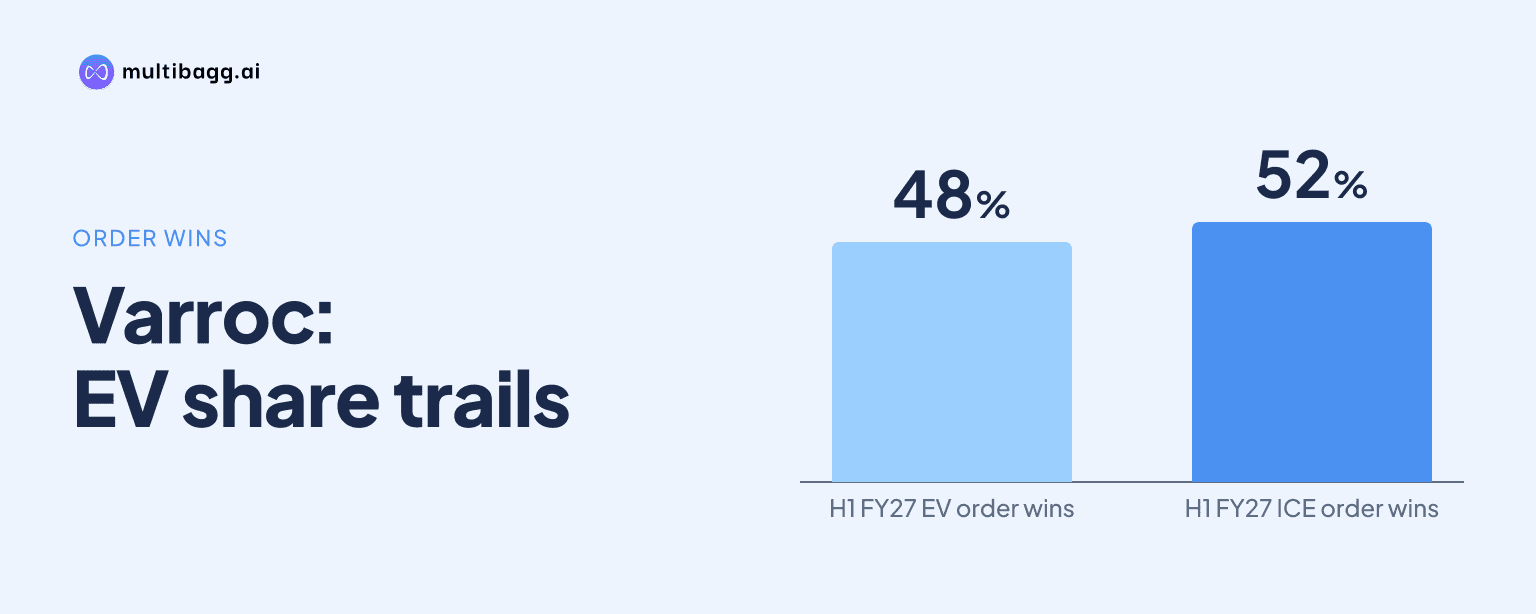
Varroc recorded Rs 1,012.7 crore of net new annual peak revenue wins in H1 FY27, and electric-vehicle, or EV, customers accounted for 48% of that intake. Internal-combustion-engine, or ICE, customers represented 52%, while the outstanding order book rose to Rs 3,699.1 crore after Rs 822.6 crore of start-of-production activity.
Know Varroc Engineering inside out
Results, valuation, peers and who's buying, in one view.
What did Varroc win in H1 FY27?
Varroc won Rs 1,012.7 crore of net new annual peak revenue in H1 FY27. The intake was added to an outstanding order book of Rs 3,509 crore at the end of FY26, while Rs 822.6 crore moved into start of production, or SoP, year to date, leaving Rs 3,699.1 crore outstanding at the end of H1 FY27.
New order intake exceeded the SoP amount by Rs 190.1 crore during the half year, increasing the outstanding order book by Rs 190.1 crore from the FY26 closing balance. Varroc presents each figure as annual peak revenue, meaning the revenue potential when programmes reach peak production rather than revenue reported during H1 FY27.
How much of Varroc’s order intake came from EV customers?
EV customers contributed 48% of Varroc’s Rs 1,012.7 crore H1 FY27 annual peak revenue intake, compared with 52% from ICE customers. The two-percentage-point difference means the half-year awards were nearly evenly divided between customers serving EV and ICE vehicle programmes.
Varroc did not disclose a comparable EV-versus-ICE order-intake split for FY26 or an earlier half year. The presentation therefore shows the H1 FY27 composition but does not establish whether EV customers’ share increased or fell from a prior period. It separately said supplies to EV vehicles represented about 19% of Q2 FY27 revenue, which is a revenue measure rather than an order-intake measure.
Which customers and vehicle segments generated Varroc’s wins?
Bajaj represented 55% of Varroc’s H1 FY27 annual peak revenue wins, while non-Bajaj customers accounted for 45%. This differed from the H1 FY27 reported revenue base, where Bajaj accounted for 46% and non-Bajaj customers for 54%, making Bajaj’s share of new awards nine percentage points higher than its share of revenue.
Two-wheelers and three-wheelers, or 2W and 3W, supplied 73% of H1 FY27 award value, against 27% from four-wheelers and other applications. The award mix was close to the reported vehicle-segment revenue split of 75% from 2W and 3W and 25% from four-wheelers, with the order intake carrying a two-percentage-point higher share from four-wheelers and other applications.
When could Varroc’s outstanding order book enter production?
Varroc scheduled Rs 2,155.7 crore of its Rs 3,699.1 crore outstanding order book for SoP in FY27. It scheduled a further Rs 1,387.1 crore for FY28 and Rs 156.3 crore for FY29, according to the H1 FY27 order-book timetable.
The FY27 schedule represents 58.3% of the outstanding order book, based on the disclosed FY27 SoP amount relative to the Rs 3,699.1 crore total. FY28 carries the next-largest part of the pipeline at 37.5%, while FY29 accounts for the remaining 4.2%, concentrating planned programme launches in FY27 and FY28.
Varroc’s disclosed schedule does not specify the EV share, customer names or product groups within the Rs 2,155.7 crore planned for FY27 SoP. It also does not state whether all programme launches will convert to revenue on the stated timetable, so the amounts remain an order-book schedule rather than reported sales guidance.
Got a follow-up? Ask IRIS
What does Varroc’s revenue mix show about e-mobility and electronics?
E-mobility represented 8.6% of Varroc’s H1 FY27 product-group revenue, while Romania Electronics represented 2.2%. Body parts were the largest category at 34.0%, followed by ICE powertrain at 22.9% and lighting solutions at 16.4%, placing e-mobility below each of those three established product groups in the reported mix.
Varroc reported consolidated revenue of Rs 5,582.2 crore in H1 FY27, up 31.8% from Rs 4,234.9 crore in H1 FY26. India business growth was 29.1%, while overseas growth was 70.7%, according to Varroc. However, the presentation does not provide prior-period revenue or a growth rate for either e-mobility or Romania Electronics specifically.
Varroc said overseas operations include two-wheeler lighting, advanced electronics and forging, and that new advanced-electronics business wins are converting to sales. Overseas revenue was Rs 243.3 crore in Q2 FY27, up 104% from Rs 119.4 crore in Q2 FY26, while overseas EBITDA loss narrowed to Rs 0.5 crore from Rs 10.2 crore. These figures relate to overseas operations as a whole, not Romania Electronics alone.
How does the EV order mix fit Varroc’s current business base?
The 48% EV-customer share of H1 FY27 order wins was much higher than e-mobility’s 8.6% share of H1 FY27 product-group revenue. The measures are not directly comparable because the first records customer type in newly awarded annual peak revenue and the second records product-group revenue during the half year, but they show that the current revenue base and incoming award mix are measured differently.
Varroc’s Q2 FY27 supplies to EV vehicles accounted for about 19% of revenue, compared with e-mobility’s 8.6% share of H1 FY27 product-group revenue. The presentation does not define how the broader EV-vehicle supply measure overlaps with the e-mobility product group, so it does not support adding the two percentages or treating them as the same revenue stream.
The customer and vehicle mix also places the order intake in Varroc’s existing concentration pattern. Bajaj generated 46% of H1 FY27 revenue but 55% of the new awards, while 2W and 3W represented 75% of revenue and 73% of awards. The disclosed figures show a larger Bajaj weighting in fresh wins, while the vehicle mix remained predominantly 2W and 3W.
Conclusion
Varroc’s H1 FY27 intake shows that EV customers supplied 48% of Rs 1,012.7 crore in annual peak revenue wins, close to the 52% supplied by ICE customers. The half-year awards were weighted toward Bajaj at 55% and 2W and 3W at 73%, while the outstanding order book increased from Rs 3,509 crore at FY26-end to Rs 3,699.1 crore at the end of H1 FY27.
The disclosed SoP schedule is the next milestone to watch: Varroc plans Rs 2,155.7 crore of outstanding annual peak revenue to enter production in FY27 and Rs 1,387.1 crore in FY28. The presentation also identifies e-mobility as 8.6% of H1 FY27 revenue and EV-vehicle supplies as about 19% of Q2 FY27 revenue, but it does not disclose product-level growth rates or the EV composition of the launch schedule.