










Varroc targets Romania EBITDA break-even by FY27-end
Key highlights
- Varroc targets Romania EBITDA break-even by FY27-end.
- Overseas revenue grew about 138% year on year in Q2 FY27.
- Italian restructuring contributed about Rs 63 crore of Q2 FY27 exceptional items.
- Net debt was Rs 554.7 crore at September 30, 2026, versus Rs 495.2 crore at March 31, 2026.
powered by IRIS
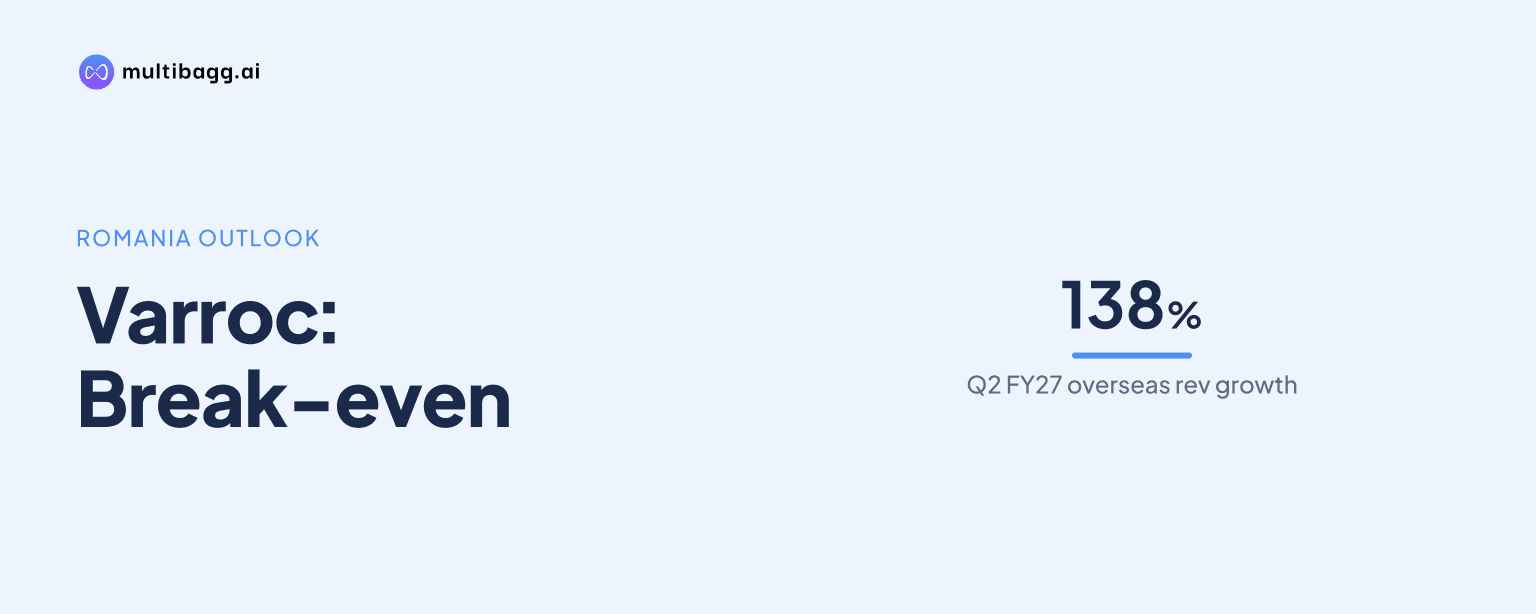
Varroc Engineering Limited is targeting earnings before interest, tax, depreciation and amortisation (EBITDA) break-even at its Romania operation by FY27-end after overseas revenue grew about 138% year on year in Q2 FY27, while it transfers Italian two-wheeler lighting manufacturing to Romania and Vietnam and expects a three-year payback on shutdown costs.
Know Varroc Engineering inside out
Results, valuation, peers and who's buying, in one view.
Can Varroc reach Romania EBITDA break-even by FY27-end?
Yes. Varroc management said its internal target remains EBITDA break-even for the Romania business by the end of FY27, with improvement expected from Q4 FY27 and most of the effect expected in the following financial year. Management identified Romania and overseas research and development (R&D) spending as the two main factors limiting overseas profitability.
Romania's Timișoara plant is Varroc's fastest-growing European facility and produces passenger-vehicle electronics. Management said it has secured high-voltage electronics business and is also targeting low-voltage applications, including electronics related to electric powertrains. The ramp-up of those programmes is central to raising capacity utilisation at the site.
Varroc's consolidated revenue rose 33.6% year on year and 11.9% sequentially to Rs 2,947.9 crore in Q2 FY27. EBITDA margin improved by 40 basis points from Q1 FY27 but was 20 basis points below Q2 FY26. Management said the overseas result included engineering income and lower R&D losses due to higher capitalisation, so the quarter does not represent only recurring manufacturing performance.
Why is Varroc moving Italian lighting production?
Varroc is relocating two-wheeler lighting manufacturing from Italy to Romania and Vietnam to retain customer programmes and technology while exiting an underutilised, high-cost manufacturing location. Management said the move is intended to improve fixed-cost absorption, plant utilisation, earnings and cash generation, and the restructuring should be completed about six months after the November 4, 2026 call.
The company did not disclose the annual savings or total shutdown investment, but said the one-time closure costs carry a three-year payback. Management said the Italian profit drag was not significant and that savings should start from the next financial year. The chief financial officer also said benefits should begin entering the profit and loss account from the next quarter, while recovering the investment would take three years.
The restructuring contributed to exceptional items of about Rs 63 crore in Q2 FY27, alongside settlement of certain older tax disputes. Profit before tax after exceptional items was Rs 78 crore, compared with Rs 140 crore before exceptional items and Rs 91 crore before exceptional items in Q2 FY26. The charge is separate from Romania's operating break-even target.
Why has Varroc's overseas growth not yet completed the turnaround?
Varroc's overseas revenue increased about 138% year on year in Q2 FY27, mainly because new programmes started contributing, but management said the prior-year base was low after earlier revenue declines. It cautioned that overseas growth of about 109% should not be expected in every quarter from the current base.
Romania remains in a production ramp-up, while management said overseas R&D is an investment for future growth and will not see a remarkable near-term reduction. A Q2 FY27 Romania electronics result also included design income, and management said it should not be treated as a standalone run-rate. It expects gradual rather than immediate improvement in the second half.
The contrast with the India operation shows why revenue growth has not fully translated into higher group margins. India revenue rose 29.1% in Q2 FY27, while India EBITDA margin was 10.3%, versus 10.6% in Q1 FY27 and 11.5% a year earlier. Management attributed the decline mainly to under-recovery of war-related input-cost inflation, with business mix changes also affecting margins.
Got a follow-up? Ask IRIS
What do customer recoveries and spending mean for Varroc's cash flow?
Varroc's consolidated net debt was Rs 554.7 crore at September 30, 2026, up from Rs 495.2 crore at March 31, 2026. Management attributed the rise principally to capital expenditure and said it did not expect a significant debt reduction by FY27-end, instead aiming to keep borrowing around current levels in coming quarters.
More than Rs 114 crore of customer-approved inflation recovery had not been received in cash in H1 FY27, which management said reduced cash generation. Under-recovery reduced H1 FY27 EBITDA by 0.4%, while management later described the year-on-year margin impact at about 0.6%. Price recovery requires customer agreement and is not automatic despite contractual mechanisms, management said.
Capital expenditure was about Rs 290 crore in H1 FY27, against management's stated full-year range of Rs 500 crore to Rs 550 crore. It expected another Rs 200 crore-plus of spending in H2 FY27. Net debt was 0.29 times equity and 0.57 times annualised adjusted EBITDA at September 2026.
How do EV orders support Varroc's Romania plan?
Varroc's revenue from products supplied to electric-vehicle models reached about 19% of Q2 FY27 consolidated revenue, up from about 16% in Q1 FY27, and EV-related revenue grew 130% year on year. Management linked Romania's high-voltage electronics wins to its European electronics strategy, with lower-voltage products also identified as a future target.
The company secured net new business with annualised peak revenue of Rs 1,012.7 crore in H1 FY27, of which more than 48% related to EVs. Management's internal FY27 target is Rs 2,500 crore of annualised peak-revenue wins, including at least Rs 1,500 crore in H2 FY27. These figures measure expected revenue at programme peak rather than sales in the first year.
Varroc also plans to acquire a controlling 45% stake in Forsee Power India, with an option to add 6%, to add battery packs and battery-management systems to its portfolio. Management said it intends to consolidate the company as a subsidiary after the transaction closes, but declined to give a profitability forecast before completion.
Conclusion
Varroc's overseas plan combines an FY27-end EBITDA break-even target for Romania with the closure of Italian two-wheeler lighting manufacturing. Q2 FY27 overseas revenue growth of about 138% reflects new programme ramp-ups, but management said Romania's utilisation and ongoing overseas R&D spending still prevent a completed profitability turnaround. The Italy shift is designed to move production to Romania and Vietnam while retaining customer programmes.
The next milestones are Romania's FY27-end break-even objective, completion of the Italian restructuring within about six months of November 2026, and the timing of cost benefits from the next financial year. Management is also pursuing collection of more than Rs 114 crore of agreed customer recoveries, plans Rs 500 crore to Rs 550 crore of FY27 capital expenditure, and is targeting Rs 2,500 crore of annualised peak-revenue order wins.