










Aerolloy Technologies secures Airbus and Safran LEAP work
Key highlights
- Aerolloy’s Airbus agreement covers titanium castings for the A320neo, A330neo and A350 programmes.
- Aerolloy received a Safran LEAP development order, with serial production conditional on successful development and qualification.
- Aerolloy reported Q2FY27 total income of Rs 90.9 crore, EBITDA of Rs 42.8 crore and profit after tax of Rs 30.4 crore.
- PTC Industries reported H1FY27 consolidated total income of Rs 426.5 crore, up 77.3% year on year.
powered by IRIS
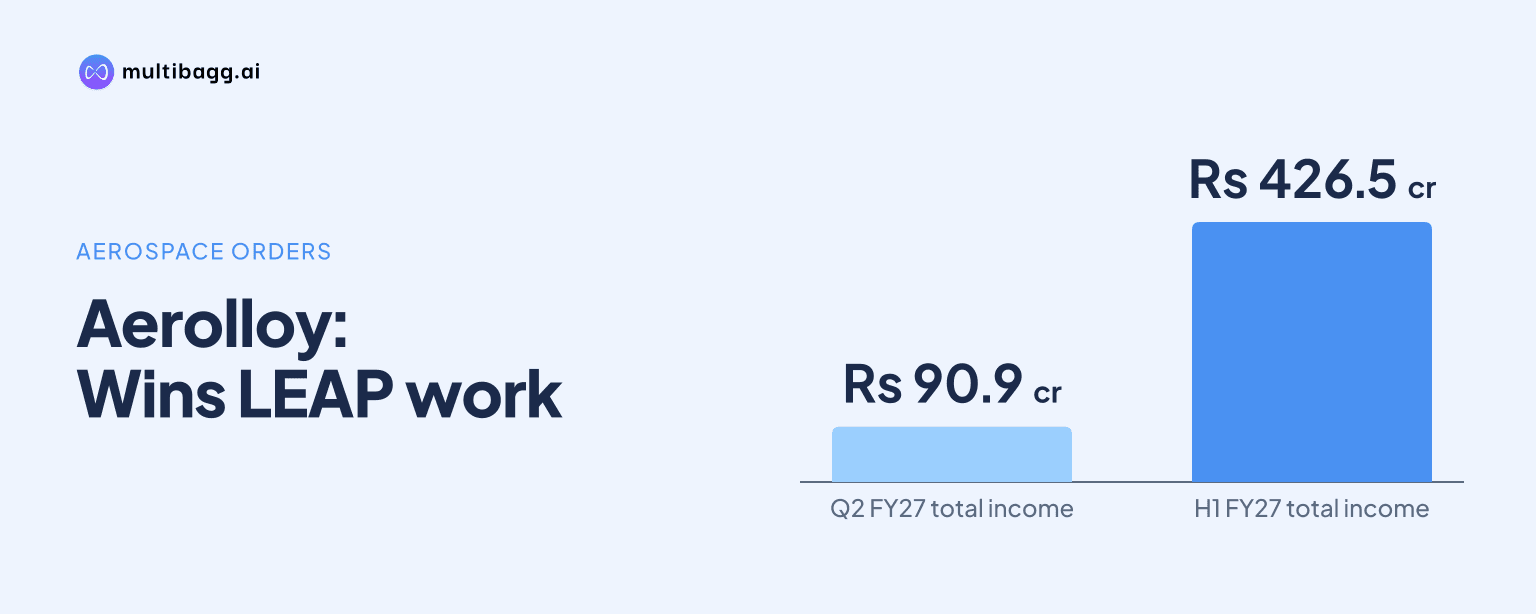
Aerolloy Technologies secured an Airbus agreement for titanium castings across three aircraft programmes and a Safran Aircraft Engines development order for LEAP engine components in Q2FY27, when it reported total income of Rs 90.9 crore. The disclosures cover fully machined, ready-to-fit titanium components, but future serial supply remains subject to development and qualification.
Know PTC Industries inside out
Results, valuation, peers and who's buying, in one view.
What does Aerolloy’s Airbus agreement cover?
Aerolloy’s Airbus agreement covers development, qualification, industrialisation and future supply of titanium castings for the A320neo, A330neo and A350 programmes. The company describes the products as fully machined and ready-to-fit, covering a finished component rather than an unmachined casting.
The agreement spans three named commercial-aircraft programmes and four stated stages: development, qualification, industrialisation and future supply. The presentation does not disclose a contract value, number of component types, production rate, delivery date or the expected duration of future supply.
Aerolloy says its manufacturing route integrates titanium material, precision casting, machining and inspection. Management describes this integrated route as supporting a higher-value role in the global aerospace supply chain, while the disclosed agreement itself does not provide a revenue or profit forecast.
Why is Aerolloy’s titanium manufacturing route relevant?
Aerolloy’s titanium route is relevant because it combines material, precision casting, machining and inspection for ready-to-fit aerospace components. That capability is directly aligned with the Airbus scope for fully machined titanium castings on the A320neo, A330neo and A350.
The Airbus scope also includes industrialisation, which distinguishes the agreement from a disclosed immediate serial-production award. The presentation does not state casting yield, machining capacity, certification milestones or whether the work will use a dedicated production line.
Aerolloy reported Q2FY27 total income of Rs 90.9 crore, up 213.5% year on year, alongside earnings before interest, tax, depreciation and amortisation, or EBITDA, of Rs 42.8 crore. Its EBITDA margin was 47.1%, and the presentation attributes the quarter’s results to aerospace and strategic-materials momentum.
What did Safran Aircraft Engines order from Aerolloy?
Safran Aircraft Engines selected Aerolloy and issued a development order for critical titanium cast components for the LEAP engine programme. The components are described as fully machined and ready-to-fit, matching the finished-component approach disclosed for the Airbus programmes.
An accompanying memorandum of understanding, or MoU, establishes the commercial framework for the LEAP components. The presentation identifies the work as a development order and does not disclose component volumes, order value, annual production quantity, unit pricing or a development timetable.
Potential long-term serial production will follow only after successful development and qualification, according to the presentation. The Safran Aircraft Engines and PTC signing ceremony was held at Supplier Conference India 2026 in October 2026, but no subsequent qualification-review or serial-production date is given.
Got a follow-up? Ask IRIS
How do the Airbus and Safran arrangements differ?
The Airbus arrangement covers three named airframe programmes and a future-supply pathway, whereas the Safran arrangement is a development order for critical components used in the LEAP aircraft-engine programme. Both concern fully machined, ready-to-fit titanium cast parts and both retain development and qualification as necessary stages.
Airbus explicitly lists development, qualification, industrialisation and future supply, while Safran discloses a development order plus an MoU commercial framework. Neither announcement gives a monetary value, so the supplied information does not establish the prospective revenue, production scale or timing of either programme.
What financial context did Aerolloy report with these milestones?
Aerolloy reported Q2FY27 profit after tax of Rs 30.4 crore alongside total income of Rs 90.9 crore and EBITDA of Rs 42.8 crore. The 47.1% EBITDA margin was reported for the business in Q2FY27, while the Airbus and Safran announcements do not isolate any revenue from the newly disclosed work.
At consolidated PTC Industries level, Q2FY27 total income rose to Rs 229.4 crore from Rs 132.8 crore in Q2FY26, an increase of 72.7%. Consolidated EBITDA increased to Rs 61.4 crore from Rs 33.9 crore, and the EBITDA margin rose to 26.7% from 25.5%, a change of 121 basis points, where one basis point is one hundredth of a percentage point.
For H1FY27, PTC Industries reported total income of Rs 426.5 crore compared with Rs 240.5 crore in H1FY26, while EBITDA increased to Rs 115.6 crore from Rs 53.3 crore. Profit after tax rose to Rs 62.5 crore from Rs 23.3 crore, and the consolidated EBITDA margin increased to 27.1% from 22.1%.
Conclusion
Aerolloy has disclosed commercial-aerospace work spanning Airbus airframe programmes and Safran’s LEAP engine programme. The Airbus agreement covers the A320neo, A330neo and A350, while the Safran order concerns critical LEAP titanium components; both disclosures centre on fully machined, ready-to-fit parts made through Aerolloy’s integrated titanium material, casting, machining and inspection route.
The next disclosed milestones are development, qualification and industrialisation. Airbus includes qualification and industrialisation before future supply, while Safran says potential long-term serial production depends on successful development and qualification; the October 2026 Safran signing disclosure provides no serial-production date, volume commitment or contract value.