










PTC Industries Reports ₹206.96 Crore H1 Capex as CWIP Rises
Key highlights
- PTC Industries' H1 FY27 consolidated revenue rose 87.6% year-on-year to ₹416.12 crore.
- PTC Industries spent ₹206.96 crore on property, plant and equipment and intangible assets in H1 FY27.
- Capital work-in-progress increased to ₹460.04 crore at September-end from ₹310.6 crore in March 2026.
- Consolidated borrowings rose to about ₹390.6 crore, while H1 operating cash flow was negative ₹8.5 crore.
powered by IRIS
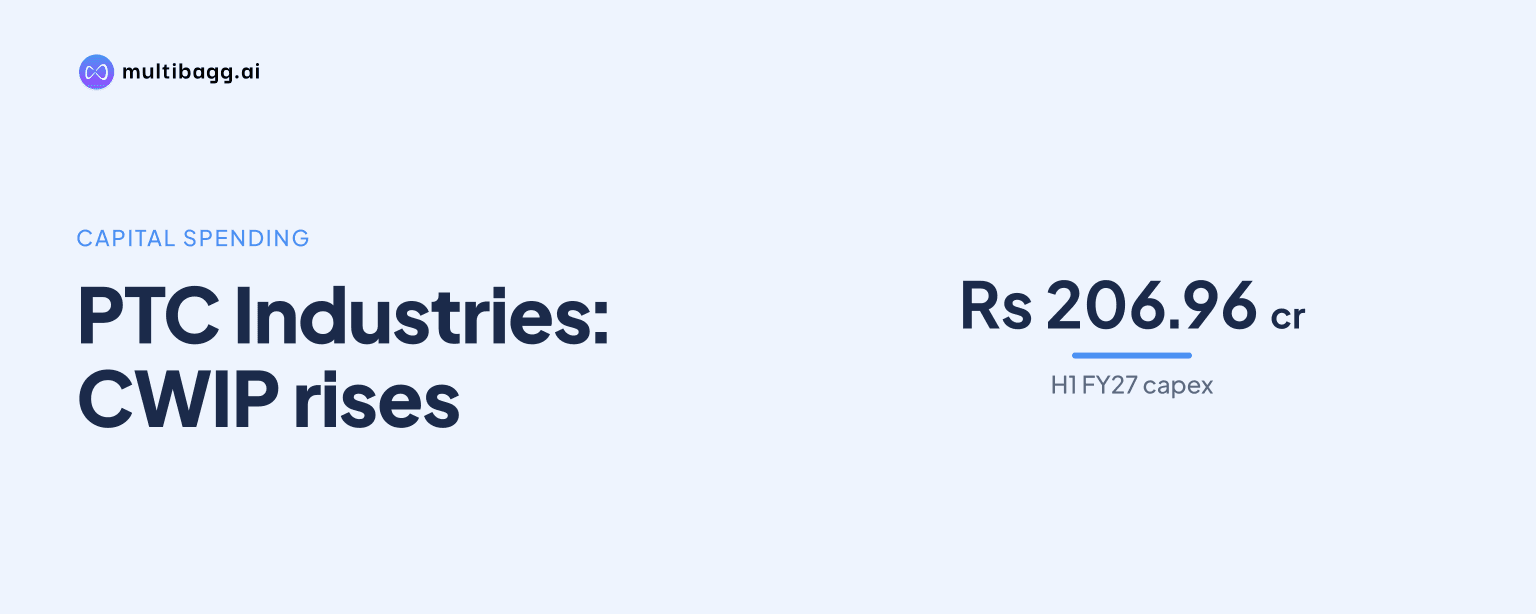
PTC Industries Limited reported ₹206.96 crore of capital expenditure in H1 FY27, lifting capital work-in-progress to ₹460.04 crore as consolidated revenue from operations rose 87.6% year-on-year to ₹416.12 crore. The figures show that the company is combining rapid revenue growth with a substantial investment programme funded partly through higher borrowings and a subsequent qualified institutional placement.
Know PTC Industries inside out
Results, valuation, peers and who's buying, in one view.
What were PTC Industries' Q2 and H1 FY27 earnings?
PTC Industries reported consolidated revenue from operations of ₹224.32 crore in Q2 FY27, up 80.0% from ₹124.63 crore in Q2 FY26. Consolidated net profit rose 83.5% to ₹33.28 crore from ₹18.14 crore in the year-earlier quarter, according to results announced on 14 November 2026.
The September-quarter performance also improved from Q1 FY27. Revenue increased 17.0% from ₹191.80 crore, while net profit grew 14.0% from ₹29.19 crore. Operating profit for Q2 stood at ₹56.30 crore, compared with ₹25.73 crore in the corresponding quarter a year earlier, based on the reported 118.81% increase.
For H1 FY27, consolidated revenue reached ₹416.12 crore, compared with ₹221.77 crore in H1 FY26. Net profit increased to ₹62.47 crore from ₹23.20 crore, while profit before tax rose to ₹77.18 crore from ₹32.02 crore. These results underline the importance of the consolidated business, as standalone H1 revenue was ₹243.85 crore and standalone net profit was ₹9.91 crore.
How did capital expenditure increase PTC Industries' work-in-progress?
PTC Industries spent ₹206.96 crore on property, plant and equipment and intangible assets during H1 FY27, with the disclosed amount rounded to ₹207 crore in the cash-flow summary. Capital work-in-progress increased to ₹460.04 crore at the end of September 2026 from ₹310.6 crore at 31 March 2026.
Capital work-in-progress represents expenditure on assets that are still under construction or yet to be commissioned. The increase therefore indicates that a significant share of the company's investment programme had not moved into completed operating assets by the September reporting date.
The company has also disclosed an Aerolloy agreement involving machined titanium castings for Airbus A320neo, A330neo and A350 aircraft. This agreement provides context for the ongoing manufacturing expansion, although the results disclosure does not specify commissioning dates, project-wise spending, or the revenue contribution expected from the facilities under construction.
Why did PTC Industries report negative operating cash flow despite higher profit?
PTC Industries reported net cash used in operating activities of ₹8.5 crore for H1 FY27 despite consolidated net profit of ₹62.47 crore. The difference reflects cash absorbed in working capital during the half year rather than a decline in reported profitability.
Inventory rose to ₹366.1 crore at September-end from ₹299.0 crore at the end of March, an increase of about ₹67 crore. Trade receivables increased to ₹282.4 crore from ₹273.9 crore over the same period. Higher inventories and receivables can consume cash because funds remain tied up in materials, work in progress, finished goods, and customer payments.
Cost increases also accompanied the larger scale of operations. H1 employee-benefit expenses rose to ₹92.82 crore from ₹69.66 crore, finance costs increased to ₹9.58 crore from ₹3.53 crore, and depreciation and amortisation rose to ₹28.81 crore from ₹17.73 crore. Total expenses for the half year were ₹349.31 crore.
Got a follow-up? Ask IRIS
How did borrowing and liquidity change during H1 FY27?
PTC Industries' consolidated borrowings rose to about ₹390.6 crore at September-end from about ₹261.3 crore at 31 March 2026. Cash and cash equivalents declined to ₹9.7 crore from ₹34.7 crore during the same period, while the company was funding investment and working-capital requirements.
The increase in borrowings occurred alongside the capital expenditure programme and the rise in inventory. The balance-sheet movement is relevant for investors because finance costs increased materially during H1, although the reported earnings growth remained strong.
In October 2026, after the end of the half-year reporting period, PTC Industries raised about ₹1,800 crore through a qualified institutional placement at ₹21,060 per share. The disclosure identifies the fundraise but does not provide a detailed allocation of proceeds in the supplied information.
What does the H1 FY27 performance mean for investors and operations?
PTC Industries' H1 FY27 results show strong growth in consolidated revenue and profit alongside a large deployment of capital into projects under construction. Revenue growth of 87.6% and net-profit growth of 169.3% year-on-year were accompanied by higher employee costs, depreciation and finance costs, consistent with an expanding operational base and investment cycle.
For investors, the key financial issue is the relationship between profit, cash generation and financing. Operating cash flow remained negative at ₹8.5 crore, borrowings increased by about ₹129 crore, and cash balances fell during the half year. The October qualified institutional placement adds a material financing event after the reporting date, but the supplied information does not state its eventual use across projects, debt reduction or working capital.
For industry operations, the higher capital work-in-progress points to continued capacity creation in the company's manufacturing activities. The pace at which projects are completed, assets are commissioned and working capital is converted into cash will be important operating measures alongside revenue growth.
Conclusion
PTC Industries delivered higher Q2 and H1 FY27 consolidated revenue and profit while committing ₹206.96 crore to capital expenditure. The rise in capital work-in-progress to ₹460.04 crore shows the scale of its ongoing expansion, but the half-year accounts also recorded negative operating cash flow, a larger inventory position and higher borrowings.
The next areas to watch are the commissioning of assets included in capital work-in-progress, changes in inventory and receivable levels, and the deployment of the approximately ₹1,800 crore raised through the October 2026 qualified institutional placement. These disclosed items will help indicate how the investment programme affects operations, liquidity and financing in subsequent periods.