










Aeron doubles GFRP rebar bend lines to eight during H1FY27
Key highlights
- Aeron doubled rebar bend production lines from 4 to 8 in H1FY27.
- Aeron started commercial GFRP rebar sales in March 2025.
- Aeron says GIGABAR is qualified under IS 18255:2023.
- India’s GFRP rebar market is projected to grow from US$56.52 million in 2025 to US$110.26 million in 2030.
powered by IRIS
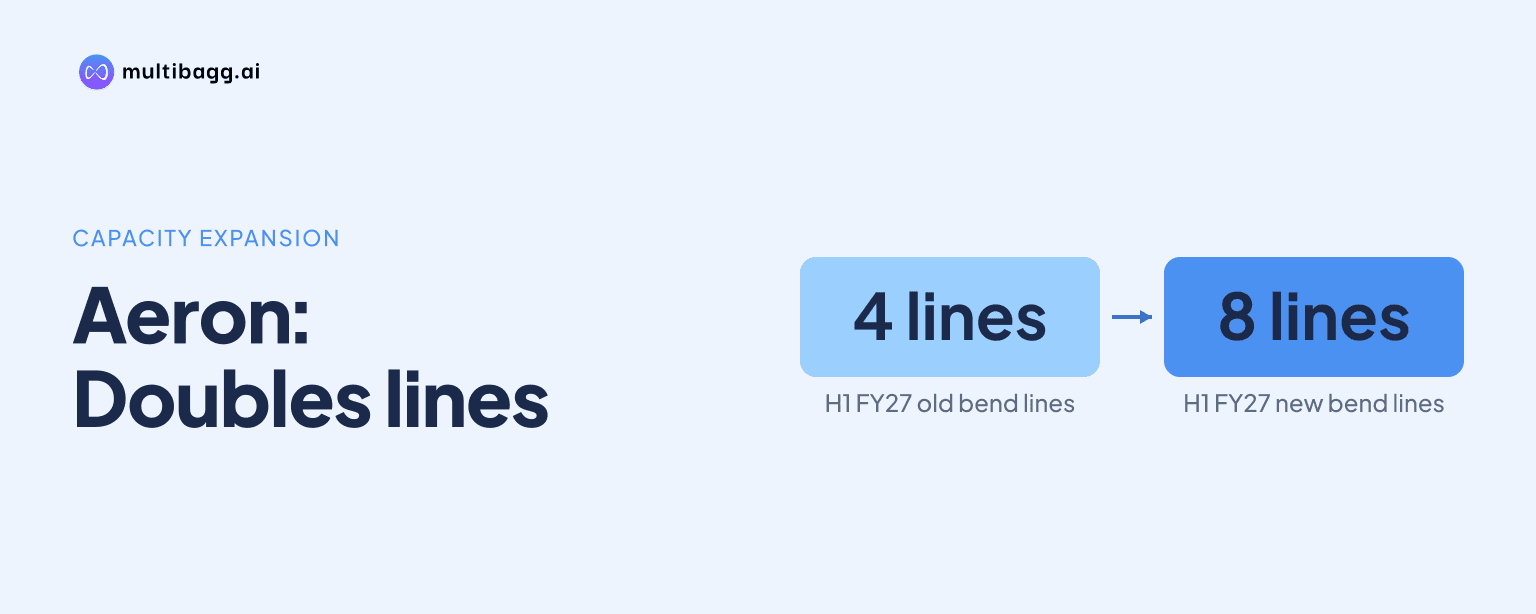
Aeron Composite Ltd. doubled its glass-fibre-reinforced polymer, or GFRP, rebar bend production lines from four to eight in the first half of fiscal 2027, or H1FY27, after commercial sales began in March 2025. The expansion supports its GIGABAR GFRP rebar business, which is qualified under IS 18255:2023, as India’s GFRP rebar market is projected to reach US$110.26 million by 2030.
Know Aeron Composites inside out
Results, valuation, peers and who's buying, in one view.
Why did Aeron expand its GFRP rebar bend lines?
Aeron expanded its GFRP rebar bend lines to support an entry into construction materials that began in fiscal year 2025, or FY25. The company started commercial GFRP rebar sales in March 2025, adding the product to its fibre-reinforced polymer, or FRP, portfolio of structural and industrial products.
The eight bend lines are intended to support future manufacturing growth, according to the presentation. Aeron says the GFRP rebar initiative can deepen its presence with infrastructure developers and engineering, procurement and construction, or EPC, companies serving roads, bridges, tunnels, marine structures, chemical plants and water-treatment facilities.
Aeron positions GIGABAR as a corrosion-free reinforcement alternative to thermo-mechanically treated, or TMT, steel. The presentation says GFRP rebar consists of continuous glass fibres embedded in polymer resin and is designed for applications exposed to moisture, salt or chemicals, including hydraulic and coastal infrastructure.
What manufacturing capacity has Aeron added for GFRP rebar?
Aeron increased rebar bend production lines from four to eight in H1FY27, while its presentation separately states that two dedicated GFRP rebar lines are operational. The disclosure identifies the bend-line expansion as a capacity increase, but does not provide output in tonnes, utilisation rates, revenue contribution or commissioning dates for the added lines.
Aeron says its rebar activity is integrated within existing infrastructure and requires minimal incremental capital expenditure. The presentation does not give a rupee capital-spending amount, a production-volume target or a timeline for further dedicated GFRP rebar lines.
The disclosed sequence runs from segment entry in FY25 to commercial sales in March 2025 and a larger bend-line base in H1FY27. The stated change is an increase of four bend lines, doubling the total to eight, although Aeron does not quantify the resulting increase in GFRP rebar output.
How does Aeron’s GFRP rebar compare with TMT steel?
Aeron says its GFRP rebar is 75% lighter than TMT steel, approximately four times lighter, and has roughly twice steel’s tensile strength. The presentation also says the product can save up to 20% in costs, but does not specify the project type, steel-price assumption, installation basis or lifecycle period behind that estimate.
The stated functional distinction is corrosion resistance: Aeron describes GFRP rebar as immune to moisture, salts and chemicals, while its FRP comparison table rates steel’s corrosion resistance as low. The product is also described as non-magnetic and non-conductive, features relevant to magnetic resonance imaging, or MRI, rooms, power-related installations and structures requiring electrical isolation.
Aeron further estimates that GFRP rebar has about 45% lower carbon-dioxide emissions and a longer lifecycle than steel reinforcement. These are product-positioning claims in the presentation rather than independently detailed lifecycle measurements, as no emissions baseline, manufacturing boundary or project-specific comparison is disclosed.
Got a follow-up? Ask IRIS
What certification and project uses support Aeron’s rollout?
Aeron says GIGABAR is qualified under IS 18255:2023 and describes itself as one of the few certified players. The qualification supports its infrastructure-products strategy for structural uses including highways, bridges, tunnels, roads, coastal construction and water-treatment facilities.
The presentation cites GFRP rebar adoption in Mumbai Coastal Road, Bandra–Worli Sea Link and water-treatment plants, or WTPs. It does not state that Aeron supplied those projects, disclose order values, name customers or indicate what share of those applications used GFRP rather than conventional reinforcement.
Beyond rebar, Aeron’s FRP range includes poles, ladders, decking, cross arms, moulded gratings and rods. FRP rods are made through pultrusion using ultraviolet-sensitive resins, while moulded gratings are made by placing continuous glass fibres in an open mould, saturating them with resin and curing the composite.
How fast is India’s GFRP rebar market expected to grow?
Aeron’s presentation projects India’s GFRP rebar market will rise from US$56.52 million in 2025 to US$110.26 million in 2030, representing a 14.3% compound annual growth rate, or CAGR. The projected market value rises in every listed year, with the 2030 figure nearly double the 2025 starting point.
The presentation projects the global GFRP rebar market will expand from US$0.54 billion to US$0.95 billion at a 12.1% CAGR, below its 14.3% forecast for India. Aeron attributes the Indian opportunity to public-infrastructure investment in bridges, highways and marine structures, alongside policies promoting corrosion-resistant and eco-friendly construction materials.
A broader composites backdrop is also cited: India’s composite-material consumption is projected to reach 768,200 tonnes by 2027. The presentation attributes this projection to the performance characteristics of composites and identifies resin and fibre technology advances as factors that can improve durability and cost-effectiveness in construction applications.
Conclusion
Aeron’s disclosed GFRP rebar expansion combines entry in FY25, commercial sales beginning in March 2025, two dedicated operational lines and a doubling of rebar bend lines from four to eight in H1FY27. Its strategy rests on a GIGABAR product qualified under IS 18255:2023 for corrosion-sensitive infrastructure uses and on a market forecast of 14.3% annual growth in Indian GFRP rebar through 2030.
The next items to watch are whether Aeron converts its eight bend lines and qualification into disclosed output, customer orders or GFRP rebar revenue. The presentation identifies minimal incremental capital expenditure and future growth support, but leaves utilisation, sales contribution and the pace of demand conversion unresolved.