










Aether EBITDA margin rises despite logistics cost surge
Key highlights
- Aether Industries’ EBITDA margin rose to 31.64% in 1H FY27 from 30.76% in 1H FY26, an 88-basis-point increase.
- Logistics costs increased nearly threefold, but Aether cited a higher CRAMS and CEM revenue mix, LSM pricing strength and cost-management measures for the margin expansion.
- Aether’s net working-capital cycle increased to 165 days at September 30, 2026, from 162 days at March 31, 2026, as inventory days rose to 172 from 151.
- Aether reported total borrowings of Rs 623.7 crore at September 30, 2026, comprising Rs 415.2 crore of working-capital loans and Rs 208.5 crore of term loans.
powered by IRIS
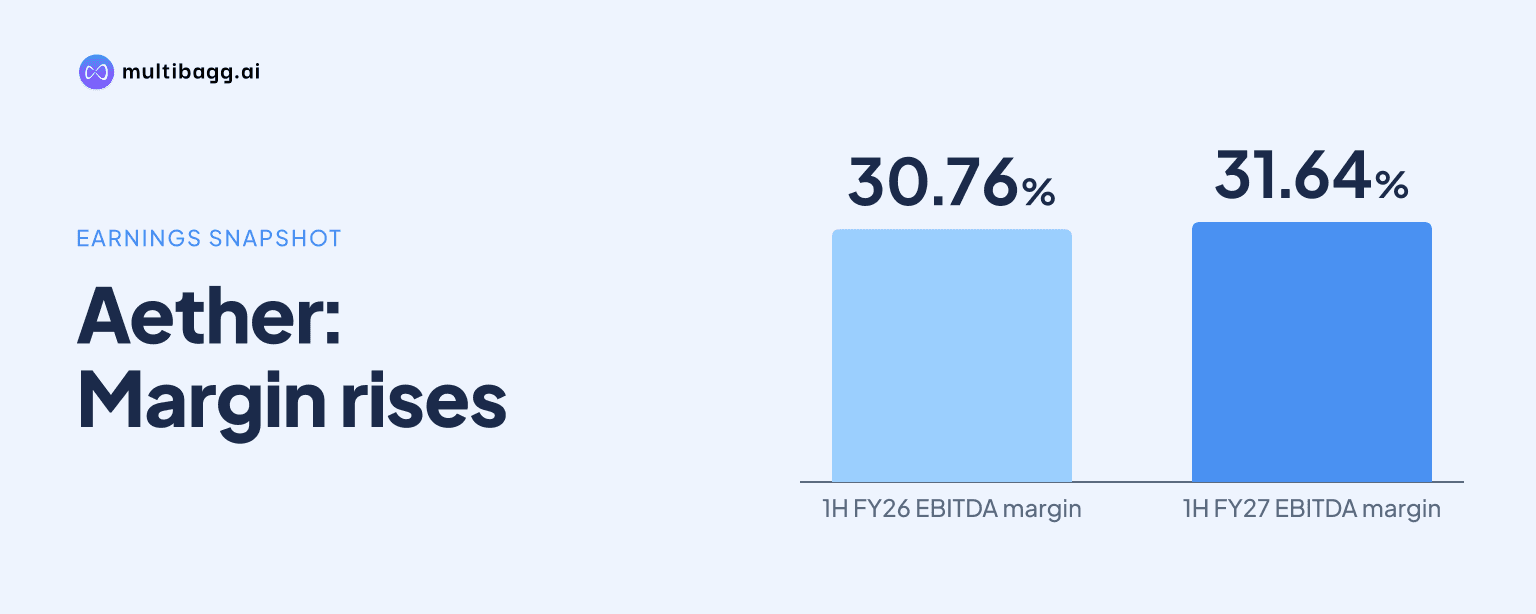
Aether Industries Limited reported an EBITDA margin of 31.64% in 1H FY27, up 88 basis points from 30.76% in 1H FY26, despite nearly threefold higher logistics costs. Aether attributed the improvement to a higher share of CRAMS and CEM revenue, pricing strength in LSM and commercial cost-management measures.
Know Aether Industries inside out
Results, valuation, peers and who's buying, in one view.
How did Aether’s EBITDA margin change in 1H FY27?
Aether’s EBITDA margin increased to 31.64% in 1H FY27 from 30.76% in 1H FY26, a year-on-year rise of 88 basis points. The reported change was a 0.88-percentage-point expansion in margin over the first half of the financial year.
The comparison is notable because Aether said logistics costs rose by nearly three times during the period. The company also described the macroeconomic environment as challenging and said raw-material prices remained elevated, making mix, pricing and cost-management measures central to the reported 31.64% margin.
Aether did not disclose EBITDA in rupees, revenue or the absolute increase in logistics expense on its September 2026 margins page. The presentation therefore supports a comparison of margins, but not a calculation of the rupee value of profitability or freight costs in 1H FY27.
What drove Aether’s margin expansion despite higher logistics costs?
Aether said the 88-basis-point margin improvement was driven by a favourable revenue-mix shift towards its higher-value CRAMS and CEM verticals. It also cited continued pricing strength in its LSM portfolio, commercial initiatives and cost-management measures.
The mix explanation is linked to Aether’s statement that CEM and CRAMS together contributed more than 60% of revenue as of September 30, 2026. The presentation does not disclose separate EBITDA margins for CRAMS, CEM or LSM, so it does not quantify the individual contribution of each vertical to the 31.64% result.
Management described the result as reflecting improved customer mix and earnings quality, while its forward view depends on operating leverage from contract ramp-ups, higher capacity utilisation and new-product introductions. These are management expectations rather than reported outcomes, and Aether did not quantify a future EBITDA-margin target.
Aether’s stated mechanism was a change in revenue mix and pricing rather than lower freight or input costs. Logistics costs were nearly three times higher and raw-material prices remained elevated, but management said CRAMS and CEM growth and LSM pricing offset those pressures sufficiently to increase the 1H FY27 margin.
Got a follow-up? Ask IRIS
How did Aether’s working-capital cycle change?
Aether’s net working-capital cycle increased to 165 days on September 30, 2026, from 162 days on March 31, 2026. The three-day increase occurred although debtor days fell by two days to 107, because inventory days rose by 21 days to 172.
Aether linked the reduction in debtor days to CEM and CRAMS contributing more than 60% of revenue. Creditor days remained unchanged at 114 days on September 30, 2026, so the reported movement in the overall cycle was concentrated in inventories rather than supplier payment terms.
Management said it deliberately built inventory amid a volatile geopolitical environment and higher shipping costs. The stock included raw materials for ongoing CEM contracts that were running ahead of production schedules, as well as materials bought for two production blocks at the Magnum site.
Aether expects inventory days and net working capital to decline over the next six months as the Magnum and Strata sites ramp production and sales. That outlook depends on the planned ramp-up, while the reported September 30, 2026 position was 172 inventory days and 165 net-working-capital days.
What debt did Aether report at September 30, 2026?
Aether reported outstanding borrowings of Rs 415.2 crore in working-capital loans and Rs 208.5 crore in term loans as of September 30, 2026. Together, the disclosed categories totalled Rs 623.7 crore, with working-capital loans representing the larger component.
The debt disclosure coincided with the 165-day net-working-capital cycle at September 30, 2026. The presentation does not provide interest expense, repayment dates, borrowing rates, cash balances or a net-debt calculation, so it does not establish how borrowings changed from March 31, 2026.
The increase in inventory days from 151 to 172 is relevant to the Rs 415.2 crore of working-capital loans, but Aether did not assign a specified portion of those borrowings to raw-material purchases or the Magnum production blocks. It stated only that inventory had been increased for key CEM materials and the Magnum blocks amid higher shipping costs.
The Rs 208.5 crore term-loan figure also cannot be matched to a particular project from the margins and debt disclosure. The presentation permits a dated split between working-capital and term loans, but not an assessment of project-level financing, scheduled maturities or the effect of future ramp-ups on debt.
Conclusion
Aether’s 1H FY27 EBITDA margin rose to 31.64% from 30.76% in 1H FY26 despite nearly tripled logistics costs. Management attributed the 88-basis-point improvement to a higher-value CRAMS and CEM mix, LSM pricing and cost measures, while net working capital increased modestly to 165 days as inventory reached 172 days.
The next disclosed item to watch is management’s expectation that inventory and net working capital will decline over the following six months as the Magnum and Strata sites ramp production and sales. Aether reported Rs 623.7 crore of borrowings at September 30, 2026, comprising Rs 415.2 crore of working-capital loans and Rs 208.5 crore of term loans.