










Akiko short-term borrowings rise to Rs 64.53 crore by September
Key highlights
- Akiko’s trade receivables increased by Rs 51.45 crore to Rs 114.69 crore at 30 September 2026.
- Akiko’s short-term borrowings rose by Rs 52.13 crore to Rs 64.53 crore over six months.
- Akiko’s total consolidated assets increased from Rs 107.54 crore to Rs 190.12 crore between March and September 2026.
- Akiko’s H1 FY27 finance costs rose to Rs 1.77 crore from Rs 0.30 crore in H1 FY26.
powered by IRIS
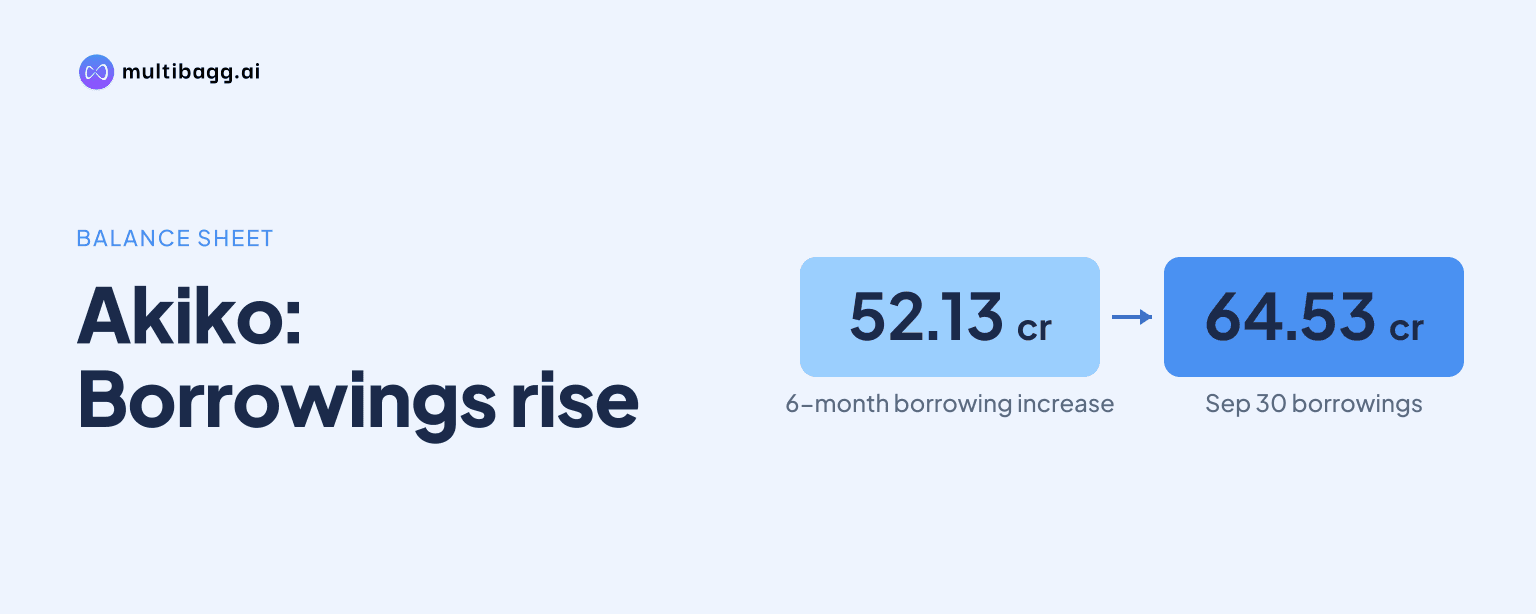
Akiko Global Services Limited reported short-term borrowings of Rs 64.53 crore at 30 September 2026, up from Rs 12.40 crore at 31 March 2026, while trade receivables increased by Rs 51.45 crore to Rs 114.69 crore. Total consolidated assets rose to Rs 190.12 crore from Rs 107.54 crore over the same six-month period.
Know Akiko Global Services inside out
Results, valuation, peers and who's buying, in one view.
How did Akiko’s balance sheet change by September 2026?
Akiko’s consolidated assets increased by Rs 82.58 crore to Rs 190.12 crore at 30 September 2026, from Rs 107.54 crore at 31 March 2026. Current assets rose by Rs 74.75 crore to Rs 171.15 crore, while non-current assets increased by Rs 7.83 crore to Rs 18.97 crore.
Trade receivables made up Rs 51.45 crore of the Rs 74.75 crore increase in current assets between March and September. Cash and bank balances rose by Rs 16.52 crore, whereas other current assets declined by Rs 1.95 crore to Rs 12.20 crore.
Other non-current assets rose from Rs 0.60 crore at 31 March 2026 to Rs 9.65 crore at 30 September 2026. Over the same period, property, intangibles and goodwill declined by Rs 0.67 crore to Rs 5.08 crore, and long-term loans and advances fell by Rs 0.64 crore to Rs 3.72 crore.
Why are Akiko’s trade receivables important to working capital?
Akiko’s trade receivables reached Rs 114.69 crore at 30 September 2026, making them the largest disclosed current-asset line within total current assets of Rs 171.15 crore. The receivables balance was Rs 63.24 crore at 31 March 2026, so it increased by Rs 51.45 crore in six months.
The November 2026 presentation does not disclose receivables ageing, collection days, overdue balances or customer concentration at either 31 March 2026 or 30 September 2026. It therefore shows the size of the receivables balance but does not identify the contribution of collection timing, customer terms or sales mix.
The three disclosed current-liability categories totalled Rs 106.98 crore at September, compared with Rs 40.45 crore at March. This calculation combines short-term borrowings, trade payables and other current liabilities and provisions, which together increased by Rs 66.53 crore as current assets increased by Rs 74.75 crore.
How was Akiko’s asset growth funded?
Akiko’s largest disclosed liability movement was a Rs 52.13 crore increase in short-term borrowings, to Rs 64.53 crore at 30 September 2026. Long-term borrowings increased by Rs 1.09 crore to Rs 3.58 crore, indicating that the reported increase in borrowings was concentrated in the short-term category.
Total shareholders’ funds increased by Rs 15.26 crore to Rs 75.24 crore, as reserves and surplus rose by Rs 15.69 crore to Rs 64.47 crore. Share capital remained Rs 10.77 crore, money received against warrants moved from Rs 0.44 crore to nil, and non-controlling interests rose by Rs 0.31 crore to Rs 4.05 crore.
Trade payables increased by Rs 8.54 crore to Rs 22.46 crore, while other current liabilities and provisions increased by Rs 5.86 crore to Rs 19.99 crore. The presentation does not allocate the Rs 64.53 crore of short-term borrowings to lenders, facilities or specific uses.
Got a follow-up? Ask IRIS
What do Akiko’s earnings and finance costs show?
Akiko reported revenue from operations of Rs 83.22 crore in Q2 FY27, up 138.1% from Rs 34.96 crore in Q2 FY26. Earnings before interest, tax, depreciation and amortisation, or EBITDA, rose to Rs 12.77 crore from Rs 4.98 crore, and EBITDA margin increased by 1.09 percentage points to 15.34%.
Finance costs rose to Rs 1.30 crore in Q2 FY27 from Rs 0.25 crore in Q2 FY26 and Rs 0.46 crore in Q1 FY27. Profit after tax, or PAT, increased 101.8% year on year to Rs 8.41 crore, but PAT margin declined to 10.10% from 11.92%; the presentation attributes the moderation to higher finance costs and tax rates.
For H1 FY27, revenue rose to Rs 151.34 crore from Rs 64.49 crore in H1 FY26, while EBITDA increased to Rs 22.86 crore from Rs 9.11 crore. Finance costs increased to Rs 1.77 crore from Rs 0.30 crore, and PAT attributable to owners rose 175.1% to Rs 15.12 crore from Rs 5.49 crore.
The income statement does not split H1 FY27 finance costs of Rs 1.77 crore between short-term and long-term borrowing categories. The reported figures show growth in revenue, receivables and short-term borrowings, but do not establish a direct link between a specific borrowing and a specific asset or operating use.
What is Akiko planning after September 2026?
Akiko’s next-phase priorities include completing customer verification, improving onboarding and building repeat app usage. The plan also covers productivity across credit cards, loans and financial partners, together with team productivity, technology adoption and customer service.
For payments, management plans to deliver UPI Scan & Pay after required approval and integration. Its near-term roadmap also includes Know Your Customer activation, wider payment usage, third-party application provider approval, Bharat BillPay System approval and cross-selling.
The longer-term options listed are insurance distribution, wealth products and micro, small and medium enterprise services through appropriate partners. Akiko states that product launches and regulatory approval timelines are forward-looking and may be affected by funding requirements, partner readiness, technology implementation, market conditions, competition and regulatory decisions.
Conclusion
Akiko’s September 2026 balance sheet shows that the Rs 82.58 crore rise in total assets occurred alongside a Rs 51.45 crore increase in trade receivables and a Rs 52.13 crore increase in short-term borrowings. Earnings expanded in H1 FY27, but finance costs rose to Rs 1.77 crore from Rs 0.30 crore in H1 FY26 as the balance sheet grew.
The next reported developments to watch are progress on customer verification and repeat app usage, plus the required approval and integration for UPI Scan & Pay. Akiko also identifies third-party application provider and Bharat BillPay System approvals as part of its near-term payments roadmap, without providing dates for those milestones.