










Akums targets API break-even in three to four quarters through mix
Key highlights
- Akums reported an API EBITDA loss of Rs 5.7 crore in Q2 FY27, compared with a Rs 14 crore loss in Q2 FY26.
- API revenue fell to Rs 29 crore in Q2 FY27 from Rs 44 crore in Q2 FY26 and Rs 32 crore in Q1 FY27.
- Management aims for API EBITDA break-even within three to four quarters through product-mix changes and geographic diversification.
- Akums said 90% to 92% of API revenue comes from India; it has two approved CEPs and two more in the pipeline.
powered by IRIS
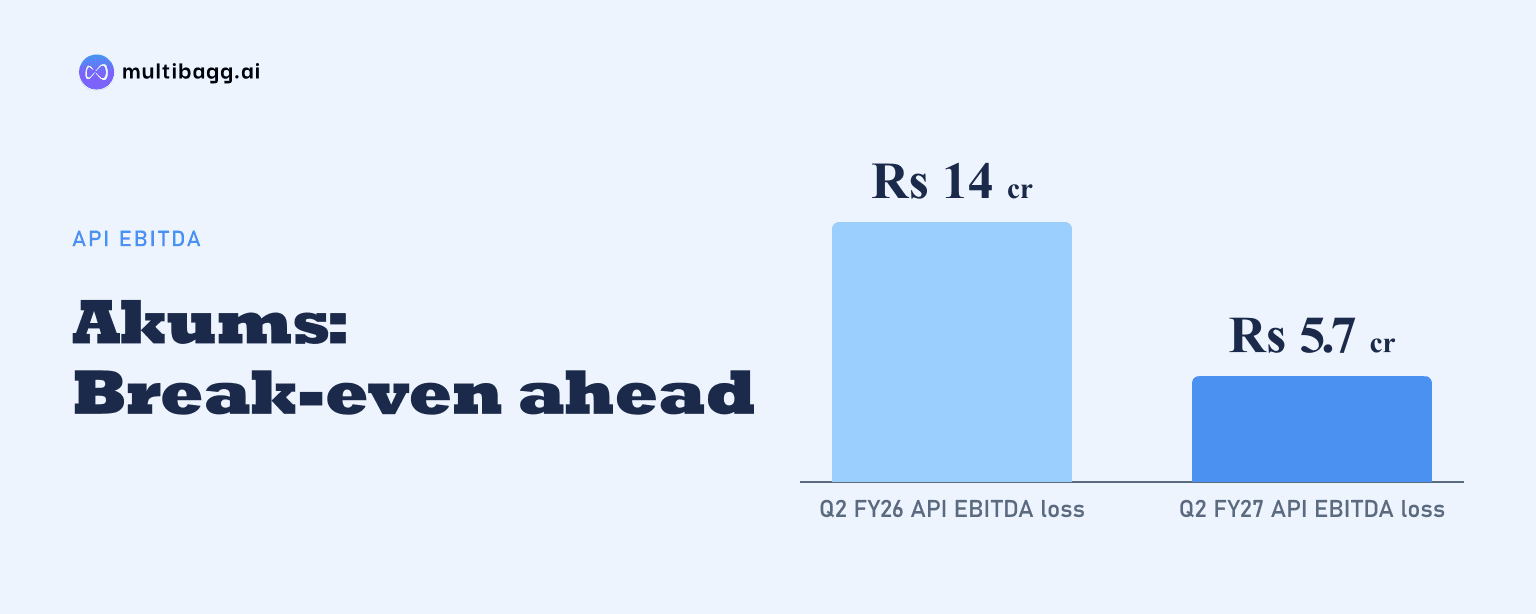
Akums Group aims to take its active pharmaceutical ingredients, or API, unit to earnings before interest, tax, depreciation and amortisation, or EBITDA, break-even within three to four quarters after reporting a Rs 5.7 crore EBITDA loss in Q2 FY27, by removing low-gross-margin products and pursuing European approvals.
Know Akums Drugs & Pharmaceuticals inside out
Results, valuation, peers and who's buying, in one view.
Why does Akums expect API break-even within four quarters?
Akums expects API EBITDA break-even in the next three to four quarters, although management gave no specific quarter for delivery or target for the unit's revenue share. Management said the business currently loses about Rs 5 crore, plus or minus Rs 1 crore, per quarter, and its immediate focus is reducing losses rather than rapidly lifting API's contribution to group sales.
The plan has two stated levers. Akums is removing products with low gross margins and concentrating on products with better gross margins. It is also seeking to expand beyond India, which accounts for about 90% to 92% of API revenue, through product approvals and a European audit process.
Management said API's share of consolidated revenue is not expected to increase dramatically in the near term. That reflects the faster expansion of contract development and manufacturing organisation, or CDMO, operations, where management said volumes have grown about 20% year on year for four consecutive quarters and coming quarters appear healthy.
How did Akums API performance change in Q2 FY27?
Akums reported API revenue of Rs 29 crore in Q2 FY27, down from Rs 44 crore in Q2 FY26 and Rs 32 crore in Q1 FY27, while its EBITDA loss increased sequentially to Rs 5.7 crore from Rs 3.9 crore. Revenue declined 35.3% year on year and 9.1% quarter on quarter, according to management.
The comparison shows a mixed movement. The Q2 FY27 EBITDA loss was Rs 8.3 crore lower than the Rs 14 crore loss a year earlier, but it rose by Rs 1.8 crore from Q1 FY27 as revenue fell by Rs 3 crore. Management said it expects full-year API losses to be lower than the previous year because of its higher-gross-margin product focus.
API was smaller than the other main operating divisions in Q2 FY27. CDMO produced revenue of Rs 1,115 crore and EBITDA of Rs 168 crore, domestic branded formulations produced Rs 132 crore of revenue and Rs 24 crore of EBITDA, and international branded formulations produced Rs 44 crore of revenue and Rs 9.9 crore of EBITDA.
What product and geographic changes is Akums making in API?
Akums is changing its API product mix by withdrawing low-gross-margin products and placing greater emphasis on products with better gross margins. Management did not identify individual molecules, price changes or product-level sales targets, but described this portfolio shift as the main operating route to reduce losses of roughly Rs 5 crore a quarter.
Akums is also pursuing geographical diversification through Europe. The company has two approved certificates of suitability, or CEPs, with two more CEPs in the pipeline, and management said it expects an approval after a European audit. These regulatory steps are intended to diversify both products and sales markets beyond the Indian market, which currently generates 90% to 92% of API revenue.
The timeline depends partly on approvals that have not yet been received. Management did not provide dates for the two pending CEPs or the European audit approval, meaning the stated three-to-four-quarter break-even objective rests on both product rationalisation and regulatory execution.
Got a follow-up? Ask IRIS
How do Akums' wider businesses affect the API plan?
Akums' European CDMO programme supports the group's broader diversification, but management did not quantify a direct contribution from that project to API break-even. For the CDMO business, Akums has two products approved in Europe, eight products filed and more than 30 products in research and development, with commercialisation expected over the next three to four years.
The European CDMO project has a separate approval timetable. Management said a filed dossier could receive regulatory approval in one or two quarters, after which Akums would approach its partner for purchase orders; supplies from the project are scheduled to begin in FY28. Akums also said two facilities are certified under European Union good manufacturing practice standards, with more facilities in the pipeline.
Zambia is another separate CDMO initiative rather than an API revenue forecast. Management expects dispatches in Q4 FY27, followed by revenue recognition in Q1 FY28 after transport from Haridwar to Lusaka that takes about 100 to 120 days. It said Zambia will not contribute to the current year's revenue and that its margins should be slightly above CDMO margins.
At the consolidated level, Akums reported Q2 FY27 revenue of Rs 1,342 crore, up 31.9% year on year, and EBITDA of Rs 195 crore, up 106%. EBITDA margin was 14.5%, compared with 9.3% in Q2 FY26 and 15% in Q1 FY27, while trade generics recorded its third consecutive profitable quarter with EBITDA of Rs 1.2 crore on revenue of Rs 23 crore.
What other capacity plans could shape Akums' mix?
Akums is commissioning the first phase of its second Baddi facility over the next three to four months, adding 6 billion annual oral-solid units to an existing annual capacity of roughly 50 billion to 51 billion units. A later phase is intended to add another 6 billion tablets, taking the facility's planned tablet capacity to about 12 billion units.
Management said the Baddi facility could contribute 10% to 15% of CDMO business in three years after phased operationalisation. The company reported H1 investment of Rs 210 crore, including about Rs 43 crore in the Baddi plant and about Rs 56 crore for the Oriflame acquisition, while saying historical annual investment has been close to Rs 300 crore.
Management said funding for Baddi could come from debt or internal funds, depending on which option is more beneficial. Akums reported cash and cash equivalents of Rs 1,680 crore and H1 free cash flow of Rs 45.5 crore after business-acquisition spending, providing the financial context for the capacity programme alongside the API turnaround.
Conclusion
Akums' API programme is primarily a margin-repair effort, not a plan for a rapid rise in revenue share. Q2 FY27 revenue fell to Rs 29 crore and the quarterly EBITDA loss rose to Rs 5.7 crore from Rs 3.9 crore in Q1 FY27, but the loss remained below the Rs 14 crore reported in Q2 FY26. The proposed remedy combines lower exposure to low-margin products with broader access outside India.
The next measures to watch are whether quarterly API losses move below the current roughly Rs 5 crore range and whether management achieves break-even within three to four quarters. Regulatory milestones include two pipeline CEPs and the expected European audit approval, while the separate European CDMO dossier could be decided within one or two quarters and Zambia revenue is scheduled for Q1 FY28.