










Akums expands field force as branded EBITDA absorbs costs
Key highlights
- Akums increased its domestic-branded field force by 200 medical representatives, from 1,400 to 1,600.
- Akums said domestic-branded gross margin remained 74% to 75%, while sales-force investment weighed on EBITDA.
- New product launches contributed almost half of domestic-branded growth of roughly 8% year on year.
- Akums said CDMO volume growth exceeded 20% year on year in each of the past four quarters.
powered by IRIS
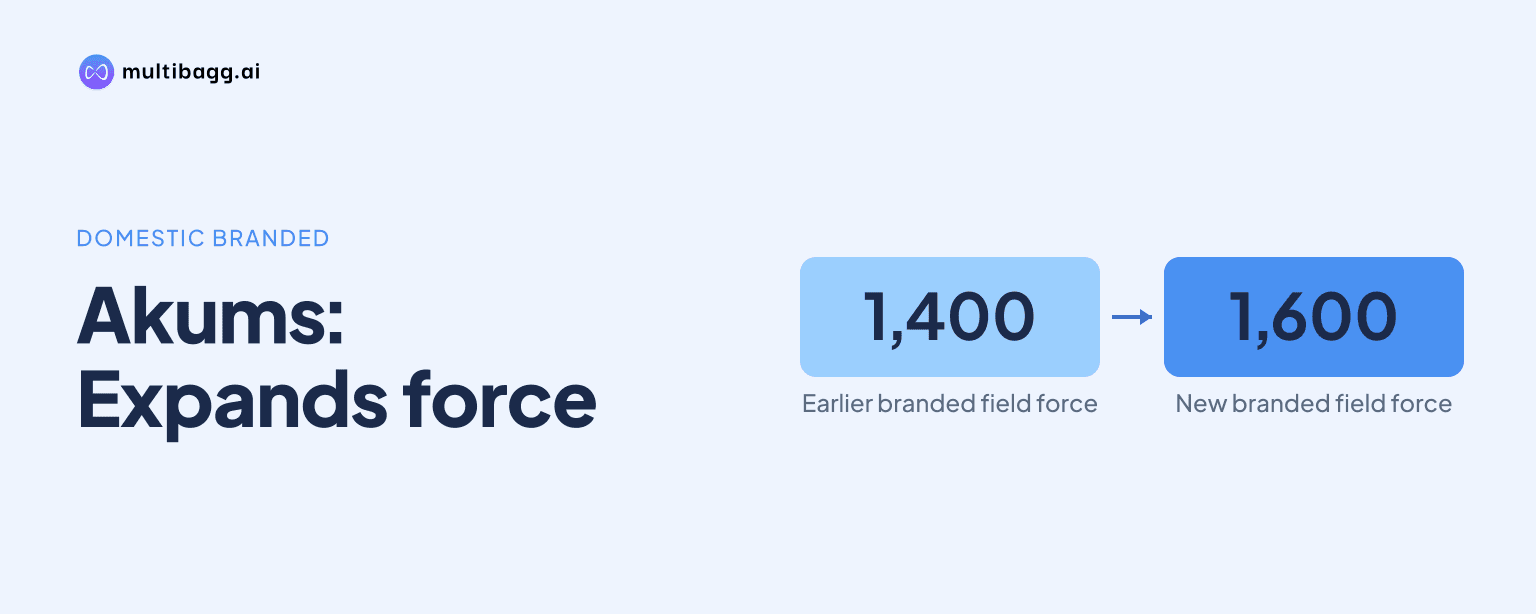
Akums Drugs and Pharmaceuticals Limited said on November 3, 2026, that domestic-branded EBITDA reflected the cost of expanding its field force from 1,400 to 1,600 medical representatives, while new product launches contributed almost half of the segment’s roughly 8% year-on-year growth.
Know Akums Drugs & Pharmaceuticals inside out
Results, valuation, peers and who's buying, in one view.
Why is Akums’s domestic-branded EBITDA under pressure?
Akums said the main reason for the EBITDA drag in domestic branded formulations was the investment in additional sales manpower, rather than a decline in gross margin. Management said the business retained a 74% to 75% gross margin while increasing its medical-representative count by 200 to 1,600. The field organisation also includes about 450 second-line and third-line managers.
The recruitment programme reduced the overall productivity measure management tracks for the branded business to roughly 2.5. Management said the 200 new field-force members joined in the first quarter and temporarily pulled down the group figure, while mature divisions remained above 3.2. It expects productivity to improve as the newer divisions and representatives mature.
Gynaecology is the largest therapy area within the domestic branded operation, contributing roughly 40% to 45% of revenue, followed by cardiology. Akums said its three mature gynaecology divisions operate at productivity above 3.2, compared with the roughly 2.5 figure for the wider business after the hiring programme.
How fast is Akums’s domestic-branded business growing?
Akums said domestic branded revenue was growing at roughly 8% year on year, which management described as single high-digit growth near the Indian pharmaceutical market. Management did not provide formal guidance for the segment, but said its endeavour is to maintain 8% to 10% growth while improving productivity and profitability.
New products accounted for almost half of the segment’s growth, according to management. Akums is pairing those launches with broader physician coverage from the larger field force, rather than concentrating on quarterly EBITDA changes. Management said it was building the business for the next three to four years.
The domestic branded business is below Rs 500 crore in scale and ranks about 56th or 57th in India, management said. Those measures explain the expansion effort, but Akums did not disclose a revenue target, an EBITDA target, or a timetable for the 200 newer representatives to reach the productivity level of mature divisions.
What does Akums expect from field-force investment and launches?
Akums expects the larger field force, greater physician engagement and additional product launches to raise productivity as divisions develop. Management said its objective is to move the overall productivity measure above 3, following the mature gynaecology divisions that already exceed 3.2. This is a management objective, not a quantified earnings forecast.
Management said it was not judging the strategy solely by whether quarterly EBITDA was Rs 10 crore, Rs 12 crore or about Rs 24 crore. Instead, it said the current investment is directed at manpower and product introductions, indicating that quarterly margin comparisons are not the primary measure it is using for the domestic branded build-out.
Product development also supports Akums’s contract development and manufacturing organisation, or CDMO, business. Management said it receives roughly two to three approvals each month from the Drugs Controller General of India, taking the annual tally to about 30 approvals. These products can reach the market early, including as a first or second supplier, and research and development spending helps fund that launch pipeline.
Got a follow-up? Ask IRIS
How does Akums’s branded growth compare with CDMO growth?
Akums’s CDMO volume growth exceeded 20% year on year in each of the past four quarters, compared with roughly 8% domestic branded revenue growth. Management attributed CDMO volume growth to both existing and new customers across prescription, private-label and regional segments, rather than to a single therapy area or dosage form.
Prices also contributed to CDMO revenue trends. Management said active pharmaceutical ingredient prices rose roughly 2% to 3% quarter on quarter and 5% to 7% compared with the second quarter of financial year 2026. It nevertheless cited volume growth above 20% and around 60 days of order-cycle visibility as the main current indicators for CDMO demand.
Management also identified international branded operations as having a better EBITDA profile than core manufacturing. Akums is present in Africa and Southeast Asia and intends to move into regulated markets in Latin America, the Middle East and Europe. It did not disclose a revenue, margin or timing forecast for that expansion.
What spending and execution factors should investors track next?
Akums said research and development expenditure was about Rs 130 crore, equivalent to roughly 3% to 3.5% of CDMO revenue. The company employs about 375 scientists and around 100 additional research and development support staff. Management expects this spending to increase as it enters regulated markets.
Capital expenditure was elevated during the first half because Akums is operationalising its Baddi facility and has acquired the Oriflame plant. Management said first-half investment was Rs 210 crore, versus historical annual spending of close to Rs 300 crore. It cited investment of about Rs 43 crore in Baddi and a purchase price of about Rs 56 crore for Oriflame.
The Baddi facility is planned to be operationalised in three phases and is expected by management to deliver at least 10% to 15% of CDMO business within three years. Oriflame’s current profit contribution was described as negligible because Akums is building customers and revenue in colour cosmetics, although management expects peak revenue to be three times the acquisition price.
Conclusion
Akums is accepting a current domestic-branded EBITDA drag to expand medical-representative coverage from 1,400 to 1,600 and support launches that supplied almost half of the segment’s roughly 8% growth. The strategy sits alongside a 74% to 75% gross margin, but its near-term growth rate remains below CDMO volume growth of more than 20% for four consecutive quarters.
The next measures to watch are whether the 200 newer representatives lift the overall productivity measure from roughly 2.5 toward management’s objective of above 3, and whether domestic branded growth remains within the stated 8% to 10% range. Management also plans a three-phase Baddi ramp expected to produce at least 10% to 15% of CDMO business within three years, while Oriflame remains in its customer-building phase.