










Akums says dossier approval could trigger abnormal revenue
Key highlights
- Akums said no European-contract revenue was included in H1 FY27 profit and loss.
- Management said the filed European dossier may take one or two quarters for approval.
- Q2 FY27 consolidated revenue was Rs 1,342 crore, up 31.9% year on year.
- Q2 FY27 CDMO revenue was Rs 1,115 crore, up 38.6% year on year.
powered by IRIS
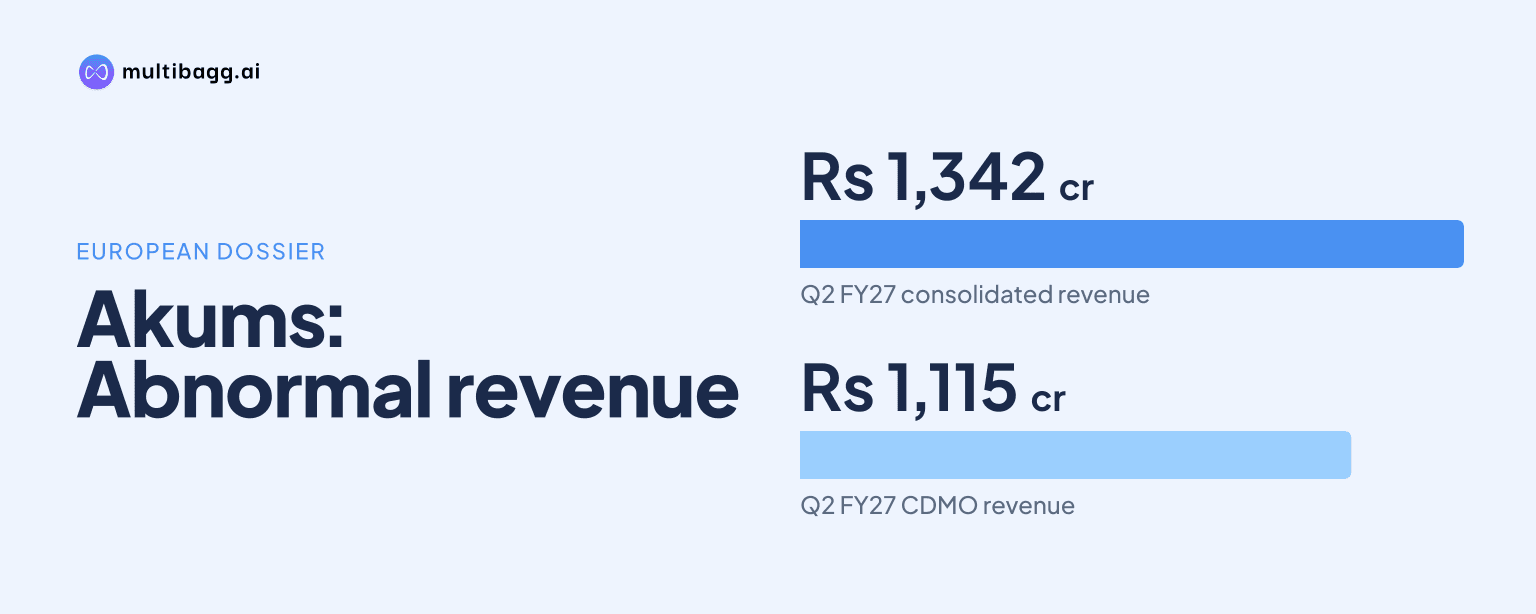
Akums Group said no European-contract revenue entered H1 FY27 profit and loss, but approval of its filed European dossier could create an abnormal revenue-recognition event. Management said the accounting will combine prior project spending, an advance described as US$100 million and the contract period, while the regulatory decision may take one or two quarters.
Know Akums Drugs & Pharmaceuticals inside out
Results, valuation, peers and who's buying, in one view.
When will Akums recognise European contract revenue?
Akums said it will start recognising European-contract revenue when the dossier receives approval from European authorities. The company said its commercial-supply plant is already approved, while the dossier has been filed and may take one or two quarters to clear, subject to the regulator's decision.
After dossier approval, Akums plans to seek purchase orders from its partner before commercial supplies begin. Management said it may be in a better position in about one quarter to discuss supply timing, but gave no FY27 or FY28 revenue forecast for the European programme.
The preparation before approval includes capital investment in the plant and research-and-development work to produce the product, according to management. Those activities have been completed ahead of the approval trigger, but management did not say they had created recognised European revenue in H1 FY27.
What European revenue was included in H1 FY27 results?
Akums said no amount from the European contract was built into H1 FY27 profit and loss. That response addressed an analyst's question on revenue and earnings before interest, tax, depreciation and amortisation, or EBITDA, linked to the advance and product-development work.
The reported Q2 FY27 figures therefore reflect other operating activity. Consolidated revenue was Rs 1,342 crore, 31.9% above Rs 1,018 crore in Q2 FY26 and 15.1% above Rs 1,167 crore in Q1 FY27. EBITDA was Rs 195 crore, up 106% year on year, while profit after tax was Rs 115 crore, up 168.3%.
Contract development and manufacturing organisation, or CDMO, revenue was Rs 1,115 crore in Q2 FY27, increasing 38.6% year on year, and management attributed group revenue growth largely to volumes. International branded formulations contributed Rs 44 crore, up 95.2% from Rs 22 crore, but Akums did not disclose a European-contract amount within that segment.
Why could dossier approval create abnormal revenue recognition?
Akums said approval could create abnormal revenue because the calculation will be composite rather than a simple supply invoice. Management said it must assess spending already incurred on the project and determine how to spread it over the contract period.
Management also cited interest earned on the advance and a notional interest cost shown in the balance sheet. It did not quantify any approval-date catch-up amount, its cash and non-cash portions, or the resulting effect on EBITDA and profit after tax.
An analyst referred to a US$100 million advance and asked about cash and non-cash revenue from FY28 to FY30. Management said an advance is used proportionately over the contract period and that, in a 60-month illustration, US$80 million remained after the first US$20 million and would be adjusted over the term.
Management said revenue largely starts when supplies begin, while also identifying dossier approval as the point when recognition starts. Akums said the detailed calculation would be disclosed in balance-sheet notes once approvals are received, leaving the timing and size of the accounting effect unresolved.
Got a follow-up? Ask IRIS
How does European recognition differ from Zambia revenue?
Akums said European revenue depends first on dossier approval, whereas Zambia revenue will depend on delivery to the Zambian government's Lusaka warehouse. The company said it has received Zambia purchase orders and expects to manufacture the goods in Q4, with revenue booked in Q1 after delivery.
Most CDMO sales are recognised ex works when goods leave the factory, management said. The Zambia arrangement differs because goods shipped from Haridwar to Lusaka require about 100 to 120 days of transit and remain goods in transit in the financial accounts until delivery.
Management described the Zambia business as US$25 million, with a margin profile slightly above CDMO margins, and said a further US$25 million supply round could be discussed after the first delivery. It also said no Zambia top-line revenue is expected in the current year despite the planned Q4 dispatch.
The European project has an approved plant but awaits regulatory clearance, purchase orders and supply timing. Zambia has purchase orders and a defined delivery condition, so the two programmes may enter reported revenue in different periods and through different recognition mechanisms.
What operating figures provide context for the accounting event?
Akums reported a Q2 FY27 EBITDA margin of 14.5%, compared with 9.3% in Q2 FY26 and 15.0% in Q1 FY27. EBITDA including other income was Rs 224 crore, 76.3% higher year on year and 9.1% higher sequentially, making the treatment of interest linked to the European advance relevant to comparisons between operating and reported results.
The API segment remained separate from the European accounting issue. API revenue was Rs 29 crore in Q2 FY27, down 35.3% from Rs 44 crore in Q2 FY26, while its EBITDA loss was Rs 5.7 crore; management said it aims to reach break-even over the next three to four quarters through product-mix and geographic changes.
Cash and cash equivalents stood at Rs 1,680 crore, and H1 FY27 free cash flow was Rs 45.5 crore after business acquisition, according to management. Akums also reported Rs 210 crore of H1 investment, including about Rs 43 crore in the Baddi plant and around Rs 56 crore for the Oriflame acquisition.
Those cash uses are distinct from the European advance accounting described on the call. Management said it would provide the relevant notes after approval, so the disclosed cash balance and investment figures do not establish the eventual European revenue or profit contribution.
Conclusion
Akums's reported Q2 FY27 revenue of Rs 1,342 crore and EBITDA of Rs 195 crore did not include European-contract revenue in H1 FY27 profit and loss. The eventual recognition could differ from ordinary product sales because management expects to account for prior project expenditure, the advance and related interest effects across the contract period.
The next event to watch is the European dossier decision, which management said could take one or two quarters, followed by purchase orders and commercial supplies. Investors can also monitor Zambia's planned Q4 dispatch and Q1 delivery-based revenue recognition, as well as the detailed balance-sheet notes Akums said it would provide after European approval.