










Alkem Laboratories Ltd. Q2 revenue rose 13.8%, PAT fell 11.7%
Key highlights
- Alkem’s Q2 FY27 revenue from operations rose 13.8% year on year to Rs 4,552 crore.
- Alkem’s reported Q2 FY27 PAT fell 11.7% year on year to Rs 675.3 crore, mainly due to a higher effective tax rate.
- Alkem’s India sales grew 9.5% to Rs 3,027.5 crore and represented 68% of Q2 FY27 sales.
- Alkem’s non-US international sales grew 58% year on year, while US sales grew 2.4% to Rs 783 crore.
powered by IRIS
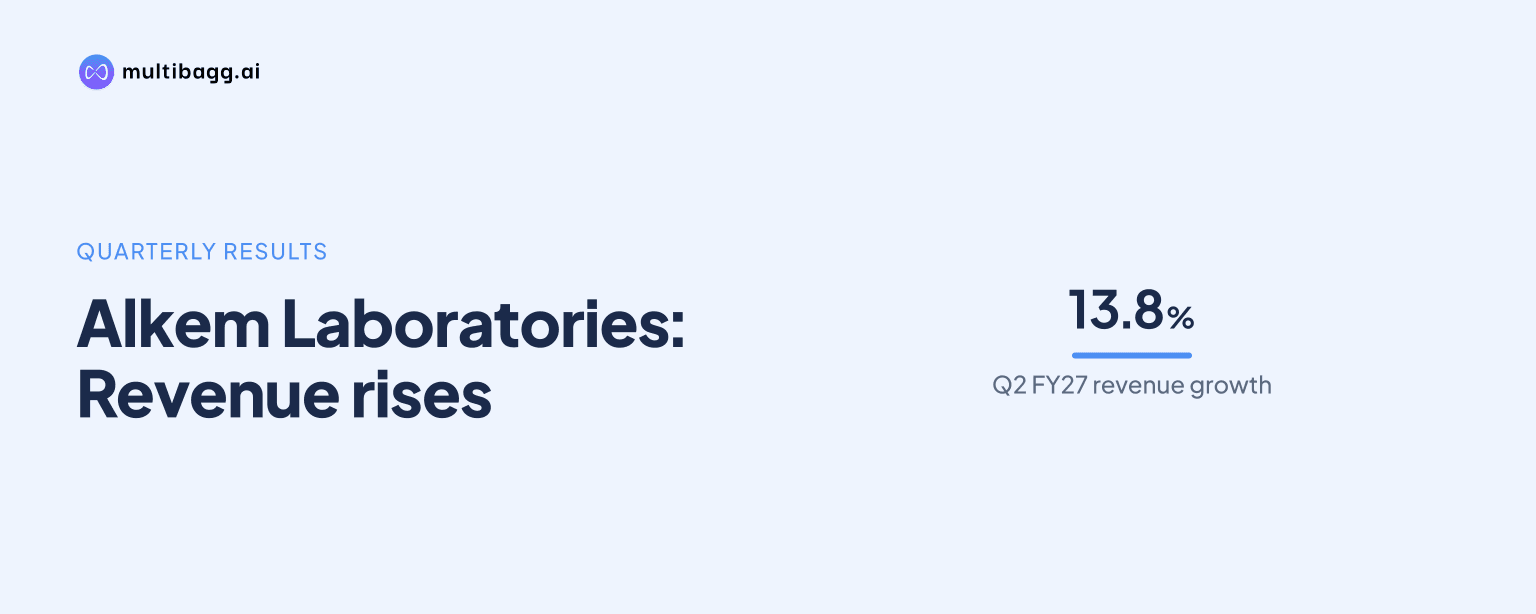
In Q2 FY27, Alkem reported revenue from operations of Rs 4,552 crore, up 13.8% year on year, while reported profit after tax (PAT) fell 11.7% to Rs 675.3 crore because management cited a higher effective tax rate. Earnings before interest, tax, depreciation and amortisation (EBITDA) increased 11.3% to Rs 1,025.2 crore.
Know Alkem Laboratories inside out
Results, valuation, peers and who's buying, in one view.
What were Alkem’s Q2 FY27 financial results?
Alkem’s Q2 FY27 revenue from operations was Rs 4,552 crore, compared with Rs 4,001 crore in Q2 FY26, while EBITDA rose to Rs 1,025.2 crore from Rs 920.8 crore. Revenue therefore increased faster than EBITDA, and the EBITDA margin declined by 50 basis points to 22.5% from 23.0% a year earlier. The company calculates margins on total revenue from operations, which includes other operating income.
Reported PAT, after adjustment for non-controlling interest, was Rs 675.3 crore in Q2 FY27, compared with Rs 765.1 crore in Q2 FY26. PAT was also higher than Rs 520 crore in Q1 FY27, but did not return to the prior-year quarter’s level. The presentation reported a PAT margin of 14.8% for Q2 FY27, against the 22.5% EBITDA margin.
Why did Alkem’s PAT fall despite revenue growth?
Alkem said reported PAT declined mainly because of a higher effective tax rate, despite a Rs 551 crore year-on-year increase in revenue and a Rs 104.4 crore increase in EBITDA. The presentation does not state the effective tax rate or the tax expense, so it does not quantify the tax-cost change that reduced PAT.
At the operating-profit level, Alkem attributed the 50-basis-point EBITDA-margin decline to Enzene operating costs and the Occlutech acquisition, which was completed in July 2026. These factors were cited for the movement from a 23.0% margin in Q2 FY26 to 22.5% in Q2 FY27. Management separately identified the higher effective tax rate as the principal reason for the lower net profit.
Which markets and businesses drove Alkem’s sales growth?
Alkem’s India business grew 9.5% year on year to Rs 3,027.5 crore in Q2 FY27 from Rs 2,766 crore in Q2 FY26, representing 68% of sales. Branded business grew 12.1%, while trade generics grew at a mid-single-digit rate. Based on IQVIA Secondary Sales Audit data, Alkem’s India-market value growth was 13.8%, equal to the 13.8% growth of the Indian pharmaceutical market.
US sales rose 2.4% year on year to Rs 783 crore and accounted for 17% of Q2 FY27 sales, with management saying growth was largely volume-led. Non-US international sales were Rs 671 crore, or 15% of sales, and grew 58% year on year. Excluding Occlutech sales, management reported non-US growth of 29% year on year and 14% quarter on quarter.
The sales split totals Rs 4,481.5 crore, distinct from Rs 4,552 crore of revenue from operations. Pharmaceuticals contributed Rs 4,277.7 crore, or 95% of sales, while MedTech contributed Rs 133.1 crore and biotech Rs 70.4 crore. In India, chronic therapies grew 22.4%, compared with 16.0% for the Indian pharmaceutical market, while acute therapies grew 12.1% against market growth of 12.3%.
Got a follow-up? Ask IRIS
How did Alkem’s Q2 FY27 performance compare with recent quarters?
Alkem’s Q2 FY27 revenue of Rs 4,552 crore was the highest in the five quarters shown, exceeding Rs 3,740.2 crore in Q1 FY27 and Rs 3,603.3 crore in Q4 FY26. EBITDA also increased sequentially from Rs 766.1 crore in Q1 FY27 to Rs 1,025.2 crore in Q2 FY27. The EBITDA margin consequently improved from 20.5% in Q1 FY27 to 22.5% in Q2 FY27.
PAT rose sequentially from Rs 520 crore in Q1 FY27 to Rs 675.3 crore in Q2 FY27, but remained below Rs 765.1 crore in Q2 FY26. The comparison shows that revenue and EBITDA surpassed the prior-year quarter, whereas reported PAT did not. Management’s disclosed explanation is the higher effective tax rate, while the presentation does not provide a detailed tax reconciliation.
Research and development (R&D) expenditure was Rs 195.3 crore in Q2 FY27, equal to 4.3% of revenue from operations. That was higher than Rs 130.2 crore, or 3.3%, in Q2 FY26 and Rs 150.2 crore, or 4.0%, in Q1 FY27. R&D spending therefore increased both year on year and quarter on quarter alongside revenue growth.
What operating and regulatory matters did Alkem report?
Alkem reported net cash of Rs 4,905.4 crore as of 30 September 2026. Its US business had filed 193 abbreviated new drug applications (ANDAs) and received 170 approvals, including 18 tentative approvals, by that date. The company received no ANDA approvals in Q2 FY27, following five approvals in Q1 FY27.
The Daman formulations facility received Official Action Indicated (OAI) status, and Alkem said it had submitted its response and that remediation was in progress. Separately, the US Food and Drug Administration (FDA) completed an inspection of the Mandva active pharmaceutical ingredient plant with zero observations. The presentation does not provide a timetable for completing Daman remediation or resolving the OAI status.
Conclusion
Alkem’s Q2 FY27 result combined higher revenue and EBITDA with lower reported PAT. India remained the largest sales contributor at 68%, while non-US international sales delivered the fastest stated year-on-year growth at 58%. However, management said the higher effective tax rate prevented operating growth from translating into higher reported PAT.
The next results will indicate whether the 22.5% EBITDA margin changes as Enzene operating costs and the July 2026 Occlutech acquisition are absorbed. The presentation also leaves two matters to watch: progress on Daman remediation after the OAI status, and whether US ANDA approvals resume after no approvals in Q2 FY27.