










Allcargo raises its FY28 EBITDA margin aspiration to 15%
Key highlights
- Allcargo reported a 13.5% H1 FY27 EBITDA margin and now aspires to reach 15% by FY28.
- Allcargo’s Q2 FY27 EBITDA margin rose to 13.9% from 13.0% in Q1 FY27.
- Consultative Logistics reported a 29.7% H1 FY27 EBITDA margin, versus 6.5% for Express Logistics.
- Allcargo expects Express Logistics capex of about Rs 15 crore to Rs 20 crore in the current year.
powered by IRIS
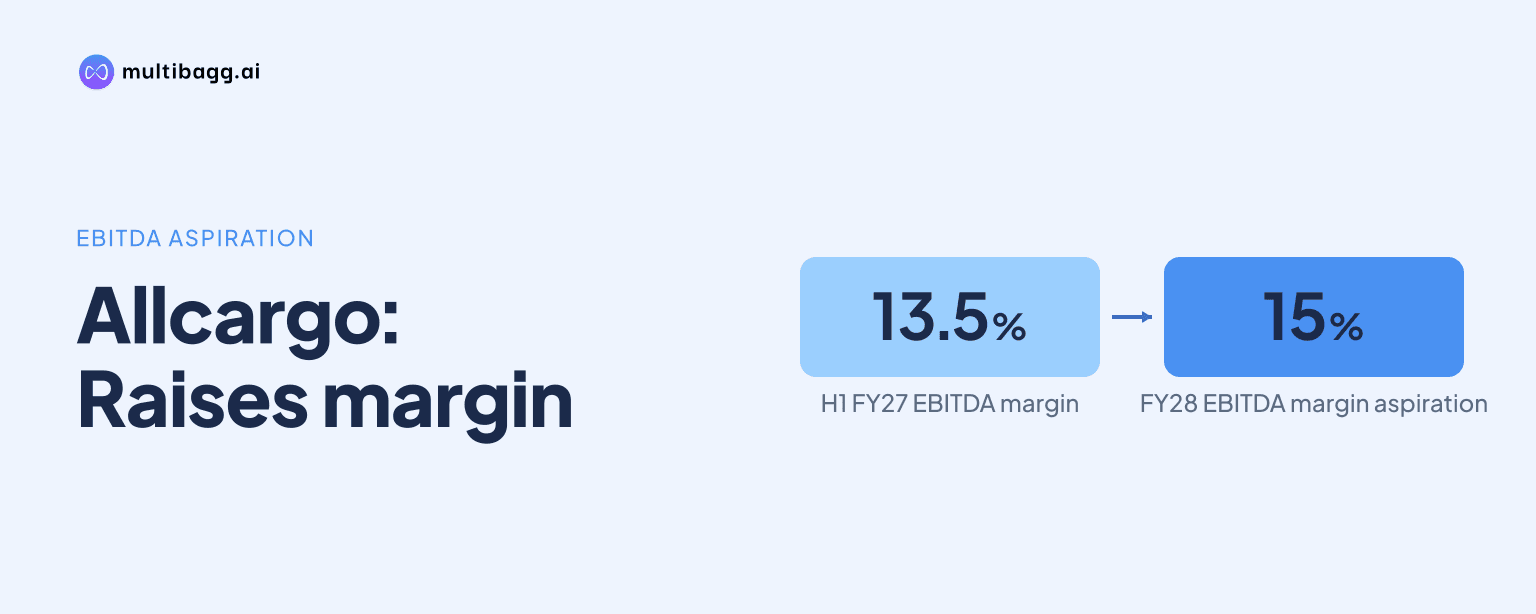
Allcargo Logistics is targeting a 15% earnings before interest, tax, depreciation and amortisation (EBITDA) margin by FY28 after reporting a 13.5% EBITDA margin in the first half (H1) of FY27. Management said price corrections in the first two quarters, cost efficiencies and operating leverage lifted profitability, surpassing its earlier FY28 aspiration of 13%-plus.
Know Allcargo Logistics inside out
Results, valuation, peers and who's buying, in one view.
What is Allcargo’s EBITDA margin target for FY28?
Allcargo now aspires to achieve a 15% EBITDA margin by FY28 on an Indian Accounting Standards (Ind AS) basis. Management said its prior FY28 EBITDA-margin aspiration of 13%-plus had already been reached, citing the 13.5% margin reported in H1 FY27.
Management also gave a separate FY28 operating EBITDA assumption of 5% before Ind AS, after rent expense. This was provided in response to an analyst’s question about the pre-Ind AS measure, while the company’s revised 15% aspiration was discussed on the Ind AS basis.
Allcargo retained its revenue-growth guidance after H1 FY27 revenue growth of about 7%-plus. Management said it expected a strong festive third quarter (Q3) and a strong end to the financial year, while continuing the margin-improvement programme alongside the existing revenue plan.
How did Allcargo improve its H1 FY27 margin?
Allcargo said price corrections implemented during the first quarter (Q1) and Q2 of FY27 were the principal initial driver of its margin improvement. Q2 FY27 EBITDA margin rose to 13.9% from 13.0% in Q1 FY27, while management said Q2 EBITDA increased 24% year on year and 8.5% quarter on quarter.
Allcargo reported a Q2 FY27 gross profit margin of 30.6%, compared with 29.1% a year earlier, an increase of nearly 1.5 percentage points. Management said the price-increase measures produced a 6.5% gain at the gross-profit level, while cost-efficiency actions added further to EBITDA. Cumulative gross profit margin was also 30.6% at the time of the call.
Management attributed a significant part of H1 FY27 EBITDA growth to operating leverage. It said revenue growth and gross-margin growth after direct costs totalled 12%, compared with EBITDA growth of 30%, leaving an 18-percentage-point difference that it attributed to operating leverage. Management said much of the initial benefit had been captured in H1, although it expected the second half to follow the same direction.
Which Allcargo segments are contributing to margins?
Allcargo’s Consultative Logistics segment reported a 29.7% H1 FY27 EBITDA margin on an Ind AS basis, compared with 6.5% for Express Logistics. The segment comparison shows that Consultative Logistics was the larger contributor to group margin in H1, while Express operated at a lower reported EBITDA margin.
On a year-to-date basis, Consultative Logistics recorded a 36.5% gross margin, compared with 27.0% for Express Logistics. Management put Consultative Logistics EBITDA margin before Ind AS at 8.8%, and said it reviews customer verticals, geographies and warehouses quarterly and half yearly to remove suboptimal contracts and avoid carrying vacant warehouse space.
Express Logistics delivered 7.7% year-on-year revenue growth while management focused on higher-yield business rather than low-margin volumes. Realisation per tonne reached an index of about 107.5, while the net service-level index reached about 110.2 in Q2 FY27. Management said it was deliberately improving the portfolio mix because chasing unviable low-margin tonnage could reduce long-term value.
Allcargo identified e-commerce, automotive engineering and chemicals as the customer verticals showing the strongest Consultative Logistics demand. Warehousing and transportation were the solutions with the strongest traction, while Express new-business development in October, the first month of Q3 FY27, was the highest monthly addition in the company’s history, according to management.
Got a follow-up? Ask IRIS
What growth and investment plans support Allcargo’s FY28 target?
Allcargo aims to grow more than the market by 1 percentage point in both Express and Consultative Logistics. Management said Consultative Logistics is pursuing both new customer accounts and more business from existing customers, particularly in chemical logistics, e-commerce and automotive, where it already has established operations.
Management referred to a five-year plan presented at an analyst meeting in September of the prior year. The plan outlined revenue compound annual growth rate (CAGR) of 10% over three years and 12% over five years, alongside a gross-margin improvement trajectory of 10% over three years and 15% over five years. It also set a five-year profit before tax (PBT) CAGR target of 20%.
Allcargo expects Express Logistics capital expenditure of about Rs 15 crore to Rs 20 crore in the current year, including hub-related and expansion spending. Management said Express has historically spent about Rs 15 crore annually. Consultative Logistics warehouse additions are linked to new business and are expected to use operating leases, with management indicating an outlay of about Rs 20 crore one year from the call.
The plan relies on pricing, contract selection, service quality and asset utilisation alongside capital spending. Allcargo said technology interventions are intended to improve productivity, efficiency and quality, while its warehouse approach is designed to avoid empty square footage. Management said these measures support its aim of further gross-margin expansion.
Conclusion
Allcargo has raised its FY28 EBITDA-margin aspiration to 15% after H1 FY27 margin reached 13.5%, above its earlier 13%-plus objective. The H1 improvement reflected price corrections, a Q2 gross profit margin of 30.6%, and management’s estimate that operating leverage accounted for 18 percentage points of the difference between 12% post-direct-cost growth and 30% EBITDA growth.
The next measure of execution will be whether the expected festive Q3 supports revenue growth while retaining pricing and service gains. Management’s disclosed plans also put focus on Express capital expenditure of Rs 15 crore to Rs 20 crore in the current year, operating-lease warehouse additions in Consultative Logistics, and progress towards growing 1 percentage point faster than the market.