










Allcargo Logistics yield rises 7.5% as Q2 volume falls
Key highlights
- Allcargo Logistics' Q2FY27 express realization-per-tonne index increased to 107.5 from 100.0 in Q2FY26.
- Allcargo Logistics handled 311,000 tonnes in Q2FY27 express operations, down 4.7% year on year.
- Allcargo Logistics' Q2FY27 express revenue rose 2.5% year on year to Rs 386 crore.
- Allcargo Logistics' Q2FY27 net service-level index reached 110.2, versus 102.9 in Q1FY27.
powered by IRIS
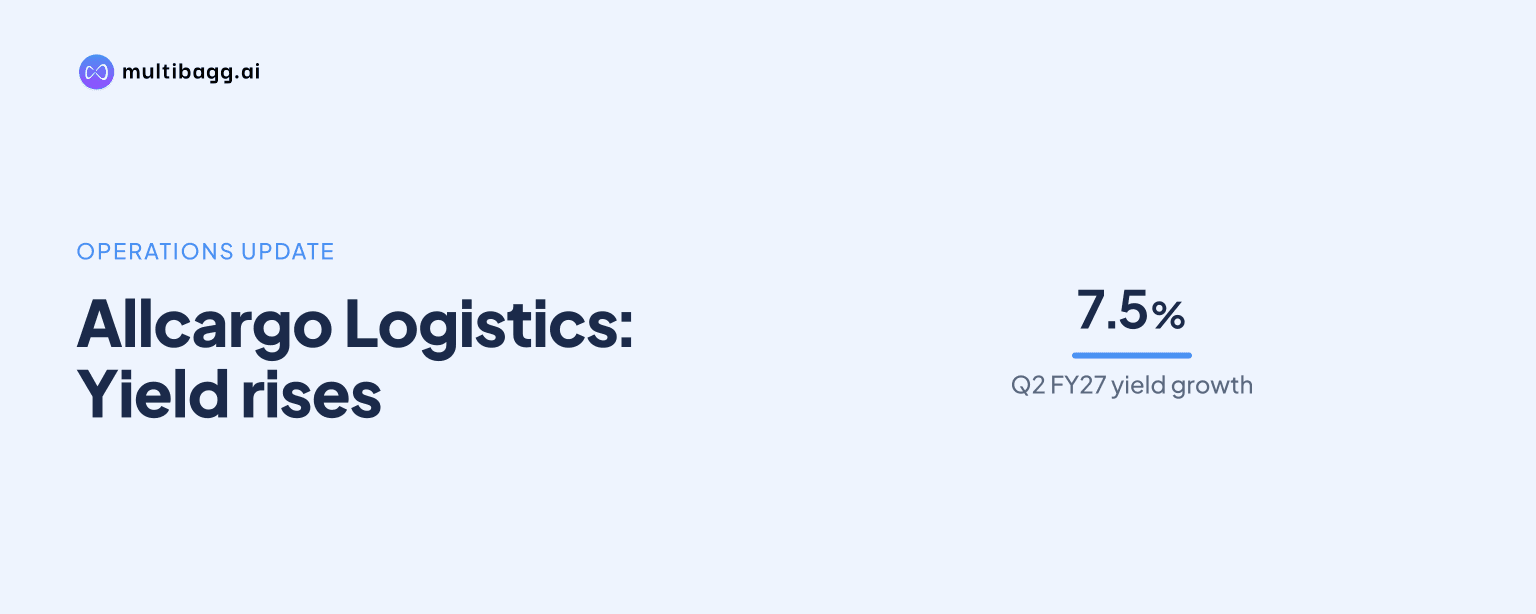
Allcargo Logistics Limited raised its indexed express realization per tonne by 7.5% year on year in Q2FY27, helping express revenue increase 2.5% to Rs 386 crore even as shipment volume fell 4.7% to 311,000 tonnes. The realization index reached 107.5, compared with a Q2FY26 base of 100.0.
Know Allcargo Logistics inside out
Results, valuation, peers and who's buying, in one view.
Why did Allcargo Logistics express revenue rise despite lower volume?
Allcargo Logistics increased Q2FY27 express revenue because its higher realization per tonne offset lower freight carried. Revenue from surface and air express reached Rs 386 crore, up from Rs 377 crore in Q2FY26, while volume declined from 326,000 tonnes to 311,000 tonnes. The Rs 9 crore revenue increase therefore occurred despite 15,000 fewer tonnes handled than a year earlier.
The sequential figures show a similar, though smaller, movement. Express revenue was Rs 386 crore in Q2FY27, compared with Rs 385 crore in Q1FY27, while volume slipped 0.5% from 312,000 tonnes to 311,000 tonnes. Over the same period, the realization-per-tonne index rose from 106.7 to 107.5.
Allcargo Logistics reports realization per tonne as an index rather than in rupees per tonne, with Q2FY26 set at 100.0. The Q2FY27 reading of 107.5 indicates a 7.5% increase from that base. The company describes its yield approach as “Deliver Value, Command Value”, based on service-led pricing, but does not disclose individual customer tariffs or a rupee freight-rate change.
How did Allcargo Logistics perform in H1FY27?
Allcargo Logistics recorded both volume and revenue growth in H1FY27, unlike the second-quarter volume comparison. Express revenue rose 7.7% year on year to Rs 772 crore from Rs 717 crore, while volume increased 0.7% to 623,000 tonnes from 619,000 tonnes. The half-year revenue gain was Rs 55 crore and the volume increase was 4,000 tonnes.
The H1FY27 realization-per-tonne index was 107.0, compared with 100.0 in H1FY26. That 7.0% increase was slightly below the 7.5% Q2FY27 increase, but accompanied by positive half-year volume growth. Allcargo Logistics said express growth was driven by volume and yield, while the quarterly data show that Q2 revenue growth came despite lower tonnage.
The first-half total also places the quarterly trend in context. Q1FY27 volume of 312,000 tonnes was already below the 326,000 tonnes handled in Q2FY26, and Q2FY27 volume decreased by a further 1,000 tonnes sequentially. Yet Q2FY27 express revenue of Rs 386 crore was Rs 1 crore above Q1FY27, reflecting the movement in the indexed realization measure.
Got a follow-up? Ask IRIS
What do service levels show about Allcargo Logistics' express operations?
Allcargo Logistics reported a net service-level index of 110.2 in Q2FY27, the highest of the four reported quarterly readings from Q3FY26. The measure stood at 100.0 in Q3FY26, 109.5 in Q4FY26 and 102.9 in Q1FY27. The Q2FY27 reading was therefore 7.3 points above the immediately preceding quarter.
The presentation does not state the calculation behind the net service-level index or provide an on-time-delivery percentage. It links its volume strategy to service quality through the principle, “Deliver the Service, Deserve the Volume.” Its stated operating tools include GEMS and Oracle Fusion platforms, real-time shipment tracking and faster billing-to-cash processes.
Allcargo Logistics also identifies network and product features relevant to its service proposition. Its surface business uses more than 9,000 trucks and serves 100% of serviceable pin codes, while its air business has direct connectivity at 24 airports. The company says its airline alliances offer more than 1,500 departures a day, with 24-hour assured delivery at 64 cities and 48-hour delivery at 576 cities.
How did express compare with consultative logistics in Q2FY27?
Allcargo Logistics' consultative logistics business grew revenue faster than express in Q2FY27, although express remained larger by revenue. Consultative logistics revenue increased 5.7% year on year to Rs 169 crore from Rs 160 crore, compared with 2.5% growth in express revenue to Rs 386 crore. Sequentially, consultative logistics revenue rose 5.0% from Rs 161 crore in Q1FY27.
Consultative logistics generated this revenue increase with less space under management. Space under management declined 5.5% year on year to 7.4 million square feet in Q2FY27 from 7.8 million square feet, and was 2.3% below 7.5 million square feet in Q1FY27. Allcargo Logistics attributed the space movement to ongoing review and optimisation of its customer and warehouse portfolio.
At the consolidated level, revenue from operations rose 3.4% year on year to Rs 555 crore in Q2FY27 from Rs 537 crore. Gross profit, excluding other income, increased 13.0% to Rs 174 crore, and gross margin rose to 31.4% from 28.7%. Allcargo Logistics attributed the express margin movement to fuel-price-hike pass-through and the consultative logistics movement to portfolio and warehouse optimisation.
Conclusion
The Q2FY27 data show that Allcargo Logistics maintained express revenue growth through improved indexed realization rather than higher quarterly volumes. Revenue increased to Rs 386 crore as the realization-per-tonne index reached 107.5, while volume declined to 311,000 tonnes. In contrast, H1FY27 combined a 7.0% improvement in indexed realization with a 0.7% increase in express volume.
The next disclosed event is Allcargo Logistics' earnings conference call, scheduled for November 4, 2026, at 3:30 PM Indian Standard Time. Management's discussion of the Q2FY27 service-level index of 110.2, its service-led pricing approach and the 4.7% volume decline will be relevant to assessing whether higher realization can be sustained alongside renewed shipment growth.