










Allcargo Terminals targets 1.345 million TEUs capacity by FY30
Key highlights
- ATL’s FY30 capacity chart targets 1.345 million TEUs, up from 830,000 TEUs in FY25.
- The roadmap identifies 515,000 TEUs of additions, led by a 170,000-TEU JNPT expansion.
- Farukhnagar is assigned 120,000 TEUs and was on track for completion by March 2027.
- ATL handled 190,100 TEUs in Q2FY27, 12.6% above Q2FY26 volume.
powered by IRIS
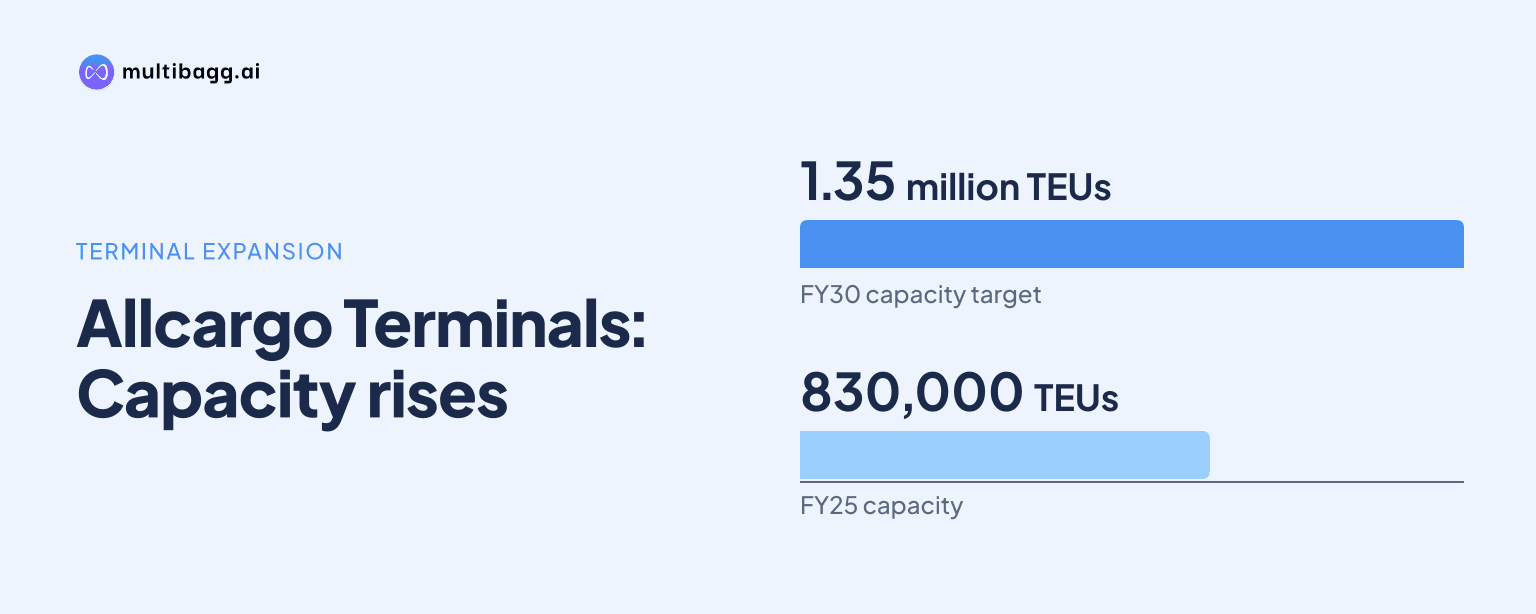
Allcargo Terminals targets annual capacity of 1.345 million twenty-foot equivalent units (TEUs) by FY30, versus 830,000 TEUs in FY25, through 515,000 TEUs of identified additions at Mundra, Jawaharlal Nehru Port Trust (JNPT), Chennai and Farukhnagar. The capacity plan supports management’s FY30 aspiration to manage one million TEUs of volume.
Know Allcargo Terminals inside out
Results, valuation, peers and who's buying, in one view.
What capacity does ATL plan to have by FY30?
ATL plans to have 1.345 million TEUs of annual capacity by FY30. Its capacity-creation chart begins with 830,000 TEUs in FY25 and lists five additions totalling 515,000 TEUs, resulting in the stated FY30 endpoint. A TEU is the standard measure of container-handling capacity.
The largest listed project is the 170,000-TEU JNPT expansion. Chennai and Farukhnagar each represent 120,000 TEUs, while CWC Mundra and the separate Mundra net-capacity entry together represent 105,000 TEUs. ATL describes its asset-right strategy as facilitating unrestricted expansion.
How does ATL's FY30 roadmap compare with its existing network?
ATL’s 1.345-million-TEU FY30 capacity endpoint is 345,000 TEUs above the one-million-TEU throughput capacity stated for its present network. The company describes six container freight stations, or CFSs, in JNPT, Chennai, Mundra and Kolkata, and one inland container depot, or ICD, at Dadri.
The FY25 capacity-chart base of 830,000 TEUs differs from the one-million-TEU network figure on the company overview page. The presentation does not reconcile the two figures or specify whether they use different reporting perimeters or dates. It separately notes that 170,000 TEUs of Mumbai CFS capacity was initiated in August 2025.
ATL states that its CFS facilities had about 90% utilisation before expansion. It also says its locations are in ports handling 80% of India’s export-import, or EXIM, trade, while another presentation page says its ports drive more than 80% of India’s container traffic.
Which projects make up ATL's capacity additions?
ATL identifies additions at CWC Mundra, JNPT, Chennai, Farukhnagar and Mundra, ranging from 50,000 TEUs to 170,000 TEUs. The 120,000-TEU Farukhnagar entry is linked to a private freight terminal, or PFT, that was under construction and on track for completion by March 2027.
At JNPT, ATL said tendering for the Speedy JNPT expansion had been completed, with 60,000 TEUs of annual handling capacity to be added. That disclosure differs from the 170,000-TEU JNPT item in the FY30 capacity chart. The presentation does not say whether the 60,000 TEUs form one phase of the 170,000-TEU project or relate to another project.
The Chennai new facility accounts for 120,000 TEUs in the FY30 chart, while CWC Mundra accounts for 50,000 TEUs. The chart also includes 55,000 TEUs at Mundra, described as net capacity after consolidation, rather than as a separately described construction project.
Got a follow-up? Ask IRIS
What operating performance supports ATL's expansion plan?
ATL reported consolidated volume of 190,100 TEUs in Q2FY27, up 12.6% from 168,755 TEUs in Q2FY26 and 7.7% from 176,499 TEUs in Q1FY27. H1FY27 volume increased 10.0% year on year to 366,599 TEUs from 333,361 TEUs in H1FY26, despite disruptions from the Middle East conflict cited by the company.
Q2FY27 revenue was Rs 252 crore, compared with Rs 207 crore in Q2FY26 and Rs 214 crore in Q1FY27. Earnings before interest, tax, depreciation and amortisation, or EBITDA, rose to Rs 59 crore in Q2FY27 from Rs 40 crore a year earlier and Rs 47 crore in the preceding quarter.
EBITDA per TEU reached Rs 3,366 in Q2FY27, up from Rs 2,390 in Q2FY26 and Rs 2,898 in Q1FY27. ATL said the measure had remained above Rs 2,000 for eight quarters, while noting that Q1 and Q2 figures were affected by transshipment volume. The company attributed improved profitability to better realisation and a higher share of transshipment containers at JNPA.
How will ATL operate the expanded network?
ATL is rolling out a Smart Yard Management System across all locations to improve operational efficiency, asset utilisation and customer service. The programme accompanies the planned increase from 830,000 TEUs of FY25 capacity to 1.345 million TEUs by FY30.
The existing network includes Mundra CFS capacities of 80,000 TEUs and 140,000 TEUs, a 100,000-TEU Chennai CFS, a 75,000-TEU Kolkata CFS and a 65,000-TEU Dadri ICD. Mumbai has stated CFS capacities of 360,000 TEUs and 180,000 TEUs, with the presentation noting the August 2025 initiation of 170,000 TEUs of capacity.
Management’s stated FY30 aspiration to manage one million TEUs is separate from the 1.345-million-TEU capacity target. The first is a throughput objective, while the second is available annual handling capacity; management cites CFS expansion and opportunities in PFT and ICD operations as support for the volume aspiration.
Conclusion
ATL’s disclosed roadmap adds 515,000 TEUs to its 830,000-TEU FY25 capacity base and sets a 1.345-million-TEU FY30 endpoint. The plan combines JNPT, Chennai and Mundra expansion with the Farukhnagar PFT, while Q2FY27 volume of 190,100 TEUs and EBITDA of Rs 59 crore provide the operating context for the programme.
The next stated milestone is completion of the Farukhnagar PFT by March 2027. Progress on the Speedy JNPT expansion also warrants attention because the disclosed 60,000-TEU annual addition is not reconciled with the 170,000-TEU JNPT figure in the FY30 capacity chart, alongside management’s one-million-TEU FY30 volume aspiration.