










JK Lakshmi Cement Ltd. reports 65% low-carbon products in H1 FY27
Key highlights
- JK Lakshmi Cement reported 65% low-carbon products in unaudited H1 FY 2026-27, up 2% year on year.
- JK Lakshmi Cement’s green-power mix was 49% in H1 FY 2026-27, against its stated FY30 goal of 60%.
- Greenhouse-gas intensity was 603 kgCO2e per tonne of cementitious material, down 1% year on year.
- JK Lakshmi Cement targets more than 120 electric vehicles by March 2027, from more than 70 active vehicles.
powered by IRIS
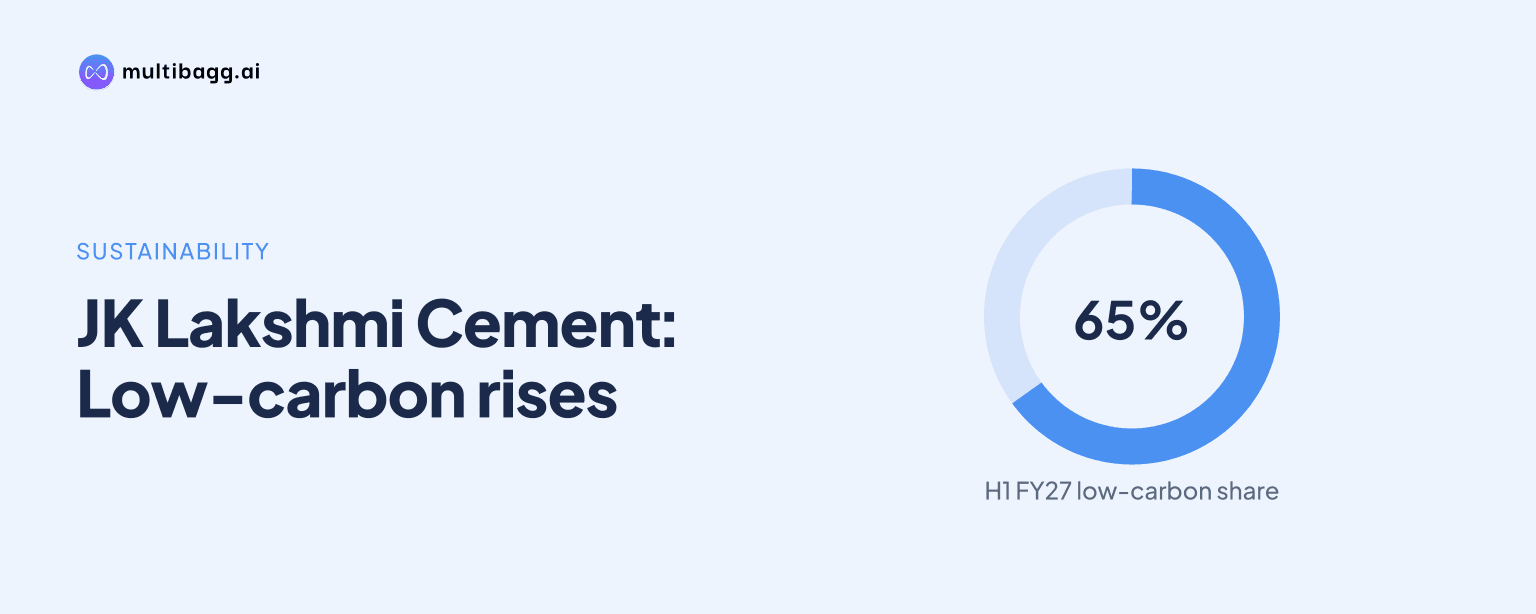
JK Lakshmi Cement Ltd. reported 65% low-carbon products and a 49% green-power mix in unaudited consolidated H1 FY 2026-27, with both measures up 2% year on year. JK Lakshmi Cement’s reported levels were below its stated FY30 goals of 75% blended cement and 60% green power.
Know JK Lakshmi Cement inside out
Results, valuation, peers and who's buying, in one view.
What did JK Lakshmi Cement report in H1 FY27?
JK Lakshmi Cement reported four sustainability indicators for consolidated H1 FY 2026-27: 65% low-carbon products, a 49% green-power mix, greenhouse-gas intensity of 603 kilograms of carbon-dioxide equivalent per tonne of cementitious material, and water positivity of 4.66 times. The presentation identifies the H1 data as unaudited.
Low-carbon products increased 2% year on year, green power increased 2% year on year, and greenhouse-gas intensity declined 1% year on year to 603 kgCO2e per tonne of cementitious material. Water positivity was reported at 4.66x, but JK Lakshmi Cement did not state a prior-year water-positivity figure or a year-on-year movement for that measure.
The 65% low-carbon-product figure is the nearest current metric supplied against JK Lakshmi Cement’s stated FY30 goal of 75% blended cement. The presentation does not provide a separate H1 blended-cement percentage, low-carbon-product volume, or the product categories included in the 65% measure.
How far is JK Lakshmi Cement from its stated goals?
JK Lakshmi Cement was 10 percentage points below its 75% blended-cement goal and 11 percentage points below its 60% green-power goal in H1 FY 2026-27. Water positivity of 4.66x was 2.34 times below the stated goal of 7x water positive. These are arithmetic comparisons with the disclosed goals, not forecasts of when the company will meet them.
The presentation does not provide the prior-year percentage levels, the volume of low-carbon products, or the quantity of green electricity used. The 49% green-power mix was lower than the 65% low-carbon-product measure, while its gap to the 60% target was one percentage point larger than the gap between the low-carbon-product measure and the 75% blended-cement goal.
JK Lakshmi Cement places “Reduction of 44.9% by 2036” beneath a heading that says “FY30 Goal” on its H1 FY 2026-27 sustainability slide. The source does not disclose a base year for the 44.9% reduction or explain the difference between the FY30 heading and the 2036 target date. The current reported emissions measure is therefore 603 kgCO2e per tonne cementitious, down 1% year on year.
Got a follow-up? Ask IRIS
How did JK Lakshmi Cement’s emissions and water measures change?
JK Lakshmi Cement’s greenhouse-gas intensity fell 1% year on year to 603 kgCO2e per tonne of cementitious material in H1 FY 2026-27. This is an intensity measure, relating emissions to cementitious output, rather than a disclosure of total emissions. The presentation does not show total production or total emissions for the period.
The 65% low-carbon-product share and 49% green-power mix are reported alongside the 603 kgCO2e-per-tonne intensity measure, but JK Lakshmi Cement does not quantify their respective contribution to the 1% intensity reduction. The 16-percentage-point difference between the two H1 percentages does not indicate a relationship between product volumes and power generation because they cover different measures.
Water positivity stood at 4.66x against JK Lakshmi Cement’s stated FY30 goal of 7x. The cited page does not define the calculation method, disclose water withdrawal or replenishment volumes, or provide a baseline. The 4.66x figure therefore shows the company’s reported position against its stated goal without providing physical water quantities.
How is JK Lakshmi Cement changing its transport network?
JK Lakshmi Cement reported more than 70 active electric vehicles and targets an electric-vehicle fleet of more than 120 by March 2027. That target indicates an increase of at least 50 vehicles from the disclosed active count, although both figures carry a “more than” qualifier. The presentation does not state capital expenditure, vehicle utilisation or emissions savings from the planned fleet expansion.
The company also listed more than 40 liquefied-natural-gas trucks and more than 80 compressed-natural-gas trucks. It said four dedicated electric-vehicle corridors had been operationalised for zero-emission clinker transportation. The source does not disclose the routes, distances, freight volumes or share of total clinker transport covered by those four corridors.
The logistics disclosures have a different reporting basis from the 49% green-power mix. The green-power figure is for H1 FY 2026-27, while the electric-vehicle fleet target is dated March 2027 and the liquefied-natural-gas and compressed-natural-gas truck counts have no stated reporting date. Future disclosures can show whether the transport programme coincides with movement in the 603 kgCO2e-per-tonne intensity measure.
Conclusion
JK Lakshmi Cement’s H1 FY 2026-27 disclosure records progress in low-carbon products, green power and emissions intensity: 65% low-carbon products, a 49% green-power mix and 603 kgCO2e per tonne of cementitious material, down 1% year on year. The company remains 10 percentage points from its 75% blended-cement goal, 11 percentage points from its 60% green-power goal and 2.34 times from its 7x water-positivity goal.
The next stated operational milestone is an electric-vehicle fleet of more than 120 by March 2027, compared with more than 70 active vehicles reported. Progress toward that target, along with future reporting on green power, blended cement, water methodology and the 44.9% emissions-reduction pathway, will determine how clearly the company’s reported H1 measures can be tracked against its disclosed goals.