










JK Lakshmi Cement Ltd. PAT falls 75% as Q2 FY27 margins contract
Key highlights
- JK Lakshmi Cement reported Q2 FY'27 PAT of Rs 21 crore, down 75% year-on-year.
- Fuel cost increased to Rs 1.82 per K.Cal. in Q2 FY'27 from Rs 1.54 per K.Cal. in Q2 FY'26.
- EBIDTA per tonne declined 29% year-on-year to Rs 517 in Q2 FY'27.
- Net debt rose to Rs 2,027 crore at September 30, 2026 from Rs 1,266 crore at March 31, 2026.
powered by IRIS
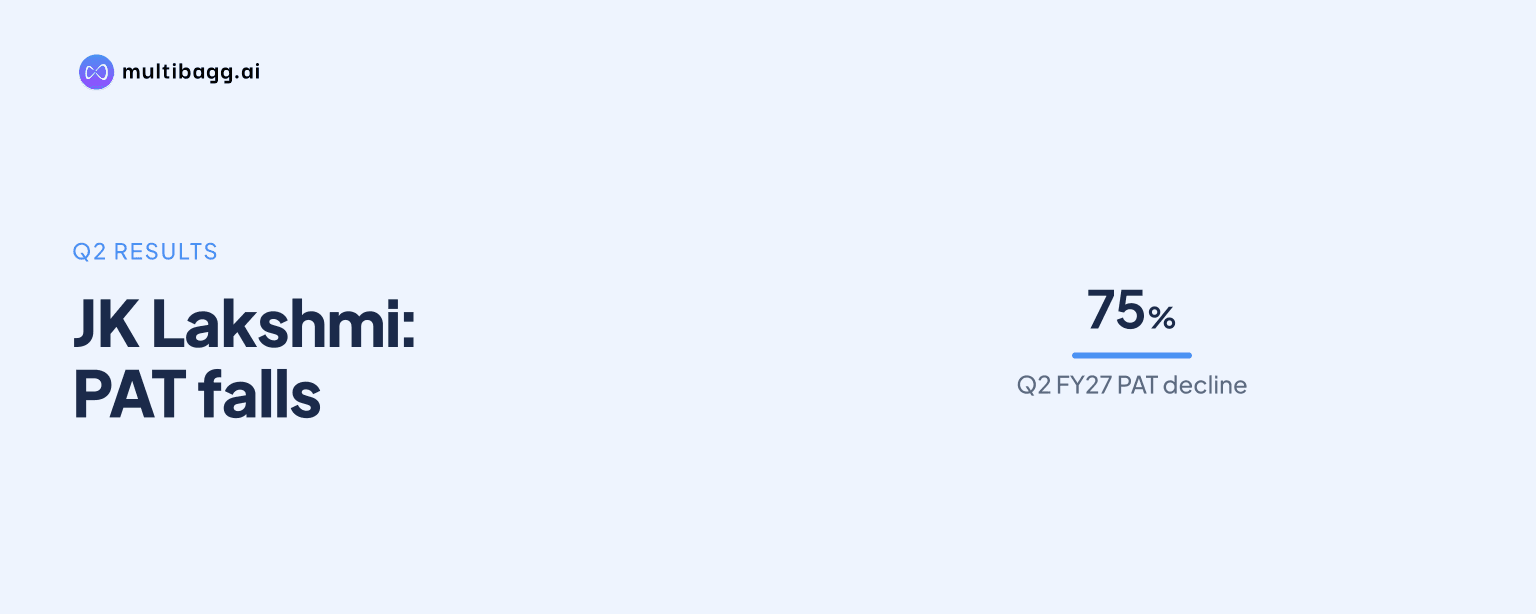
In Q2 FY'27, JK Lakshmi Cement Ltd. reported profit after tax of Rs 21 crore, down 75% year-on-year, as fuel cost reached Rs 1.82 per K.Cal. and EBIDTA per tonne fell 29% to Rs 517 despite net sales rising 6% from Q2 FY'26 to Rs 1,617 crore.
Know JK Lakshmi Cement inside out
Results, valuation, peers and who's buying, in one view.
Why did JK Lakshmi Cement’s quarterly profit decline?
JK Lakshmi Cement’s quarterly profit declined as earnings fell at each reported stage below net sales in Q2 FY'27. Net sales were Rs 1,617 crore, down 15% from Rs 1,905 crore in Q1 FY'27 but 6% above Rs 1,532 crore in Q2 FY'26. The presentation therefore shows a sequential sales decline despite year-on-year revenue growth.
PBIDT was Rs 164 crore in Q2 FY'27, compared with Rs 274 crore in Q1 FY'27 and Rs 233 crore in Q2 FY'26. That represented a 40% quarter-on-quarter decline and a 29% year-on-year decline. PBDT fell 49% sequentially to Rs 113 crore and 38% year-on-year, while PBT declined to Rs 29 crore from Rs 140 crore in Q1 FY'27 and Rs 105 crore in Q2 FY'26.
PAT fell to Rs 21 crore from Rs 107 crore in Q1 FY'27 and Rs 82 crore in Q2 FY'26, a decline of 80% sequentially and 75% year-on-year. Earnings per share also fell to Rs 1.68 from Rs 8.60 in the preceding quarter and Rs 6.63 a year earlier, matching the reported PAT decline percentages.
How did fuel cost and operating profitability change?
Fuel cost increased to Rs 1.82 per K.Cal. in Q2 FY'27 from Rs 1.65 per K.Cal. in Q1 FY'27 and Rs 1.54 per K.Cal. in Q2 FY'26. The Q2 FY'27 level was Rs 0.17 per K.Cal. higher sequentially and Rs 0.28 per K.Cal. higher year-on-year, while net sales declined by Rs 288 crore from Q1 FY'27.
EBIDTA, excluding other income as specified by the company, was Rs 154 crore in Q2 FY'27. This was 40% below Rs 259 crore in Q1 FY'27 and 26% below Rs 208 crore in Q2 FY'26. EBIDTA per tonne was Rs 517, compared with Rs 719 in the prior quarter and Rs 732 a year earlier.
The per-tonne measure declined 28% sequentially and 29% year-on-year, a larger year-on-year fall than the 6% increase in net sales. Power consumption was 72 kilowatt-hours per metric tonne of cement, unchanged from Q1 FY'27 but above 70 kilowatt-hours per metric tonne in Q2 FY'26. Lead distance declined to 363 kilometres from 368 kilometres sequentially and 395 kilometres year-on-year.
Did sales realisation offset the revenue decline?
Sales realisation did not offset the sequential revenue decline because it increased only 1% to Rs 4,885 per metric tonne in Q2 FY'27 from Rs 4,843 in Q1 FY'27. Realisation was effectively unchanged year-on-year, at Rs 4,885 per metric tonne versus Rs 4,895 in Q2 FY'26, which the company describes as flat.
The combination of a Rs 288 crore sequential reduction in net sales and a Rs 42-per-tonne improvement in realisation indicates that lower sales throughput accompanied the revenue decline. However, the presentation pages do not provide quarterly cement sales-volume figures, so the change in volume cannot be quantified from the disclosed data.
Trade sales accounted for 58% in Q2 FY'27, compared with 59% in Q1 FY'27 and 53% in Q2 FY'26. Premium products rose to 27% from 24% sequentially and 26% year-on-year. Blended cement increased to 65%, compared with 64% in Q1 FY'27 and 62% in Q2 FY'26.
Got a follow-up? Ask IRIS
What do the energy and product-mix metrics show?
JK Lakshmi Cement reported that green power represented 48% in Q2 FY'27, compared with 49% in Q1 FY'27 and 46% in Q2 FY'26. The one-percentage-point sequential decline came as fuel cost increased from Rs 1.65 per K.Cal. to Rs 1.82 per K.Cal.; the presentation does not quantify a direct relationship between those measures.
The company listed 252 megawatts of captive power capacity, including 45 megawatts of waste-heat recovery, 129 megawatts of solar, 4 megawatts of wind and 74 megawatts of thermal power. Waste-heat recovery, solar and wind totalled 178 megawatts, which JK Lakshmi Cement identified as green energy.
The product indicators moved positively across the year-on-year comparison, with premium-product share rising one percentage point to 27% and blended-cement share rising three percentage points to 65%. Yet the same period saw EBIDTA per tonne decrease by Rs 215, from Rs 732 to Rs 517, while fuel cost increased by Rs 0.28 per K.Cal.
How did JK Lakshmi Cement’s debt position change?
JK Lakshmi Cement’s net debt increased to Rs 2,027 crore at September 30, 2026, from Rs 1,266 crore at March 31, 2026. Gross debt rose by Rs 147 crore to Rs 2,638 crore, while cash fell by Rs 614 crore to Rs 611 crore over the same period.
Net debt to EBITDA increased to 2.31 times at September 30, 2026, from 1.12 times at March 31, 2026. Net debt to equity rose to 0.51 times from 0.32 times. These balance-sheet measures were reported after the Q2 FY'27 period in which EBIDTA was Rs 154 crore and PAT was Rs 21 crore.
The increase in net debt was driven more by the cash reduction than by the rise in gross debt. Cash declined from Rs 1,225 crore at March 31, 2026 to Rs 611 crore at September 30, 2026, while gross debt rose from Rs 2,491 crore to Rs 2,638 crore.
Conclusion
JK Lakshmi Cement’s Q2 FY'27 figures show that 6% year-on-year net-sales growth did not translate into earnings growth. Sales realisation remained broadly flat at Rs 4,885 per metric tonne, while fuel cost rose to Rs 1.82 per K.Cal. and EBIDTA per tonne declined to Rs 517, followed by a 75% fall in PAT to Rs 21 crore.
The key unresolved matter in the disclosed data is whether sales realisation, fuel cost and operating throughput change in subsequent quarters. The presentation does not provide quarterly sales volumes or quantify the separate contribution of energy sources to the Q2 FY'27 fuel-cost increase, while net debt stood at Rs 2,027 crore at September 30, 2026.