










Allcargo Terminals Limited reports 85% Q2 profit growth
Key highlights
- ATL handled 190,100 TEUs in Q2 FY27, up 12.6% year on year.
- Q2 FY27 revenue rose 21.5% year on year to ₹252 crore.
- EBITDA excluding other income increased 45.9% year on year to ₹59 crore.
- Q2 FY27 net profit rose 85.0% year on year to ₹21 crore.
powered by IRIS
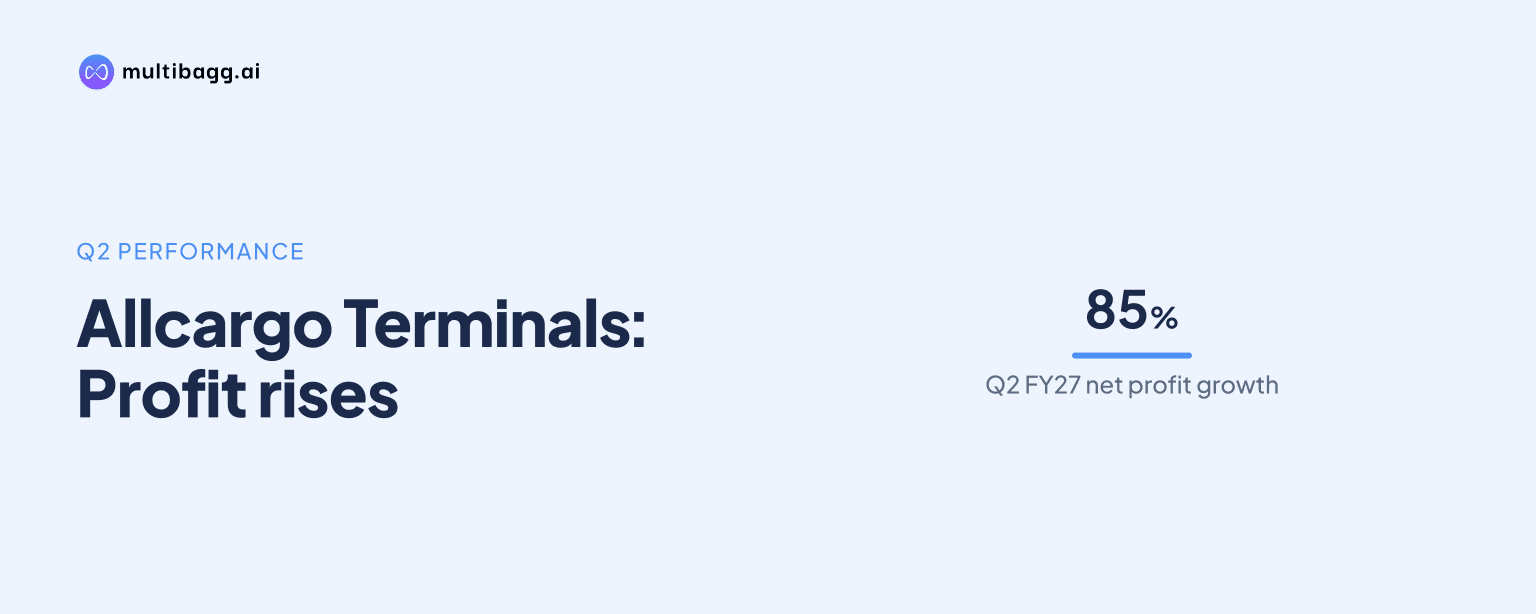
Allcargo Terminals Limited reported Q2 FY27 net profit of ₹21 crore, up 85% year on year, after revenue rose 21.5% to ₹252 crore and container volumes increased 12.6% to 190,100 TEUs for the quarter ended September 30, 2026.
Know Allcargo Terminals inside out
Results, valuation, peers and who's buying, in one view.
What did ATL report for Q2 FY27?
ATL reported higher volumes, revenue and operating profit in Q2 FY27, with profitability growing faster than its container throughput. Total volume handled reached 190,100 twenty-foot equivalent units, or TEUs, compared with the year-earlier quarter. Revenue from operations was ₹252 crore, while EBITDA excluding other income rose 45.9% year on year to ₹59 crore.
The company said EBITDA per TEU increased 40.8% year on year to ₹3,366. Management attributed this improvement to better realisations, operating efficiency and gains from transshipment business. Consolidated net profit stood at ₹20.89 crore, rounded to ₹21 crore, versus the corresponding prior-year period, representing growth of 84.9%. The reported operating margin was 23.4%.
How did the quarter compare with the first half?
ATL handled 366,599 TEUs in H1 FY27, a 10% increase over H1 FY26, showing that volume growth continued across the first six months of the financial year. H1 revenue rose to ₹466 crore from ₹394 crore a year earlier, while EBITDA increased to ₹106 crore from ₹75 crore.
H1 net profit was ₹27 crore, compared with ₹20 crore in H1 FY26. The second-quarter profit was also 228% higher sequentially, while quarterly revenue increased 17.4% and EBITDA rose 24% from the preceding quarter. The gap between revenue growth and EBITDA growth indicates improved operating leverage during the period, based on the figures reported by the company.
Management said India’s trade showed volume resilience despite dynamic global trade patterns. It also cited India’s expanding trade base, better port logistics infrastructure and greater integration with global supply chains as supportive factors for container-terminal demand. The company did not provide a quantified forecast for future volumes or profitability in the supplied material.
What supported ATL's operating performance?
ATL said improved realisations, operating efficiency and transshipment business gains supported the rise in EBITDA per TEU. The company also linked its growth strategy to expanding its presence in locations and trade corridors where it sees structural opportunities in India’s containerised trade and logistics infrastructure.
The supplied results material refers to capacity expansion at JNPA, Mundra and Chennai, along with a north India expansion through rail-linked inland container depots using the Dedicated Freight Corridor. It also noted that temporary geopolitical shifts aided transshipment-related volume growth. These factors provide context for the quarter’s volume increase, though the company did not quantify the separate contribution of each location or trade flow.
ATL has outlined a ₹400 crore capital-expenditure pipeline. The source material does not specify a completion schedule, project-wise spending allocation or expected financial return from this pipeline. Investors therefore have a stated expansion amount but limited disclosed detail on the timing and financial structure of individual projects.
Got a follow-up? Ask IRIS
What do the results mean for investors and operations?
The results show that ATL converted a 12.6% increase in Q2 volume into a 45.9% rise in EBITDA and an 85% increase in net profit. Higher EBITDA per TEU was central to this outcome, as the metric rose to ₹3,366 from the prior-year level. For investors, the quarter provides evidence of better unit economics alongside higher traffic through the company’s CFS and ICD network.
The financial results also included a board approval for a subsequent call on partly paid rights shares, with timing to be determined. The source material refers to a rights issue of 3.98 million shares at ₹20 per share. Auditors reported no qualifications in the limited-review reports. No share-price movement was provided in the supplied information, so the immediate market reaction cannot be assessed from these disclosures.
For customers and trade users, higher container volumes and the company’s stated focus on capacity and corridor expansion are relevant to terminal and inland logistics operations. However, the disclosed results do not state changes in tariffs, service levels or customer contracts. The reported gains are operational and financial measures rather than a confirmation of new commercial terms.
What should investors monitor after the Q2 update?
Investors should monitor whether volume growth and EBITDA per TEU remain strong as transshipment conditions and global trade routes evolve. Q2 revenue of ₹252 crore was supported by a combination of volume growth and improved realisations, making both measures relevant to the sustainability of operating performance.
Further disclosures on the ₹400 crore capital-expenditure pipeline will also matter. Project timelines, funding details, capacity additions and returns on investment were not specified in the supplied call material. The timing of the subsequent call on partly paid rights shares is another pending corporate action identified by the board.
Conclusion
ATL delivered a stronger Q2 FY27 across its main reported measures, with 190,100 TEUs of volume, ₹252 crore of revenue, ₹59 crore of EBITDA and ₹21 crore of net profit. The faster rise in EBITDA and profit than in volumes points to improved realisations and operating efficiency during the quarter.
The next areas to watch are management’s execution of the ₹400 crore expansion pipeline, the timing of the rights-share call and whether H1 trends in volumes and EBITDA per TEU continue in later quarters. The company has identified capacity expansion and rail-linked inland logistics as part of its operating growth agenda.